Physical & Chemical Changes quiz #6 Flashcards

Physical & Chemical Changes quiz #6
Control buttons has been changed to "navigation" mode.
1/40
  • What is the opposite of evaporation?
    Condensation is the opposite of evaporation.
  • Which change of state is taking place?
    If a liquid becomes a gas, vaporization is taking place.
  • Which of the following is evidence that a chemical change has occurred?
    Formation of a new substance is evidence of a chemical change.
  • How many chemical changes occurred in this scenario: one, two, three, or four?
    The number depends on how many new substances formed.
  • Which of the following describes a texture containing bubble-shaped cavities?
    This texture may indicate gas production during a chemical change.
  • Which statement about the physical change of liquid water boiling into steam is true?
    The chemical composition of water remains unchanged during boiling.
  • During which changes of state do atoms overcome the attractive forces between them?
    Atoms overcome attractive forces during melting, vaporization, and sublimation.
  • During which change of state would the volume of a substance increase the most?
    During sublimation, volume increases the most as a solid becomes a gas.
  • What happens to the total mass of a substance undergoing a physical change?
    The total mass remains the same during a physical change.
  • Which event always involves a chemical change: boiling, melting, conducting, or burning?
    Burning always involves a chemical change.
  • During which change of state do atoms lose energy: sublimation, freezing, boiling, or melting?
    Atoms lose energy during freezing.
  • Which most likely indicates a chemical change has occurred?
    Formation of a new substance most likely indicates a chemical change.
  • Melting butter is a physical change. Which best describes what is happening?
    Butter changes from solid to liquid, but its chemical composition remains the same.
  • Which changes of state are characterized by having atoms that gain energy? Check all that apply.
    Melting, vaporization, and sublimation involve atoms gaining energy.
  • In which step(s) did a chemical change most likely occur?
    Steps where new substances formed most likely involved chemical changes.
  • What happens during a chemical change?
    New substances with different chemical properties are formed.
  • Which best explains why making a pancake from batter is an example of a chemical change?
    New substances are formed during cooking, changing the chemical composition.
  • How would you describe the appearance of the substance before the phase change?
    It has its original physical state and appearance.
  • When water (H2O) freezes into ice, what type of change occurs?
    Freezing water is a physical change.
  • Eliana cuts a watermelon into several slices. Which statement best describes the physical change?
    The watermelon is physically altered in shape, but its chemical composition remains the same.
  • A gaseous substance turns directly into a solid. Which term describes this change?
    Deposition describes a gas turning directly into a solid.
  • Is changing the color of the coin from copper to silver a sign of a physical or chemical change?
    If a new substance forms, it is a chemical change; if only appearance changes, it is physical.
  • What happens to liquid water as it freezes and then as it melts again?
    It changes between solid and liquid states, but its chemical composition remains the same.
  • How can the effectiveness of evaporative cooling be increased?
    By increasing the rate of evaporation, such as by increasing temperature or airflow.
  • When a substance changes states (melts), what type of change occurs?
    A physical change occurs.
  • During which processes does the space between particles tend to increase?
    During melting, vaporization, and sublimation, the space between particles increases.
  • Which statement best describes the difference between a physical change and a chemical change?
    Physical changes do not alter chemical composition; chemical changes do.
  • Which changes were caused by light from a light bulb?
    If a chemical reaction occurred due to light, it is a chemical change.
  • What process allows the drops to spread out in the fish tank?
    Diffusion, a physical change, allows drops to spread out.
  • When solid NaCl is stirred into water, what type of change occurs?
    Dissolving NaCl in water is a physical change.
  • Which of the following is a chemical change in the formation of soils?
    Decomposition of organic matter is a chemical change.
  • Which of the following is not a likely indicator of a chemical change?
    Change in size is not a likely indicator of a chemical change.
  • Which process is a chemical change: burning a match, boiling water, melting ice, or breaking glass?
    Burning a match is a chemical change.
  • Is the change you observed during the mixing of mineral oil and food coloring chemical or physical?
    Mixing mineral oil and food coloring is a physical change.
  • When molten gallium solidifies to Ga(s) at its normal melting point, what type of change occurs?
    Solidification of gallium is a physical change.
  • What new information can you add to your definition of physical change?
    Physical changes do not alter chemical composition and are often reversible.
  • Which of the following statements about ice melting is true?
    Ice melting is a physical change; water's chemical composition remains unchanged.
  • How is a physical change different from a chemical change?
    Physical changes do not alter chemical composition; chemical changes do.
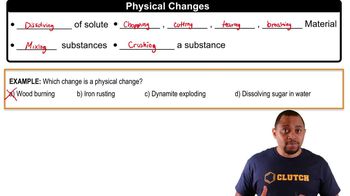
  • Which change is a chemical change?
    Burning wood is a chemical change.
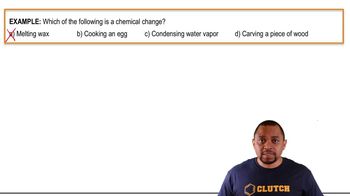
  • Which term refers to what happens when an egg cooks in a pan on the stove?
    Cooking an egg is a chemical change.