Back

Quantum Numbers: Magnetic Quantum Number quiz

Control buttons has been changed to "navigation" mode.
1/15
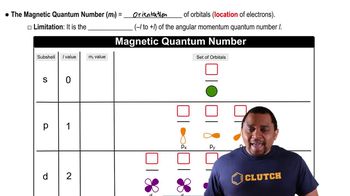
  • What does the magnetic quantum number (ml) indicate about an electron in an atom?

    The magnetic quantum number (ml) indicates the orientation and specific location of an electron within an orbital of a subshell.
  • What is the range of possible values for the magnetic quantum number (ml)?

    The values of ml range from -l to +l, including all whole numbers in between.
  • If the angular momentum quantum number (l) is 2, what are the possible values for ml?

    If l is 2, ml can be -2, -1, 0, +1, or +2.
  • How many orbitals are present in a p subshell and what are their ml values?

    A p subshell has three orbitals with ml values of -1, 0, and +1.
  • What is the maximum number of electrons that can occupy an s subshell?

    An s subshell can hold a maximum of 2 electrons.
  • How is the ml value related to the l value for a given subshell?

    The ml value is determined by the l value and includes all integer values from -l to +l.
  • What is the ml value for an s subshell?

    For an s subshell (l = 0), the only possible ml value is 0.
  • How many orbitals are in a d subshell and what are their ml values?

    A d subshell has five orbitals with ml values of -2, -1, 0, +1, and +2.
  • What is the maximum number of electrons that can occupy a p subshell?

    A p subshell can hold a maximum of 6 electrons.
  • What does each unique ml value represent within a subshell?

    Each unique ml value represents a specific orbital within a subshell.
  • How many orbitals are in an f subshell and what are their ml values?

    An f subshell has seven orbitals with ml values from -3 to +3.
  • What is the maximum number of electrons that can occupy a d subshell?

    A d subshell can hold a maximum of 10 electrons.
  • How does the magnetic quantum number help in identifying the location of electrons?

    The magnetic quantum number assigns a numerical designation to each orbital, helping to specify the electron's location within a subshell.
  • What is the maximum number of electrons that can occupy an f subshell?

    An f subshell can hold a maximum of 14 electrons.
  • Why are only the numerical values of ml important when discussing orbitals?

    Only the numerical values of ml are important because they correspond to the specific orbitals within a subshell, regardless of the orbital's letter designation.