Quantum Numbers: Number of Electrons quiz #1 Flashcards

Quantum Numbers: Number of Electrons quiz #1
Control buttons has been changed to "navigation" mode.
1/37
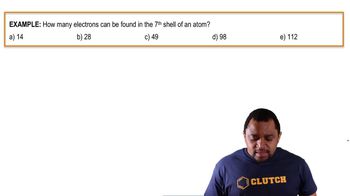
  • How many electrons can the n = 4 shell hold?
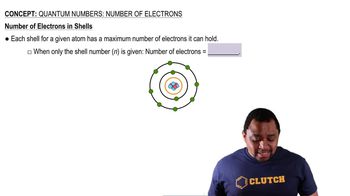
    The n = 4 shell can hold 32 electrons, calculated by 2 × (4^2) = 32.
  • How many electrons are in the third energy level (n = 3)?
    The third energy level (n = 3) can hold a maximum of 18 electrons.
  • How many electrons can the first energy level (n = 1) hold?
    The first energy level (n = 1) can hold a maximum of 2 electrons.
  • How many orbitals in an atom can have each of the following designations (given quantum numbers)?
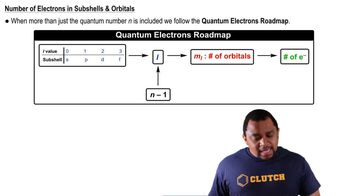
    The number of orbitals is determined by the possible values of the magnetic quantum number (m_l) for each l value; for each l, there are (2l + 1) orbitals.
  • What is the maximum number of electrons in an atom that can have the following quantum numbers (for a given orbital)?
    Each orbital, defined by a unique set of quantum numbers, can hold a maximum of 2 electrons.
  • How many electrons could have the following set of quantum numbers (for a specific orbital)?
    A specific set of quantum numbers (n, l, m_l) can describe one orbital, which can hold up to 2 electrons (with ms = +1/2 and -1/2).
  • How many quantum numbers are needed to describe the energy state of an electron in an atom?
    Four quantum numbers are needed: n (principal), l (angular momentum), m_l (magnetic), and m_s (spin).
  • How many orbitals are described by each of the below combinations of quantum numbers (n and l)?
    For each l value, the number of orbitals is (2l + 1).
  • An electron in a 3d orbital could have which of the following quantum numbers?
    For a 3d orbital: n = 3, l = 2, m_l = -2, -1, 0, +1, or +2, and m_s = +1/2 or -1/2.
  • How many electrons in an atom can have the quantum number n = 3?
    A maximum of 18 electrons can have n = 3.
  • What is the maximum number of electrons an orbital may contain?
    Each orbital may contain a maximum of 2 electrons.
  • How many energy sublevels are contained in each of the hydrogen atom's first three energy levels?
    The first energy level has 1 sublevel, the second has 2, and the third has 3 sublevels.
  • What is the maximum number of electrons that can have the quantum numbers n = 3?
    The maximum number is 18 electrons.
  • What is the maximum number of electrons that can have n = 3 and ms = +1/2?
    There are 9 electrons with n = 3 and ms = +1/2.
  • How many electrons can be assigned to orbitals designated by the quantum numbers n = 2?
    The n = 2 shell can hold a maximum of 8 electrons.
  • How many electrons in an atom can have the following designations (for a given orbital)?
    Each orbital can hold up to 2 electrons.
  • What is the maximum number of electrons that the d-sublevel can hold?
    The d-sublevel can hold a maximum of 10 electrons.
  • How many electrons in an atom can have the quantum number n = 5?
    A maximum of 50 electrons can have n = 5.
  • How many electrons can be described by the quantum numbers n = 5?
    The n = 5 shell can hold up to 50 electrons.
  • How many electrons in an atom can have the following quantum numbers (for a specific orbital)?
    A specific orbital can hold up to 2 electrons.
  • How many electrons can be assigned to orbitals designated by the quantum numbers n = 3?
    The n = 3 shell can hold a maximum of 18 electrons.
  • How many electrons in an atom can have the quantum number n = 6?
    A maximum of 72 electrons can have n = 6.
  • What is the maximum number of electrons that can have the quantum number n = 2 in an atom?
    The n = 2 shell can hold a maximum of 8 electrons.
  • How many electrons in an atom can have the quantum number n = 8?
    A maximum of 128 electrons can have n = 8.
  • What is the maximum number of electrons that can occupy the 3rd energy level?
    The third energy level (n = 3) can hold up to 18 electrons.
  • How many electrons in an atom can have the quantum number n = 4?
    A maximum of 32 electrons can have n = 4.
  • What is the maximum number of electrons in the n = 3 shell?
    The n = 3 shell can hold a maximum of 18 electrons.
  • How many electrons go into an individual orbital?
    Each orbital can hold up to 2 electrons.
  • How many electrons in an atom can be described by the quantum number n = 3?
    A maximum of 18 electrons can have n = 3.
  • How many orbitals are in the n = 5 shell?
    The n = 5 shell contains 25 orbitals.
  • How many electrons can the fourth energy level hold?
    The fourth energy level (n = 4) can hold up to 32 electrons.
  • What is the maximum number of electrons that can occupy one p orbital?
    One p orbital can hold a maximum of 2 electrons.
  • What is the maximum number of electrons that can occupy one p orbital?
    One p orbital can hold a maximum of 2 electrons.
  • In one atom, what is the maximum number of electrons that could have the quantum number n = 2?
    A maximum of 8 electrons can have n = 2.
  • In one atom, what is the maximum number of electrons that could have the quantum number n = 3?
    A maximum of 18 electrons can have n = 3.
  • How many electrons in an atom can have the following quantum numbers: n = 3, l = 2?
    The n = 3, l = 2 sublevel (3d) has 5 orbitals, so it can hold 10 electrons.
  • How many electrons in an atom could have these sets of quantum numbers (for a specific orbital)?
    A specific set of quantum numbers (n, l, m_l) describes one orbital, which can hold up to 2 electrons.