Back

Scientific Notation quiz

Control buttons has been changed to "navigation" mode.
1/15
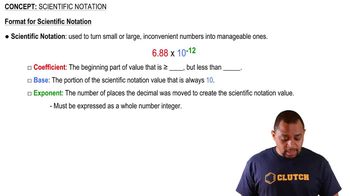
  • What are the three main parts of a number written in scientific notation?

    The three main parts are the coefficient, the base (which is always 10), and the exponent.
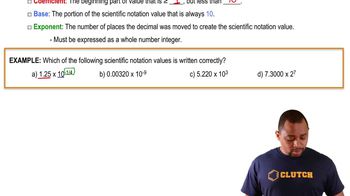
  • What range must the coefficient in scientific notation fall within?

    The coefficient must be equal to or greater than 1 but less than 10.
  • What does a positive exponent in scientific notation indicate about the list of the decimal point?

    A positive exponent means the decimal point is moved to the right, making the number larger.
  • What does a negative exponent in scientific notation indicate about the movement of the decimal point?

    A negative exponent means the decimal point is moved to the left, making the number smaller.
  • How do you convert a number from scientific notation to standard notation when the exponent is positive?

    Move the decimal point to the right by the number of places indicated by the exponent.
  • How do you convert a number from scientific notation to standard notation when the exponent is negative?

    Move the decimal point to the left by the number of places indicated by the exponent.
  • What must the exponent in scientific notation always be?

    The exponent must always be a whole number integer, not a decimal or fraction.
  • Why is scientific notation useful in chemistry and physics?

    It makes very large or very small numbers more manageable and easier to use in calculations.
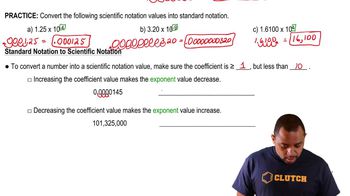
  • What happens to the exponent when you increase the coefficient while converting to scientific notation?

    When the coefficient increases, the exponent decreases by the same number of places.
  • What happens to the exponent when you decrease the coefficient while converting to scientific notation?

    When the coefficient decreases, the exponent increases by the same number of places.
  • How do you determine the exponent when converting a number to scientific notation?

    Count how many places you move the decimal to get a coefficient between 1 and 10; this number is the exponent.
  • What is standard notation?

    Standard notation is the normal way of writing numbers without exponents.
  • If you convert 0.000145 to scientific notation, what is the coefficient and exponent?

    The coefficient is 1.45 and the exponent is -4, so it is written as 1.45 × 10⁻⁴.
  • If you convert 7.17 × 10⁵ to standard notation, what is the result?

    The result is 717,000.
  • What is the base in scientific notation always equal to?

    The base is always 10 in scientific notation.