Back

Simple Cubic Unit Cell quiz

Control buttons has been changed to "navigation" mode.
1/15
  • How many atoms are contained in a simple cubic unit cell?

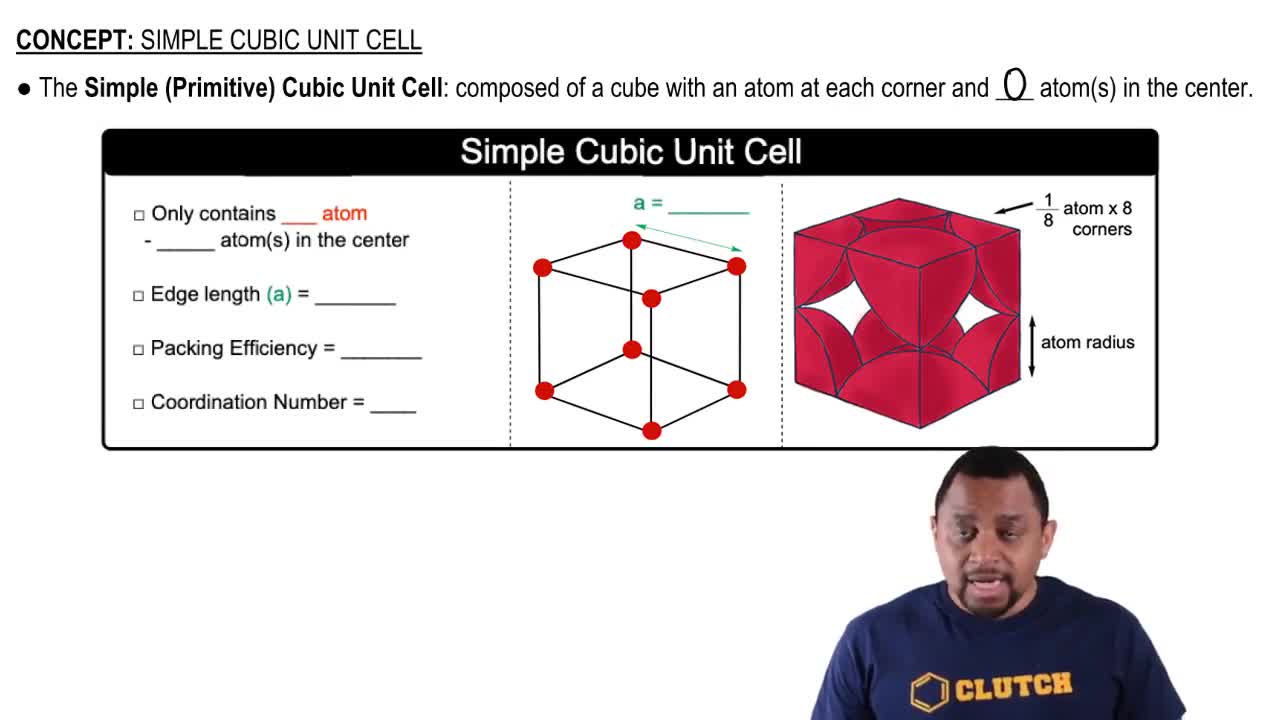
    A simple cubic unit cell contains 1 atom.
  • Where are the atoms located in a simple cubic unit cell?

    Atoms are located at each of the 8 corners of the cube.
  • How much of each corner atom belongs to a single simple cubic unit cell?

    Each corner atom contributes 1/8th of an atom to the unit cell.
  • How is the total number of atoms in a simple cubic unit cell calculated?

    Multiply 8 corners by 1/8th atom per corner to get 1 atom.
  • What is the formula for the edge length (a) of a simple cubic unit cell in terms of atomic radius (r)?

    The edge length a = 2r, where r is the atomic radius.
  • Why is the edge length of a simple cubic unit cell equal to 2r?

    Because the atoms at the corners touch along the edge, so the edge is two atomic radii long.
  • Does a simple cubic unit cell have any atoms in its center?

    No, there are 0 atoms in the center of a simple cubic unit cell.
  • What is the packing efficiency of a simple cubic unit cell?

    The packing efficiency is 52%.
  • What does packing efficiency mean in the context of unit cells?

    Packing efficiency is the percentage of space occupied by atoms in the unit cell.
  • What is the coordination number of a simple cubic unit cell?

    The coordination number is 6.
  • What does the coordination number represent in a unit cell?

    It represents the number of nearest neighbor atoms surrounding a given atom.
  • How does the complexity of a unit cell affect its packing efficiency and coordination number?

    As the complexity increases, both packing efficiency and coordination number increase.
  • What is another name for the simple cubic unit cell?

    It is also called the primitive cubic unit cell.
  • How many corners does a simple cubic unit cell have?

    It has 8 corners.
  • Why is the simple cubic unit cell considered less efficient than more complex unit cells?

    Because it has a lower packing efficiency and coordination number compared to more complex structures.