Solubility Rules quiz #3 Flashcards

Solubility Rules quiz #3
Control buttons has been changed to "navigation" mode.
1/40
  • Which of the following is equal to the solubility of a solute in a particular solvent?

    The concentration of solute in a saturated solution equals its solubility.
  • Are all ionic compounds soluble in water?

    No, only those following the solubility rules are soluble.
  • What is a saturated solution?

    A saturated solution contains the maximum amount of dissolved solute at a given temperature.
  • Why does sodium bromide dissolve in water?

    NaBr is ionic and water is polar, so it dissociates and is hydrated by water.
  • Why does NaBr dissolve in water?

    NaBr is ionic and water is polar, so it dissociates and is hydrated by water.
  • Which of these substances will water not dissolve?

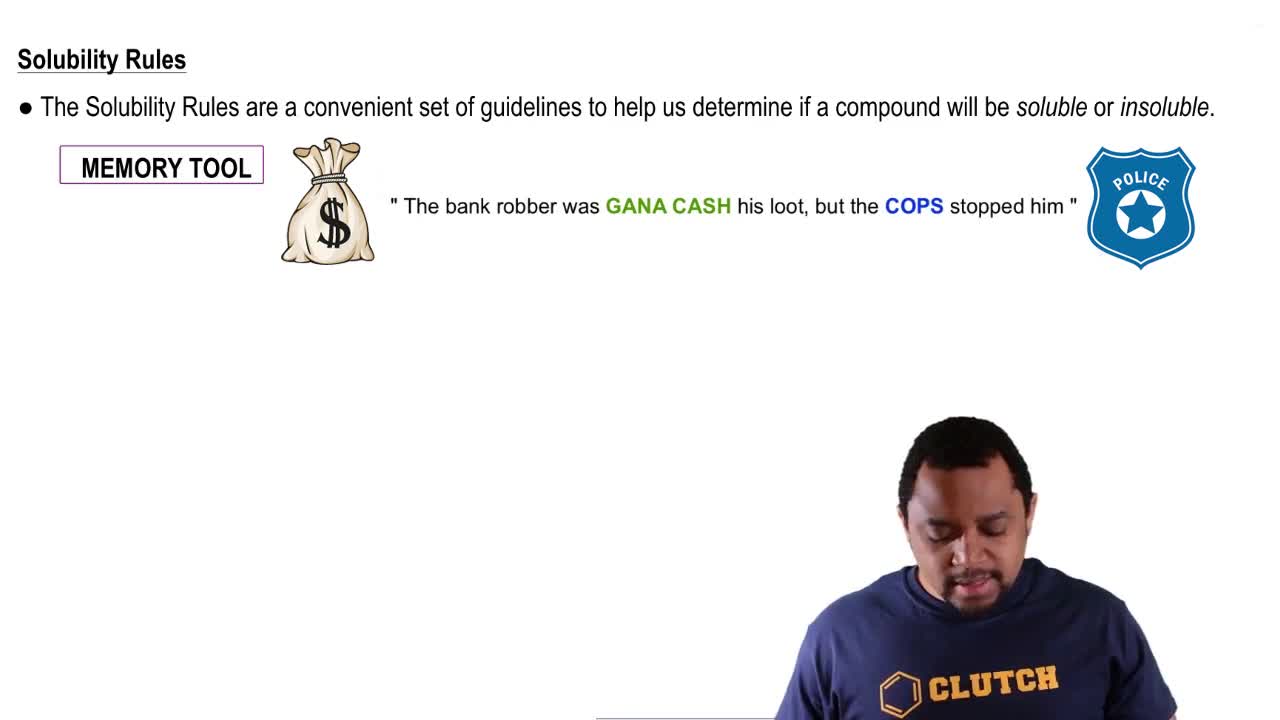
    Nonpolar substances and most COPS salts are not dissolved by water.
  • Which of the following substances has the greatest solubility in water?

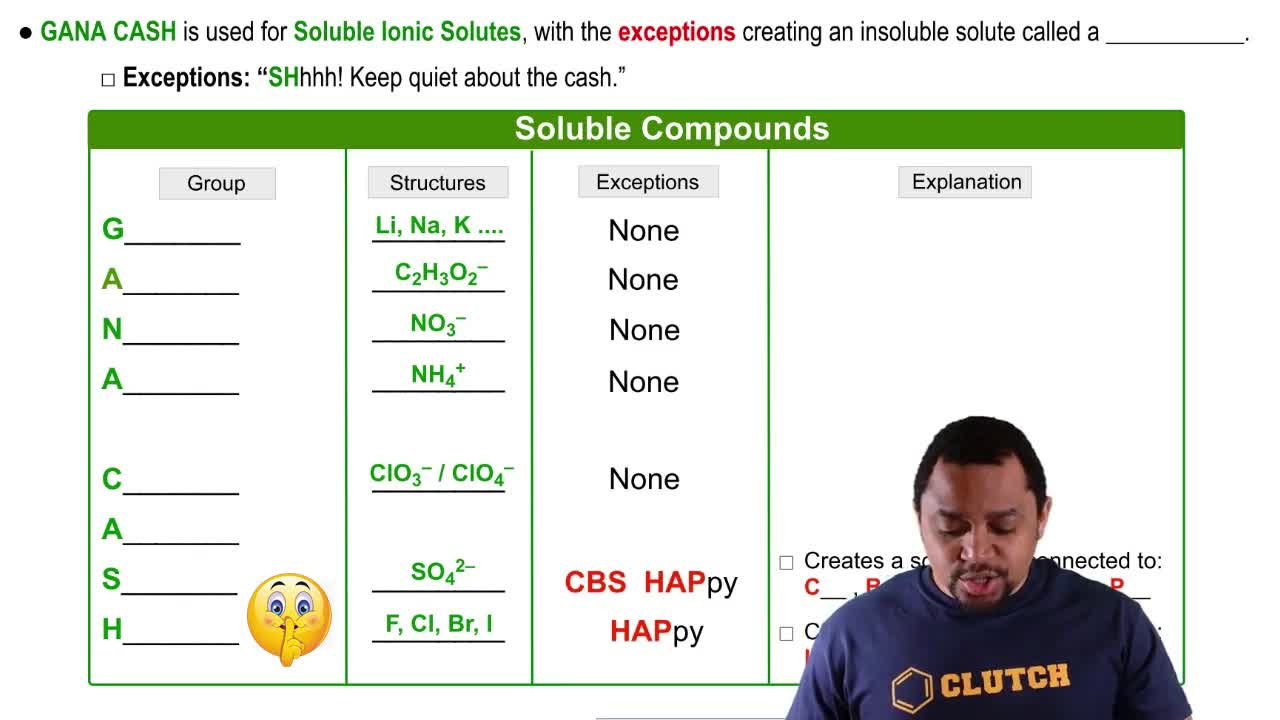
    Substances with Group 1A, ammonium, nitrate, or acetate ions.
  • What is the solubility of M(OH)2 in pure water?

    M(OH)2 is generally insoluble unless M is Ca, Ba, or Sr.
  • Which anions form compounds that are usually soluble?

    Nitrate, acetate, chlorate, and perchlorate anions form usually soluble compounds.
  • Evaluate the following reaction. What is the precipitate that forms?

    The precipitate is the insoluble product, determined by solubility rules.
  • What can be added to silver bromide to promote dissolution?

    Adding a complexing agent or changing pH may increase dissolution.
  • What distinguishes a saturated solution from a supersaturated solution?

    A supersaturated solution contains more solute than a saturated solution at the same temperature.
  • Which of the following molecules are predicted to easily dissolve in water?

    Polar molecules and ionic compounds following solubility rules.
  • Which of the following compounds is expected to be the least soluble in H2O?

    Nonpolar compounds and most COPS salts are least soluble.
  • Which one of the following substances is more likely to dissolve in benzene (C6H6)?

    Nonpolar substances are more likely to dissolve in benzene.
  • Which one of the following compounds will be soluble in water?

    Compounds with Group 1A, ammonium, nitrate, or acetate ions.
  • Oil molecules are nonpolar. What kind of solvent is required to remove an oil stain?

    A nonpolar solvent is required to dissolve oil.
  • With which of the following will the ammonium ion form an insoluble salt?

    Ammonium salts are generally soluble; few exceptions exist.
  • Which of the following is soluble in water at 25°C?

    Compounds with Group 1A, ammonium, nitrate, or acetate ions.
  • Which substance will dissolve in hexane?

    Nonpolar substances will dissolve in hexane.
  • Which of the following substances is insoluble in water?

    Compounds with carbonate, phosphate, or sulfide ions (except exceptions) are insoluble.
  • Which one of the following compounds will not be soluble in water?

    Compounds with carbonate, phosphate, or sulfide ions (except exceptions) are not soluble.
  • Which one of the following compounds is soluble in water?

    Compounds with Group 1A, ammonium, nitrate, or acetate ions.
  • Which of the following best describes why ionic molecules dissolve and dissociate in water?

    Water's polarity allows it to surround and separate ions, causing dissolution.
  • Which of the following is most soluble in water?

    Compounds with Group 1A, ammonium, nitrate, or acetate ions.
  • In which of these solutions will AgCl be most soluble?

    AgCl is most soluble in solutions containing complexing agents or low Cl- concentration.
  • Which one of the following is most soluble in water?

    Compounds with Group 1A, ammonium, nitrate, or acetate ions.
  • Carbonates are insoluble. What does this mean?

    Most carbonate salts do not dissolve in water, except those with Group 1A or ammonium.
  • Which of the following compounds would you expect to be soluble in water?

    Compounds with Group 1A, ammonium, nitrate, or acetate ions.
  • Is (NH4)2CO3 soluble or insoluble?

    Ammonium carbonate is soluble in water.
  • What is the difference between a saturated and an unsaturated solution?

    A saturated solution holds the maximum solute; an unsaturated solution can dissolve more.
  • Which solution will form a precipitate when mixed with a solution of aqueous Ba(NO3)2?

    Solutions containing sulfate ions will form BaSO4 precipitate.
  • Which of the following would be the most soluble in water?

    Compounds with Group 1A, ammonium, nitrate, or acetate ions.
  • Which of the following is soluble in water?

    Compounds with Group 1A, ammonium, nitrate, or acetate ions.
  • Which compounds are not soluble in water at room temperature?

    Compounds with carbonate, phosphate, or sulfide ions (except exceptions) are not soluble.
  • Which of the following describes the process of dissolution?

    Dissolution involves breaking solute bonds and dispersing particles in the solvent.
  • Which of the following is soluble in water at 25°C?

    Compounds with Group 1A, ammonium, nitrate, or acetate ions.
  • Why do compounds like NaCl dissolve easily in water?

    NaCl is ionic and water is polar, so it dissociates and is hydrated by water.
  • Which of the following substances is more likely to dissolve in CH3OH?

    Polar substances and those capable of hydrogen bonding are more likely to dissolve in CH3OH.
  • Which of the following compounds is least soluble in water?

    Nonpolar compounds and most COPS salts are least soluble.