Back

Solution Stoichiometry quiz

Control buttons has been changed to "navigation" mode.
1/15
  • What two new factors are important in solution stoichiometry compared to regular stoichiometry?

    Volume and molarity are important factors in solution stoichiometry.
  • How do you convert a solution's volume in milliliters to liters?

    Divide the volume in milliliters by 1000 to get the volume in liters.
  • What formula is used to calculate moles from volume and molarity?

    Moles = Liters × Molarity.
  • In solution stoichiometry, what does the word 'of' between two numbers indicate?

    The word 'of' means you should multiply the two numbers.
  • What is the first step when given the volume and molarity of a solution in a stoichiometry problem?

    Convert the volume to liters if necessary and multiply by the molarity to find moles.
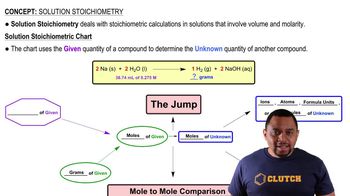
  • What is the purpose of the stoichiometric chart in solution stoichiometry?

    It helps organize the process of converting the given quantity to the unknown quantity using stoichiometric relationships.
  • What is the 'jump' in a stoichiometric chart?

    The 'jump' refers to using the mole-to-mole ratio from the balanced equation to convert moles of the given substance to moles of the unknown.
  • How do you find the grams of a product after determining its moles?

    Multiply the moles of the product by its molar mass to get grams.
  • What information does the balanced chemical equation provide in solution stoichiometry?

    It provides the mole ratios needed to relate reactants and products.
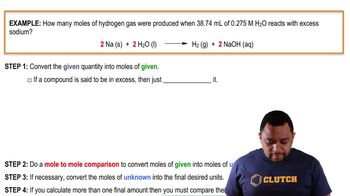
  • If you are given 38.74 mL of 0.275 M water, what is your first calculation?

    Convert 38.74 mL to liters and multiply by 0.275 M to find moles of water.
  • Why is it important to use the coefficients from the balanced equation in solution stoichiometry?

    The coefficients give the correct mole ratios for converting between substances.
  • What is the unknown in the example provided in the transcript?

    The unknown is the grams of hydrogen gas (H₂) produced.
  • What does solution stoichiometry extend from basic stoichiometry?

    It extends stoichiometry by including calculations involving solution volume and molarity.
  • After finding moles of the given substance, what is the next step in solution stoichiometry?

    Use the mole ratio from the balanced equation to find moles of the unknown substance.
  • What should you do if you are unfamiliar with basic stoichiometry before learning solution stoichiometry?

    Review basic stoichiometry concepts before proceeding with solution stoichiometry.