Subatomic Particles quiz #5 Flashcards

Subatomic Particles quiz #5
Control buttons has been changed to "navigation" mode.
1/40
  • What subatomic particle determines the identity of an element?
    The number of protons determines the identity of an element.
  • The majority of an atom's mass comes from which two particles?
    The majority of an atom's mass comes from protons and neutrons.
  • What was the first subatomic particle discovered?
    The electron was the first subatomic particle discovered.
  • Which of the following particles is smallest?
    The electron is the smallest particle.
  • What do neutrons and protons have in common?
    Neutrons and protons are both found in the nucleus and have similar mass.
  • Where is the smallest negatively-charged particle found in an atom?
    Electrons, the smallest negatively-charged particles, are found surrounding the nucleus.
  • Which subatomic particle orbits the nucleus?
    Electrons orbit the nucleus.
  • What particles are located in the nucleus of an atom?
    Protons and neutrons are located in the nucleus.
  • What subatomic particle has a negative charge and a mass that is approximately 1/1836 amu?
    The electron has a negative charge and a mass of about 1/1836 amu.
  • What are the relative charges of the three main subatomic particles?
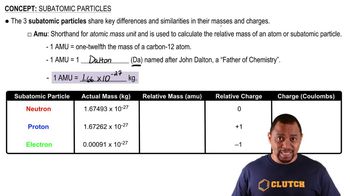
    Proton: +1, Neutron: 0, Electron: -1.
  • The cathode ray experiments led to which particle being discovered?
    The electron was discovered through cathode ray experiments.
  • What three particles with charges compose atoms?
    Protons (+1), neutrons (0), and electrons (-1) compose atoms.
  • What subatomic particle did Thomson discover?
    J.J. Thomson discovered the electron.
  • Which is true about subatomic particles?
    Protons and neutrons are in the nucleus and have similar mass; electrons are much lighter and orbit the nucleus.
  • The identity of an element is determined by the number of what particle?
    The number of protons determines the identity of an element.
  • What particles are found in the nucleus of the atom?
    Protons and neutrons are found in the nucleus.
  • Protons are subatomic particles with which type of charge?
    Protons have a positive charge.
  • What are the three types of subatomic particles?
    The three types are protons, neutrons, and electrons.
  • Which of the following is a negatively charged particle?
    The electron is a negatively charged particle.
  • Which particle has the lightest mass?
    The electron has the lightest mass.
  • What charge do neutrons carry?
    Neutrons carry no charge.
  • Which subatomic particle is the smallest in size?
    The electron is the smallest in size.
  • Which region of an atom has a negative charge?
    The electron cloud has a negative charge.
  • What is the mass of the neutron?
    The mass of a neutron is about 1.67493 × 10⁻²⁷ kg or about 1 amu.
  • Which subatomic particle has a positive charge and a relative mass of 1?
    The proton has a positive charge and a relative mass of 1.
  • Which part of a helium atom is positively charged?
    The nucleus of a helium atom is positively charged due to protons.
  • Which of the following subatomic particles has the least amount of mass?
    The electron has the least amount of mass.
  • The mass of a proton is closest to the mass of which particle?
    The mass of a proton is closest to the mass of a neutron.
  • How does the mass of an electron compare to the mass of a proton or neutron?
    The electron's mass is much smaller than that of a proton or neutron.
  • What are three types of subatomic particles?
    Protons, neutrons, and electrons.
  • What are the three types of sub-atomic particles?
    Protons, neutrons, and electrons.
  • Which subatomic particles are found in the nucleus of an atom of beryllium?
    Protons and neutrons are found in the nucleus of beryllium.
  • Which of the particles are responsible for the atomic number of carbon-12?
    Protons are responsible for the atomic number of carbon-12.
  • Which particle is J. J. Thomson credited with discovering?
    J.J. Thomson is credited with discovering the electron.
  • How does the mass of a proton compare to the mass of an electron?
    A proton is about 1836 times more massive than an electron.
  • Which of the following particles has the lowest mass?
    The electron has the lowest mass.
  • Which of the following particles has the largest mass?
    The neutron has the largest mass, slightly more than the proton.
  • Which two particles each have a mass of 1 amu?
    Protons and neutrons each have a mass of about 1 amu.
  • Which subatomic particle determines an element's chemical properties?
    Electrons determine an element's chemical properties.
  • Which particle has the least amount of mass?
    The electron has the least amount of mass.