The Atom quiz #12 Flashcards

The Atom quiz #12
Control buttons has been changed to "navigation" mode.
1/40
  • What is the smallest possible unit of matter called?
    The atom is the smallest possible unit of matter.
  • What is the smallest unit of an element that still retains the element’s properties?
    An atom is the smallest unit of an element that retains its properties.
  • Which atom has the smallest number of neutrons?
    Hydrogen-1 has the smallest number of neutrons (zero).
  • An atom includes 8 electrons. What element is it?
    An atom with 8 electrons is oxygen.
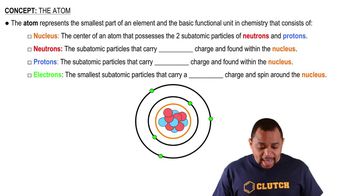
  • Where are the protons?
    Protons are located in the nucleus of the atom.
  • Approximately how much of the air we breathe is composed of nitrogen and oxygen?
    About 99% of the air is nitrogen and oxygen (78% nitrogen, 21% oxygen).
  • What is the gas that makes up most of the air that we breathe?
    Nitrogen is the gas that makes up most of the air we breathe.
  • How many p electrons are there in an atom of gallium (Ga)?
    Gallium has 10 p electrons.
  • How many inner shell electrons are there in beryllium?
    Beryllium has 2 inner shell electrons.
  • What are the number of protons?
    The number of protons is equal to the atomic number of the element.
  • Why might you say that an atom is mostly composed of empty space?
    Most of an atom's volume is the electron cloud, which is mostly empty space.
  • How many protons does platinum have?
    Platinum has 78 protons.
  • How many neutrons are in an atom of iridium which has a mass number of 193?
    Iridium-193 has 116 neutrons (mass number 193 minus atomic number 77).
  • What characteristic of an element's atoms always determines the element's identity?
    The number of protons always determines the element's identity.
  • How many protons does chromium have?
    Chromium has 24 protons.
  • An atom with an atomic mass of 89 and an atomic number of 39 has how many neutrons?
    It has 50 neutrons (mass number 89 minus atomic number 39).
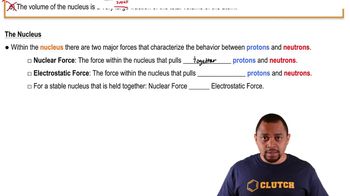
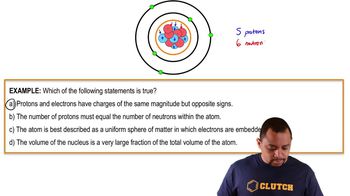
  • Roughly what percentage of the atom's volume is the nucleus?
    The nucleus occupies less than 0.01% of the atom's volume.
  • Which of these has 28 protons and 26 electrons?
    A nickel ion with a 2+ charge (Ni2+).
  • Where is most of the atom's mass located?
    Most of the atom's mass is located in the nucleus.
  • What is the maximum number of electrons that can be contained within the n = 2 shell of an atom?
    The n = 2 shell can hold a maximum of 8 electrons.
  • How many electrons are in a neutral phosphorus atom?
    A neutral phosphorus atom has 15 electrons.
  • Why do atoms have neutral charges?
    Atoms have neutral charges because they have equal numbers of protons and electrons.
  • How many protons are contained in the nucleus of an argon atom?
    An argon atom has 18 protons in its nucleus.
  • In which of the following atoms is the 2s orbital closest to the nucleus?
    The 2s orbital is closest to the nucleus in the atom with the highest nuclear charge (atomic number).
  • How many protons does an atom of carbon have?
    Carbon has 6 protons.
  • How many electrons does the first energy level hold?
    The first energy level holds up to 2 electrons.
  • How many protons and electrons are present in an element of strontium?
    Strontium has 38 protons and, if neutral, 38 electrons.
  • An atom of calcium contains 20 protons. How many electrons does it have?
    A neutral calcium atom has 20 electrons.
  • Which of the following defines the atomic number of a given element?
    The atomic number is defined as the number of protons in the nucleus.
  • What is the mass number for an atom of xenon containing 54 protons and 76 neutrons?
    The mass number is 130 (54 protons + 76 neutrons).
  • An atom has an atomic number of 15 and a mass number of 31. How many protons are there in the atom?
    There are 15 protons in the atom.
  • How many protons does an atom of oxygen have?
    Oxygen has 8 protons.
  • The atomic number of boron is 5. What is the mass number of a boron atom with 4 neutrons?
    The mass number is 9 (5 protons + 4 neutrons).
  • Astatine has 85 protons. What is its atomic number?
    Astatine's atomic number is 85.
  • How many protons are present in an atom of argon?
    Argon has 18 protons.
  • What is the mass number for an atom of xenon containing 54 protons and 79 neutrons?
    The mass number is 133 (54 protons + 79 neutrons).
  • How many protons does an atom of bromine (Br) have?
    Bromine has 35 protons.
  • The atomic number of oxygen is 8. What is the mass number of an oxygen atom with 7 neutrons?
    The mass number is 15 (8 protons + 7 neutrons).
  • How many electrons does O2– contain?
    O2– has 10 electrons (8 from oxygen, plus 2 extra for the 2– charge).
  • How many protons does phosphorus (P) have?
    Phosphorus has 15 protons.