The Atom quiz #15 Flashcards

The Atom quiz #15
Control buttons has been changed to "navigation" mode.
1/40
  • The identity of a chemical element is determined by which of the following?
    The number of protons in the nucleus determines the identity of a chemical element.
  • How many protons are in aluminum-28?
    Aluminum has 13 protons, regardless of isotope.
  • How many protons does a carbon atom have?
    A carbon atom has 6 protons.
  • What is the difference between mass number and atomic number?
    Mass number is protons plus neutrons; atomic number is just protons.
  • How many neutrons does manganese have?
    Manganese-55 has 30 neutrons (mass number 55 minus atomic number 25).
  • Which atom would be neutral?
    An atom with equal numbers of protons and electrons is neutral.
  • How many neutrons does oxygen have?
    Oxygen-16 has 8 neutrons (mass number 16 minus atomic number 8).
  • Rutherfordium has an atomic number of 104. How many protons and electrons does it have?
    Rutherfordium has 104 protons and, if neutral, 104 electrons.
  • How would you describe the structure of an atom?
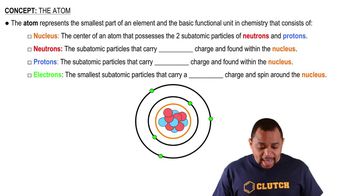
    An atom has a nucleus of protons and neutrons, surrounded by electrons.
  • How many protons does an aluminum atom have?
    Aluminum has 13 protons.
  • How many protons does aluminum (Al) have?
    Aluminum has 13 protons.
  • How many electrons does a neutral K atom have?
    A neutral potassium atom has 19 electrons.
  • How many protons are in the nucleus of an atom of beryllium?
    Beryllium has 4 protons in its nucleus.
  • What percentage of the atom is empty space?
    Over 99.99% of the atom is empty space.
  • Is the substance an atom or a molecule?
    If it consists of one type of atom, it is an atom; if it consists of two or more atoms bonded, it is a molecule.
  • Which is defined as anything that takes up space and has mass?
    Matter is anything that takes up space and has mass.
  • What is the measure of the amount of matter in an object?
    Mass is the measure of the amount of matter in an object.
  • How many protons does K+ have?
    K+ (potassium ion) has 19 protons.
  • How many neutrons does tin have?
    Tin-120 has 70 neutrons (mass number 120 minus atomic number 50).
  • How many total electrons does carbon have?
    A neutral carbon atom has 6 electrons.
  • Which one of the following is the most abundant gas in the atmosphere?
    Nitrogen is the most abundant gas in the atmosphere.
  • Which particle type can be identified as being from a specific element?
    Protons can be identified as being from a specific element.
  • What is the total number of subatomic particles found in the nucleus of an atom of argon?
    Argon-40 has 18 protons and 22 neutrons, totaling 40 subatomic particles in the nucleus.
  • What is the smallest unit of a compound?
    A molecule is the smallest unit of a compound.
  • How many protons does an atom of phosphorus contain?
    Phosphorus has 15 protons.
  • How many shells does sulfur have?
    Sulfur has 3 electron shells.
  • Which of the following correctly describes an atomic orbital?
    An atomic orbital is a region where an electron is most likely to be found.
  • Which scientist discovered atomic nuclei?
    Ernest Rutherford discovered atomic nuclei.
  • How many protons and electrons are present in a vanadium atom?
    Vanadium has 23 protons and, if neutral, 23 electrons.
  • What is a pure substance that cannot be broken down by chemical means into other substances?
    An element is a pure substance that cannot be broken down by chemical means.
  • How many neutrons are in beryllium?
    Beryllium-9 has 5 neutrons (mass number 9 minus atomic number 4).
  • The element with atomic number 13 has how many protons?
    It has 13 protons.
  • What is the smallest chemical unit of a type of pure substance?
    An atom is the smallest chemical unit of a pure substance (element).
  • What is the atomic number and the mass number of an atom with 11 protons and 12 neutrons?
    Atomic number is 11; mass number is 23.
  • How many electrons does an atom of titanium have?
    A neutral titanium atom has 22 electrons.
  • What is the major impurity in silicon used to make semiconductors?
    Phosphorus is a common impurity in silicon semiconductors.
  • If an atom has 17 protons, what element is it?
    An atom with 17 protons is chlorine.
  • How many neutrons are found in an atom of cadmium that has a mass number of 112?
    Cadmium-112 has 64 neutrons (mass number 112 minus atomic number 48).
  • How many protons does an atom of aluminum have?
    Aluminum has 13 protons.
  • What is a chemical substance that cannot be broken down into another chemical substance?
    An element cannot be broken down into another chemical substance.