The Atom quiz #21 Flashcards

The Atom quiz #21
Control buttons has been changed to "navigation" mode.
1/40
  • The atoms in the plastic of your chair were formed when?
    Atoms were formed billions of years ago in stars.
  • An atom's atomic number is 7. Its valence is most likely what?
    Atomic number 7 is nitrogen, which typically has a valence of 3.
  • The behavior of an atom depends on the __________.
    The behavior of an atom depends on its electrons, especially valence electrons.
  • In an atom, which electrons tend to do the most shielding (core electrons or valence electrons)?
    Core electrons do the most shielding.
  • Ba element: protons, neutrons, electrons?
    Barium has 56 protons, 81–82 neutrons (common isotopes), and 56 electrons if neutral.
  • Which is a characteristic of the part of the atom marked 'a'?
    'a' typically marks the nucleus, which is dense and positively charged.
  • Which is a characteristic of the part of the atom marked 'b'?
    'b' typically marks the electron cloud, which is mostly empty space and negatively charged.
  • Ozone is a molecule in the upper atmosphere that is made up of three atoms of _____.
    Ozone is made up of three atoms of oxygen.
  • What is the total number of protons, neutrons, and electrons in a cadmium atom?
    Cadmium-112 has 48 protons, 64 neutrons, and 48 electrons; total is 160.
  • The form of oxygen that combines three oxygen atoms into each molecule is called _____.
    It is called ozone.
  • The smallest basic unit of matter is what?
    The atom is the smallest basic unit of matter.
  • The smallest units of matter having the chemical properties of the element are called what?
    They are called atoms.
  • The nucleus of an atom contains what?
    The nucleus contains protons and neutrons.
  • How much stuff (protons, neutrons & electrons) an object is made of is called what?
    It is called mass.
  • The number of protons in one atom of an element determines the atom’s what?
    It determines the atom's identity (element).
  • The smallest particle of an element that can exist is what?
    It is an atom.
  • Which of these relationships is true of an uncharged atom?
    An uncharged atom has equal numbers of protons and electrons.
  • Positively charged center of an atom is called what?
    It is called the nucleus.
  • A pure chemical substance that consists of one type of atom is called a(n) what?
    It is called an element.
  • Does mercury have more protons and electrons than tin?
    Yes, mercury has more protons and electrons than tin.
  • When two hydrogen atoms combine with one oxygen atom, the result is a water molecule, which is a(n):
    It is a compound.
  • The smallest unit of an element that retains the properties of that element is what?
    It is an atom.
  • The lowest allowable energy state of an atom is called its what?
    It is called the ground state.
  • The smallest unit of matter is a(n) ________.
    Atom.
  • The basic unit of matter is what?
    The atom is the basic unit of matter.
  • Atomic numbers that add up to 200: what combination of elements could this be?
    Any combination of elements whose atomic numbers sum to 200.
  • Gas made of three oxygen atoms is called what?
    It is called ozone (O3).
  • How many elements are gaseous at room temperature?
    There are 11 elements that are gases at room temperature.
  • What is the smallest representative particle of an element?
    An atom is the smallest representative particle of an element.
  • An example of an atom that has no charge is one that has what?
    Equal numbers of protons and electrons.
  • What element's neutral atom has 17 electrons?
    Chlorine's neutral atom has 17 electrons.
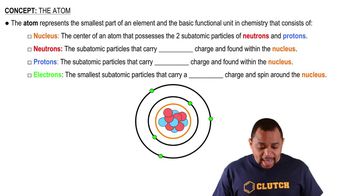
  • Identify the parts of the atom that are labeled in the diagram. Label a: Label b:
    Label a: nucleus; Label b: electron cloud.
  • 6 protons, 6 neutrons, 6 electrons: total charge?
    The atom is neutral (total charge is zero).
  • Region surrounding the nucleus where electrons are found is called what?
    It is called the electron cloud.
  • Select the atomic models that belong to the same element.
    Models with the same number of protons belong to the same element.
  • Has an atomic number that doubles silicon's: what element is it?
    Silicon's atomic number is 14; double is 28, which is nickel.
  • How many protons are in an atom of magnesium?
    Magnesium has 12 protons.
  • What is the mass number of an atom with 5 protons and 7 neutrons?
    The mass number is 12.
  • Massive particle in center of atom is called what?
    It is called the nucleus.
  • How many protons does indium have?
    Indium has 49 protons.