The Atom quiz #4 Flashcards

The Atom quiz #4
Control buttons has been changed to "navigation" mode.
1/40
  • How do nuclear force and electrostatic force affect the stability of an atomic nucleus?
    Nuclear force binds protons and neutrons together in the nucleus, while electrostatic force tries to push protons apart due to their positive charges. For a stable nucleus, the nuclear force must be greater than the electrostatic force.
  • What are the four primary parts of an atom discussed in general chemistry?
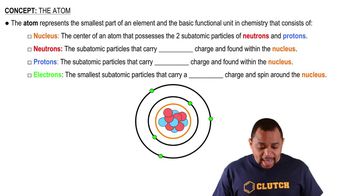
    The four primary parts are the nucleus, protons, neutrons, and electrons.
  • Where are protons and neutrons located within the atom?
    Protons and neutrons are located in the nucleus at the center of the atom.
  • What charge do protons, neutrons, and electrons each carry?
    Protons have a positive charge, neutrons have no charge, and electrons have a negative charge.
  • How does the size of the nucleus compare to the overall size of the atom?
    The nucleus is extremely small relative to the total volume of the atom.
  • What role do neutrons play in the stability of the nucleus?
    Neutrons act as the glue that helps keep the positively charged protons together in the nucleus.
  • What is the nuclear force and what does it do?
    The nuclear force is the force within the nucleus that pulls together protons and neutrons.
  • What is the electrostatic force in the context of the atomic nucleus?
    The electrostatic force is the force that tries to push protons apart due to their like positive charges.
  • What condition must be met for a nucleus to be stable?
    For a stable nucleus, the nuclear force must be greater than the electrostatic force.
  • What happens if the electrostatic force becomes greater than the nuclear force in a nucleus?
    If the electrostatic force is greater, the nucleus can break down and be destroyed.
  • Where are the reactive electrons of an atom found?
    Reactive electrons are found in the outermost electron shell, known as the valence shell.
  • Why do atoms of elements have neutral charges?
    Atoms are neutral because they have equal numbers of protons (positive charge) and electrons (negative charge).
  • What is the basic unit of matter: atom, molecule, gas, or compound?
    The atom is the basic unit of matter.
  • How many electrons does one neutrally charged atom of argon have?
    A neutral argon atom has 18 electrons.
  • Where are electrons located in an atom?
    Electrons are located in the electron cloud around the nucleus.
  • How many electrons does an aluminum atom have?
    A neutral aluminum atom has 13 electrons.
  • How many protons are in an atom of copper?
    An atom of copper has 29 protons.
  • How many neutrons are in an atom of copper? Round your answer to the nearest whole number.
    Copper-63 has 34 neutrons; copper-65 has 36 neutrons. The most common isotope is copper-63, so 34 neutrons.
  • How many electrons are in a neutral calcium atom?
    A neutral calcium atom has 20 electrons.
  • Where are electrons located?
    Electrons are located in the electron cloud surrounding the nucleus.
  • How many protons are in an atom of bismuth?
    An atom of bismuth has 83 protons.
  • What kind of charge does an electron have?
    An electron has a negative charge.
  • Which particles zoom around the center of atoms?
    Electrons zoom around the center (nucleus) of atoms.
  • Which part of an atom is mostly empty space?
    The electron cloud is mostly empty space.
  • What is the smallest particle of an element?
    The atom is the smallest particle of an element.
  • What type of charge do electrons have?
    Electrons have a negative charge.
  • Which is the smallest possible particle of an element: molecule, atom, compound, or matter?
    The atom is the smallest possible particle of an element.
  • What does the atomic number represent?
    The atomic number represents the number of protons in an atom's nucleus.
  • How many electrons does lithium have?
    A neutral lithium atom has 3 electrons.
  • What is the smallest part of an element that still retains properties of that element?
    An atom is the smallest part of an element that retains its properties.
  • Which element has 14 protons?
    Silicon has 14 protons.
  • How many electrons are in a neutral carbon-14 atom?
    A neutral carbon-14 atom has 6 electrons.
  • How many protons does a standard hydrogen atom have in its nucleus?
    A standard hydrogen atom has 1 proton in its nucleus.
  • What did Thomson’s model of the atom include that Dalton’s model did not have?
    Thomson’s model included electrons; Dalton’s model did not.
  • How many protons does iron have?
    Iron has 26 protons.
  • Which best describes an element?
    An element is a pure substance made of only one kind of atom.
  • Where are neutrons located?
    Neutrons are located in the nucleus of the atom.
  • Which of the following are defined as the basic units of matter?
    Atoms are the basic units of matter.
  • Which of these is the part of an atom that contains the protons and neutrons?
    The nucleus contains the protons and neutrons.
  • What is the precise mass of the neutron?
    A neutron has a mass of approximately 1 atomic mass unit (amu).