The Energy of Light quiz #1 Flashcards

The Energy of Light quiz #1
Control buttons has been changed to "navigation" mode.
1/29
  • What is the formula for calculating the energy of a photon?
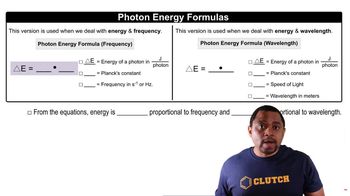
    The energy of a photon is calculated using E = h × f, where h is Planck's constant and f is the frequency of the photon.
  • What is the smallest packet of electromagnetic energy that can be absorbed or emitted called?
    The smallest packet of electromagnetic energy is called a photon.
  • What happens when an electron absorbs energy?
    When an electron absorbs energy, it moves to a higher energy level or excited state.
  • How much energy does an individual photon of 470 nm light have?
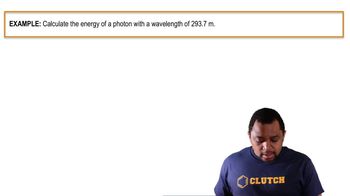
    Use E = h × c / λ. For λ = 470 nm (4.70 × 10⁻⁷ m), E = (6.626 × 10⁻³⁴ J·s × 3.00 × 10⁸ m/s) / (4.70 × 10⁻⁷ m) ≈ 4.23 × 10⁻¹⁹ J per photon.
  • Which of the following transitions represents the emission of a photon with the largest energy: n=5 to n=1, n=4 to n=2, or n=3 to n=2?
    The n=5 to n=1 transition emits a photon with the largest energy.
  • Which color of light corresponds to the highest energy?
    Violet light corresponds to the highest energy among visible colors.
  • Which of the following frequencies of light has the highest energy: 3.0 × 10¹⁴ Hz, 5.0 × 10¹⁴ Hz, or 7.0 × 10¹⁴ Hz?
    7.0 × 10¹⁴ Hz has the highest energy.
  • A photon of which type of electromagnetic radiation has the most energy: radio, infrared, visible, ultraviolet, or gamma?
    A gamma ray photon has the most energy.
  • Which of the following occurs as the energy of a photon increases?
    As the energy of a photon increases, its frequency increases and its wavelength decreases.
  • Which of the following photons carries the smallest amount of energy: infrared, visible, ultraviolet, or gamma?
    An infrared photon carries the smallest amount of energy.
  • Which of the following photons has the highest energy: red, green, blue, or violet?
    A violet photon has the highest energy.
  • What name is given to a discrete packet of light?
    A discrete packet of light is called a photon.
  • Which of the following best determines the amount of energy of a single photon of light?
    The frequency of the photon best determines its energy.
  • How is the energy of a photon related to its frequency?
    The energy of a photon is directly proportional to its frequency.
  • What is the relationship between energy and frequency for a photon?
    Energy increases as frequency increases; they are directly proportional.
  • Which type of electromagnetic radiation has the highest amount of radiant energy?
    Gamma rays have the highest amount of radiant energy.
  • What are quanta of light called?
    Quanta of light are called photons.
  • What is the energy of a photon with a wavelength of 400.0 nm?
    E = h × c / λ; for λ = 400.0 nm (4.00 × 10⁻⁷ m), E ≈ 4.97 × 10⁻¹⁹ J per photon.
  • What must occur before an atom in its ground state can emit a photon?
    The atom must first absorb energy and move to an excited state before it can emit a photon.
  • What is the energy of a UV photon whose wavelength is 254 nm?
    E = h × c / λ; for λ = 254 nm (2.54 × 10⁻⁷ m), E ≈ 7.83 × 10⁻¹⁹ J per photon.
  • Which part of visible light transfers the most energy?
    The violet part of visible light transfers the most energy.
  • What is a quantum of light called?
    A quantum of light is called a photon.
  • Which of the following frequencies of light has the highest energy: 2.0 × 10¹⁴ Hz, 4.0 × 10¹⁴ Hz, or 6.0 × 10¹⁴ Hz?
    6.0 × 10¹⁴ Hz has the highest energy.
  • Which describes the relationship when calculating the energy of a photon?
    The energy of a photon is directly proportional to its frequency and inversely proportional to its wavelength.
  • Upon which parameter does the energy of a photon depend?
    The energy of a photon depends on its frequency (or equivalently, its wavelength).
  • What is the energy of a mole of photons of light that have a frequency of 8.23 × 10¹⁵ Hz?
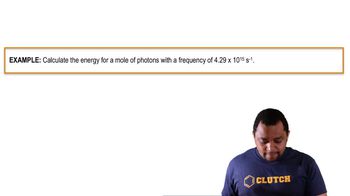
    E (per photon) = h × f = 6.626 × 10⁻³⁴ × 8.23 × 10¹⁵ ≈ 5.45 × 10⁻¹⁸ J; for a mole: 5.45 × 10⁻¹⁸ J × 6.022 × 10²³ ≈ 3.28 × 10⁶ J/mol.
  • What is the energy of a single photon of light that has a frequency of 2.30 × 10¹⁷ Hz?
    E = h × f = 6.626 × 10⁻³⁴ × 2.30 × 10¹⁷ ≈ 1.52 × 10⁻¹⁶ J per photon.
  • What is the energy of a single photon of light that has a frequency of 9.28 × 10²² Hz?
    E = h × f = 6.626 × 10⁻³⁴ × 9.28 × 10²² ≈ 6.14 × 10⁻¹¹ J per photon.
  • What is the energy (in kJ) of 1.00 mole of photons that have 4.25 × 10⁻¹⁹ J of energy each?
    Total energy = 4.25 × 10⁻¹⁹ J × 6.022 × 10²³ ≈ 2.56 × 10⁵ J = 256 kJ.