Back

Titrations: Weak Acid-Strong Base quiz

Control buttons has been changed to "navigation" mode.
1/15
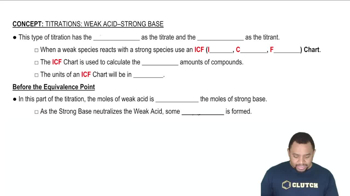
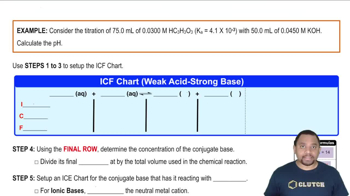
  • What is the role of the ICF (Initial, Change, Final) chart in a weak acid-strong base titration?

    The ICF chart is used to calculate the final amounts of compounds in moles during the titration.
  • How do you calculate moles using volume and molarity in titration problems?

    Moles are calculated by multiplying liters (volume) by molarity (concentration).
  • Before the equivalence point in a weak acid-strong base titration, which species is present in excess?

    The moles of weak acid are greater than the moles of strong base before the equivalence point.
  • What is formed as the strong base neutralizes the weak acid before the equivalence point?

    A conjugate base is formed as the strong base neutralizes the weak acid.
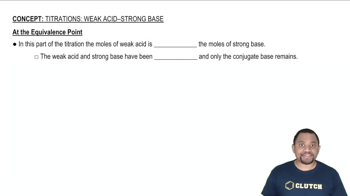
  • At the equivalence point, what is the relationship between the moles of weak acid and strong base?

    At the equivalence point, the moles of weak acid are equal to the moles of strong base.
  • What remains in the solution at the equivalence point of a weak acid-strong base titration?

    Only the conjugate base remains in the solution at the equivalence point.
  • Which equation can be used to determine the volume of titrant at the equivalence point?

    The equation Macid × Vacid = Mbase × Vbase can be used to find the volume of titrant.
  • What happens to the buffer system after the equivalence point in a weak acid-strong base titration?

    After the equivalence point, the solution no longer behaves as a buffer.
  • What is present in excess beyond the equivalence point in a weak acid-strong base titration?

    There is an excess of strong base beyond the equivalence point.
  • Why is it easier to calculate pH beyond the equivalence point in this titration?

    It is easier because only the excess strong base determines the pH.
  • What is the titrate in a weak acid-strong base titration?

    The titrate is the strong base, which is added to the weak acid.
  • Why is the ICF chart used instead of an ICE chart in these titrations?

    The ICF chart is used because it tracks moles during neutralization, not concentrations at equilibrium.
  • What does it mean when the moles of weak acid are less than the moles of strong base?

    It means the titration has passed the equivalence point and there is excess strong base.
  • What is the significance of the equivalence volume in titration calculations?

    The equivalence volume is the volume of titrant needed to completely neutralize the analyte.
  • How does the presence of a strong base after the equivalence point affect the solution's pH?

    The excess strong base raises the pH, making the solution basic.