Van der Waals Equation quiz #1 Flashcards

Van der Waals Equation quiz #1
Control buttons has been changed to "navigation" mode.
1/10
  • In the Van der Waals equation, what aspect of real gases does the factor 'b' correct for compared to ideal gases?
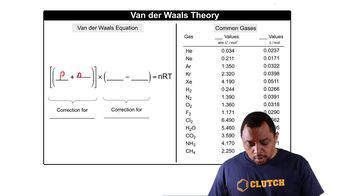
    The factor 'b' in the Van der Waals equation corrects for the volume occupied by gas molecules themselves, accounting for their finite size, which is ignored in the ideal gas law.
  • What does the Van der Waals constant 'a' account for in the behavior of real gases?
    The constant 'a' corrects for the attractive forces (polarity) between gas molecules, which are ignored in the ideal gas law.
  • Under what conditions do real gases deviate most from ideal gas behavior?
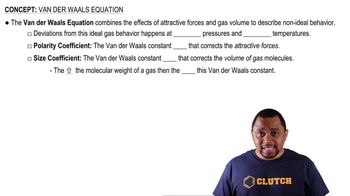
    Real gases deviate most from ideal behavior at high pressures and low temperatures, where molecules are forced closer together.
  • How does the Van der Waals equation relate to the Ideal Gas Law when the constants 'a' and 'b' are negligible?
    When 'a' and 'b' are negligible, the Van der Waals equation simplifies to the Ideal Gas Law because corrections for molecular size and attractions are not needed.
  • What happens to the value of the Van der Waals constant 'b' as the molecular weight of a gas increases?
    As the molecular weight of a gas increases, the value of the Van der Waals constant 'b' generally increases, reflecting the larger volume occupied by heavier molecules.
  • Why is it unnecessary to memorize the Van der Waals equation for most chemistry exams?
    It is usually provided on formula sheets or within exam questions, so understanding the meaning of the constants is more important than memorizing the equation.
  • What units are typically used for the Van der Waals constant 'a'?
    The units for 'a' are atmospheres times liters squared per mole squared (atm·L²/mol²).
  • What units are typically used for the Van der Waals constant 'b'?
    The units for 'b' are liters per mole (L/mol).
  • What does postulate 1 of the ideal gas law say about the volume of gas molecules?
    Postulate 1 states that the volume of gas molecules is so small that it is negligible compared to the volume of the container.
  • How does the Van der Waals equation correct for the non-elastic collisions of real gas molecules?
    The equation includes the 'a' constant to account for intermolecular attractions, which cause collisions to be less than perfectly elastic in real gases.