Back

Writing Ionic Compounds quiz

Control buttons has been changed to "navigation" mode.
1/15
  • What is the first step when writing the formula for an ionic compound from its name?

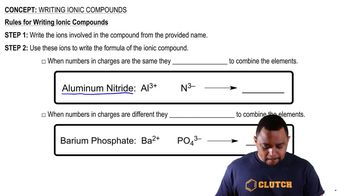
    The first step is to write the ions involved in the compound based on the provided name.
  • How do you determine the charge of aluminum in aluminum nitride?

    Aluminum is in group 3A of the periodic table, so its charge is +3 (Al3+).
  • What does the 'ide' ending in 'nitride' indicate about the element?

    The 'ide' ending indicates that the element is a nonmetal and has gained electrons to form an anion.
  • What is the charge on the nitride ion?

    The nitride ion (N) has a charge of -3 (N3-).
  • When do the charges of ions cancel each other out in an ionic compound?

    The charges cancel out when the numbers in the charges are the same but opposite in sign.
  • What is the correct formula for aluminum nitride?

    The formula for aluminum nitride is AlN.
  • How do you determine the charge of barium in barium phosphate?

    Barium is in group 2A, so its charge is +2 (Ba2+).
  • What is the formula and charge of the phosphate ion?

    The phosphate ion has the formula PO4 and a charge of -3 (PO4^3-).
  • What method is used when the charges of the ions are different in an ionic compound?

    The crisscross method is used to balance the charges by swapping the numbers of the charges.
  • How do you write the formula for barium phosphate using the crisscross method?

    The formula is Ba3(PO4)2, with the 3 from phosphate going to barium and the 2 from barium going to phosphate.
  • Why are parentheses used around PO4 in the formula for barium phosphate?

    Parentheses are used because the subscript applies to the entire polyatomic ion, not just one element.
  • When using the crisscross method, do you crisscross the charges or just the numbers?

    You only crisscross the numbers, not the charges themselves.
  • Why is it important to know the periodic table groups when writing ionic compounds?

    Knowing the groups helps you determine the common charges of elements, which is essential for writing correct formulas.
  • What should you do if you forget the common charges of elements?

    You should review the periodic table and the common charges associated with each group.
  • What are the two main steps to follow when given the name of an ionic compound?

    First, write out the ions; second, check if the charges are the same (cancel) or different (crisscross the numbers).