Ch.7 - Periodic Properties of the Elements
Brown - Chemistry: The Central Science 14th Edition
Brown14th EditionChemistry: The Central ScienceISBN: 9780134414232Not the one you use?Change textbook
Chapter 7, Problem 35

Provide a brief explanation for each of the following: (a) Cl- is larger than Ar. (b) P3- is larger than S2-. (c) K+ is larger than Na+. (d) F- is larger than F.

Verified step by step guidance
1
Consider the position of K and Na in the periodic table. K (potassium) is located in period 4, while Na (sodium) is in period 3.
Understand that as you move down a group in the periodic table, the number of electron shells increases. This means K has more electron shells than Na.
Recognize that both K+ and Na+ ions have lost one electron compared to their neutral atoms, resulting in the same electron configuration as the noble gas preceding them.
Despite having the same electron configuration, K+ has more electron shells than Na+, making it larger in size.
Conclude that the increase in the number of electron shells as you move down a group results in a larger ionic radius for K+ compared to Na+.

Verified video answer for a similar problem:

This video solution was recommended by our tutors as helpful for the problem above.
Video duration:
2m

Key Concepts

Here are the essential concepts you must grasp in order to answer the question correctly.

Ionic Radius

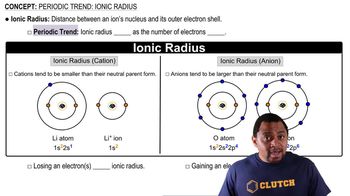
Ionic radius refers to the size of an ion in a crystal lattice. Cations, like K<sup>+</sup> and Na<sup>+</sup>, are formed when atoms lose electrons, resulting in a decrease in size due to reduced electron-electron repulsion and increased effective nuclear charge. The ionic radius can vary based on the ion's charge and the number of electron shells.
Recommended video:

Periodic Trends

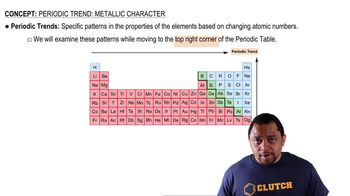
Periodic trends are patterns observed in the properties of elements across the periodic table. As you move down a group, the ionic radius increases due to the addition of electron shells, which outweighs the increase in nuclear charge. This explains why K<sup>+</sup>, located below Na<sup>+</sup> in Group 1, is larger.
Recommended video:
Guided course
00:38
Periodic Trends

Effective Nuclear Charge

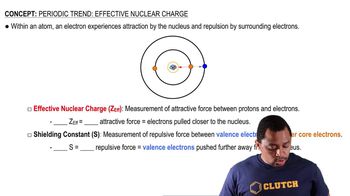
Effective nuclear charge (Z<sub>eff</sub>) is the net positive charge experienced by an electron in a multi-electron atom. It accounts for the shielding effect of inner electrons. In the case of K<sup>+</sup> and Na<sup>+</sup>, although both are cations, K<sup>+</sup> has more electron shells, leading to a larger ionic radius despite a similar Z<sub>eff</sub>.
Recommended video:
Guided course
01:51
Effective Nuclear Charge