 Back
Back
Problem 1a
Indicate whether each of the following nuclides lies within the belt of stability in Figure 21.2: (a) neon-24. For any that do not, describe a nuclear decay process that would alter the neutron-to-proton ratio in the direction of increased stability. [Section 21.2]

Problem 2
Write the balanced nuclear equation for the reaction represented by the diagram shown here. [Section 21.2]

- Complete and balance the following nuclear equations by supplying the missing particle: (b) 40₁₉K + 0₋₁e → ? (c) ? + 4₂He → 30₁₄Si + 1₁H
Problem 3
Problem 4c
In the sketch below, the red spheres represent protons and the gray spheres represent neutrons. (c) Based on its atomic number and mass number, do you think the product nucleus is stable or radioactive? [Section 21.3]

Problem 5a
The steps below show three of the steps in the radioactive decay chain for 23290Th. The half-life of each isotope is shown below the symbol of the isotope. (a) Identify the type of radioactive decay for each of the steps (i), (ii), and (iii). [Sections 21.2 and 21.4]

Problem 5d
The steps below show three of the steps in the radioactive decay chain for 23290Th. The half-life of each isotope is shown below the symbol of the isotope. (d) The next step in the decay chain is an alpha emission. What is the next isotope in the chain? [Sections 21.2 and 21.4]
Problem 6a
The accompanying graph illustrates the decay of 8842Mo, which decays via positron emission. (a) What is the halflife of the decay? [Section 21.4]

Problem 6b
The accompanying graph illustrates the decay of 8842Mo, which decays via positron emission. (b) What is the rate constant for the decay? [Section 21.4]
Problem 6c
The accompanying graph illustrates the decay of 8842Mo, which decays via positron emission. (c) What fraction of the original sample of 8842Mo remains after 12 min? [Section 21.4]

Problem 6d
The accompanying graph illustrates the decay of 8842Mo, which decays via positron emission. (d) What is the product of the decay process? [Section 21.4]
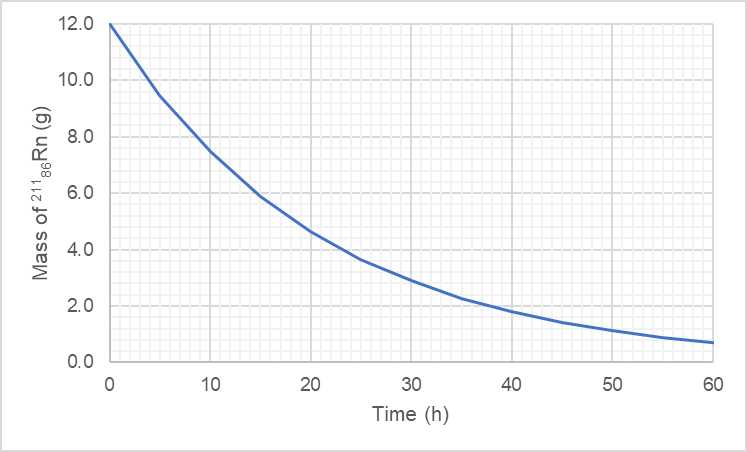
Problem 7b
All the stable isotopes of boron, carbon, nitrogen, oxygen, and fluorine are shown in the accompanying chart (in red), along with their radioactive isotopes with t1>2 7 1 min (in blue). (b) Which radioactive isotopes are most likely to decay by beta emission? [Sections 21.2, 21.4, and 21.5]

Problem 9b
Indicate the number of protons and neutrons in the following nuclei: (b) 193Tl.
Problem 10c
Indicate the number of protons and neutrons in the following nuclei: (c) neptunium-237.
Problem 11b
Give the symbol for (b) an alpha particle.
Problem 11c
Give the symbol for (c) gamma radiation.
Problem 12b
Give the symbol for (b) a beta particle.
Problem 12c
Give the symbol for (c) a positron.
Problem 13a
Write balanced nuclear equations for the following processes: (a) rubidium-90 undergoes beta emission.
Problem 13b
Write balanced nuclear equations for the following processes: (b) selenium-72 undergoes electron capture.
Problem 13c
Write balanced nuclear equations for the following processes: (c) krypton-76 undergoes positron emission.
Problem 13d
Write balanced nuclear equations for the following processes: (d) radium-226 emits alpha radiation.
Problem 14a
Write balanced nuclear equations for the following transformations: (a) bismuth-213 undergoes alpha decay.
Problem 14b
Write balanced nuclear equations for the following transformations:
(b) nitrogen-13 undergoes electron capture.
Problem 14c
Write balanced nuclear equations for the following transformations: (c) technicium-98 undergoes electron capture.
Problem 15a
Decay of which nucleus will lead to the following products: (a) bismuth-211 by beta decay?
Problem 15b
Decay of which nucleus will lead to the following products: (b) chromium-50 by positron emission?
Problem 15c
Decay of which nucleus will lead to the following products: (c) tantalum-179 by electron capture?
Problem 16c
What particle is produced during the following decay processes: (c) iodine-122 decays to xenon-122?
- The naturally occurring radioactive decay series that begins with 235 92U stops with the formation of the stable 207 82Pb nucleus. The decays proceed through a series of alpha-particle and beta-particle emissions. How many of each type of emission are involved in this series?
Problem 17
- A radioactive decay series that begins with 23290Th ends with the formation of the stable nuclide 20882Pb. How many alpha-particle emissions and how many beta-particle emissions are involved in the sequence of radioactive decays?
Problem 18