What term refers to different forms of the same gene?
Allele.
What is the difference between two alleles of the same gene?
Two alleles of the same gene have different DNA sequences, which may result in different phenotypes.
What is the term for one possible form of the gene for a particular trait?
Allele.
Which are different forms of the same gene?
Alleles.
An ______ is an alternative form of a single gene passed from generation to generation.
Allele.
What is a different, alternative version of a gene called?
Allele.
Alternative versions of a gene that produce distinguishable phenotypes are called what?
Alleles.
The allele frequency is ______.
The proportion of a specific allele among all alleles for a gene in a population.
What is the alternative form that a single gene may have for a particular trait?
Allele.
How do you calculate the allele frequencies in the iguana population following the mutation event?
Count the number of each allele in the population after the mutation and divide by the total number of alleles for that gene.
What is an alternative form of a single gene passed from generation to generation?
Allele.
What is a version of a gene called?
Allele.
What are different forms of genes for a single trait called?
Alleles.
What are different forms of the same gene called?
Alleles.
What is one of two or more versions of a gene at a location called?
Allele.
How is gene flow accomplished in populations?
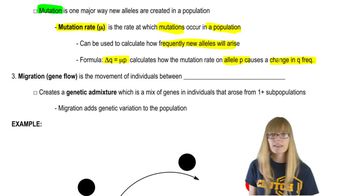
Gene flow is accomplished by the movement of individuals between different populations, resulting in the transfer of alleles and genetic material from one population to another.
What events or processes can cause gene flow in a population?
Gene flow can be caused by migration, where individuals move from one population or subpopulation to another and interbreed, introducing new alleles into the recipient population.
What is the best definition of gene flow in genetics?
Gene flow is the movement of alleles or genetic material between populations due to the migration and interbreeding of individuals, which increases genetic variation.
What is an example of gene flow in a population?
An example of gene flow is when an individual from one population migrates to another population and mates, resulting in offspring with genetic admixture from both populations.
How is gene flow defined in the context of allelic frequency changes?
Gene flow is defined as the transfer of alleles between populations through the migration and interbreeding of individuals, leading to changes in allelic frequencies and increased genetic variation.
What produces gene flow in natural populations?
Gene flow is produced by the migration of individuals between populations, which allows for the exchange and mixing of genetic material.
When does gene flow occur in populations?
Gene flow occurs when individuals move from one population to another and successfully interbreed, resulting in the introduction of new alleles and genetic variation.
 Back
Back
 10:15
10:15