Uncoiled DNA is referred to as relaxed DNA, which is DNA that is not supercoiled or tightly packed.
What is the relaxed form of DNA?
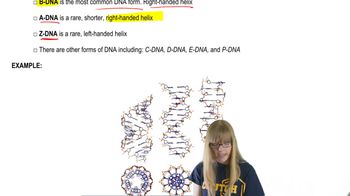
The relaxed form of DNA is B-DNA, which is the most common right-handed helical structure found in humans and other organisms.
What two alternative forms of DNA did Rosalind Franklin discover?
Rosalind Franklin discovered the A-DNA and B-DNA forms, where A-DNA is a shorter right-handed helix and B-DNA is the common right-handed helix.
Which DNA form is characterized by a left-handed helix?
Z-DNA is characterized by a left-handed helix, making it distinct from the more common right-handed forms like B-DNA and A-DNA.
Under what laboratory conditions might alternative DNA forms arise?
Alternative DNA forms can arise under conditions such as high salt concentrations, extreme pH levels, or low water availability. These unusual environments promote structural changes in DNA.
How does the appearance of A-DNA differ from B-DNA?
A-DNA appears shorter and more crunched together compared to the elongated structure of B-DNA. Both are right-handed helices, but A-DNA is more compact.
Name three less common DNA forms mentioned besides A-DNA, B-DNA, and Z-DNA.
Three less common DNA forms mentioned are C-DNA, D-DNA, and E-DNA. These forms have different sizes and structures.
Why is B-DNA considered the 'real' form of DNA in most organisms?
B-DNA is considered the 'real' form because it is the most common structure found in humans and other organisms under normal conditions. It is the standard right-handed helix typically depicted in textbooks.
What structural feature distinguishes Z-DNA from A-DNA and B-DNA?
Z-DNA is distinguished by its left-handed helical structure, whereas A-DNA and B-DNA are both right-handed helices. This reversal in helical direction makes Z-DNA look 'backwards' compared to the others.
Can all DNA be classified as B-DNA under normal conditions?
No, not all DNA is B-DNA; alternative forms like A-DNA and Z-DNA can exist, especially under unusual environmental conditions. These forms differ in helical direction and compactness.
 Back
Back
 01:57
01:57