What happens to genetic information when a chromosome undergoes a deletion mutation?
When a chromosome undergoes a deletion mutation, a segment of the chromosome is lost, resulting in the loss of genetic information contained in that segment. The deleted segment, which typically lacks a centromere, is degraded and lost during cell division.
What are the consequences when a piece of DNA is missing due to a chromosomal deletion?
When a piece of DNA is missing due to a chromosomal deletion, the genes in that segment are lost, which can lead to the absence of gene function, altered phenotypes such as pseudodominance, and in some cases, genetic disorders like Cri du Chat Syndrome. The missing segment is not inherited by daughter cells because it lacks a centromere and is degraded during cell division.
What structural feature prevents a deleted chromosomal segment from being inherited during cell division?
A deleted chromosomal segment typically lacks a centromere. Without a centromere, spindle fibers cannot attach, so the segment is not inherited and is degraded.
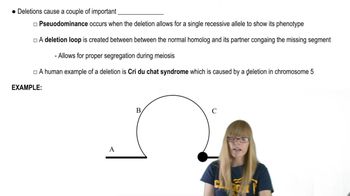
What is a deletion loop and when does it form during meiosis?
A deletion loop is a structure formed between a normal homolog and a chromosome missing a segment. It helps ensure proper segregation of chromosomes during meiosis.
How many double-stranded breaks are usually required to produce a chromosomal deletion?
Two double-stranded breaks are typically required to produce a chromosomal deletion. These breaks remove a segment of the chromosome.
What is the difference between terminal and intercalary deletions?
Terminal deletions remove the end of a chromosome, while intercalary deletions remove a segment from within the chromosome. Both types result in loss of genetic material.
What type of chromosomal deletion can completely disrupt the function of a single gene?
An enterogenic deletion occurs within a gene and can completely disrupt its function. This usually results in the gene not working at all.
What is the characteristic cry associated with Cri du Chat Syndrome and its genetic cause?
Cri du Chat Syndrome is characterized by infants having a cry that sounds like a cat's meow. This is caused by a deletion on chromosome 5.
Why do spindle fibers fail to attach to a deleted chromosomal segment during cell division?
Spindle fibers fail to attach because the deleted segment lacks a centromere. Without a centromere, the segment cannot be properly segregated and is lost.
What phenotype results when a dominant allele is deleted and only a recessive allele remains?
The phenotype is called pseudodominance, where the recessive allele expresses its trait. This occurs because the dominant allele is missing due to the deletion.