Where do homologous chromosomes exchange genetic material through crossing over?
Homologous chromosomes exchange genetic material at the chiasmata during prophase I of meiosis.
Which statements describe crossing over?
Crossing over is the exchange of genetic material between non-sister chromatids of homologous chromosomes, resulting in new combinations of alleles and increased genetic variation.
Which correctly describes crossing over?
Crossing over is the process where non-sister chromatids of homologous chromosomes exchange segments during meiosis, leading to genetic recombination.
Which diagram demonstrates how crossing-over contributes to genetic variety during meiosis?
A diagram showing homologous chromosomes paired in a tetrad, with segments exchanged between non-sister chromatids at chiasmata, resulting in recombinant chromatids, demonstrates how crossing-over increases genetic variety.
Why will cleaving at points a and b in figure 2 result in non-recombinant chromosomes?
Cleaving at points a and b does not result in an exchange of genetic material between homologous chromosomes, so the chromatids remain unchanged and non-recombinant.
Between which two genes would you expect the highest frequency of recombination?
The highest frequency of recombination is expected between two genes that are farthest apart on the same chromosome.
What is crossing over?
Crossing over is the exchange of genetic material between non-sister chromatids of homologous chromosomes during meiosis, resulting in new allele combinations.
With what process is the formation and dissociation of chiasmata specifically associated?
The formation and dissociation of chiasmata are specifically associated with crossing over between homologous chromosomes during prophase I of meiosis.
What are the characteristics of recombinants in genetics?
Recombinants have new combinations of alleles that differ from those found in either parent due to crossing over.
Crossing over is the process in which ______.
Crossing over is the process in which homologous chromosomes exchange genetic material during meiosis.
During meiosis, homologous pairs of chromosomes can exchange pieces of DNA after they synapse.
True. After synapsis during prophase I of meiosis, homologous chromosomes can exchange DNA through crossing over.
How could crossing over affect the distribution of the four alleles: A, a, B, and b?
Crossing over can create new combinations of these alleles in gametes, such as AB, ab, Ab, and aB, increasing genetic diversity.
What type of allele combinations do gametes receive if two crossovers occur between two loci?
If two crossovers occur between two loci, the gametes may receive parental (non-recombinant) combinations due to double crossover restoring the original arrangement.
True or false: Crossing over only occurs during prophase I, not prophase II.
True. Crossing over occurs during prophase I of meiosis, not during prophase II.
Crossing over is __________.
Crossing over is the exchange of genetic material between non-sister chromatids of homologous chromosomes during meiosis.
As a result of crossing over, sister chromatids are no longer identical to each other.
True. After crossing over, sister chromatids may have different genetic information and are no longer identical.
Sister chromatids present at metaphase II might not be genetically identical to each other because
Sister chromatids at metaphase II might not be genetically identical because crossing over has exchanged segments between non-sister chromatids during prophase I.
Explain the relationship between crossing over and genetic variation.
Crossing over increases genetic variation by creating new combinations of alleles in gametes, which contributes to diversity in offspring.
Crossing over, resulting in an increase in genetic variation, occurs between _____.
Crossing over occurs between non-sister chromatids of homologous chromosomes.
A crossover in meiosis is an exchange of genetic material between
A crossover in meiosis is an exchange of genetic material between non-sister chromatids of homologous chromosomes.
In prophase I, allele shuffling between homologous chromosomes occurs in a process called
In prophase I, allele shuffling between homologous chromosomes occurs in a process called crossing over.
When does crossing over occur?
Crossing over occurs during prophase I of meiosis.
During which stage of meiosis does crossing over occur?
Crossing over occurs during prophase I of meiosis.
Does crossing over occur in meiosis I or meiosis II?
Crossing over occurs in meiosis I, specifically during prophase I.
What exchanges DNA during crossing over in meiosis?
Non-sister chromatids of homologous chromosomes exchange DNA during crossing over.
What are the points called where crossing over occurs in meiosis?
The points where crossing over occurs are called chiasmata.
Why is crossing over in meiosis important?
Crossing over is important because it increases genetic variation by producing recombinant chromosomes, which leads to greater diversity in gametes and offspring.
What is a tetrad in the context of meiosis and crossing over?
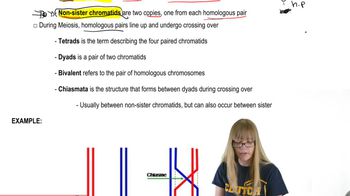
A tetrad is a group of four chromatids formed when homologous chromosomes pair up during prophase I of meiosis.
What is a bivalent in meiosis?
A bivalent refers to a pair of homologous chromosomes that are aligned together during meiosis.
What is the difference between cis and trans conformations in linked genes?
Cis conformation means both dominant alleles of two genes are on the same chromosome, while trans conformation means each chromosome has one dominant and one recessive allele for the two genes.
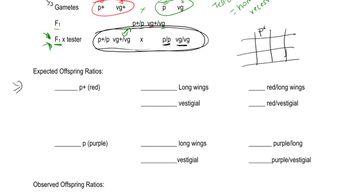
How does crossing over affect the expected ratios of offspring in genetic crosses involving linked genes?
Crossing over reduces the frequency of recombinant offspring compared to independent assortment, resulting in more parental types and fewer recombinants than the expected 1:1:1:1 ratio.
How can recombination frequency be used in genetic mapping?
Recombination frequency, expressed as a percentage, indicates the distance between genes on a chromosome; 1% recombination equals 1 map unit apart.
What experimental evidence first demonstrated the occurrence of crossing over?
Experiments by McClintock and Creighton in corn and by Thomas Hunt Morgan and Alfred in fruit flies provided evidence for crossing over by using chromosomal markers and analyzing recombinant offspring.
What is a chiasma and what is its role in meiosis?
A chiasma is the physical site where two chromatids exchange genetic material during crossing over in meiosis, facilitating genetic recombination.
 Back
Back
 07:38
07:38