In plants, which structures are produced by meiosis during the development of gametes?
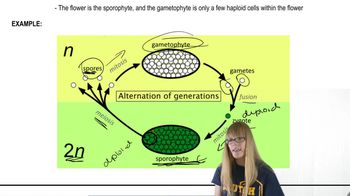
In plants, meiosis in the diploid sporophyte produces haploid spores: microspores (in male organs) and megaspores (in female organs). These spores then undergo mitosis to form gametophytes.
Why does a tulip need to undergo meiosis as part of its reproductive cycle?
A tulip undergoes meiosis to produce haploid spores from its diploid sporophyte stage. These spores develop into gametophytes, which generate gametes for sexual reproduction, ensuring genetic diversity and continuation of the species.
What is the difference between primary and secondary sexual differentiation in plants?
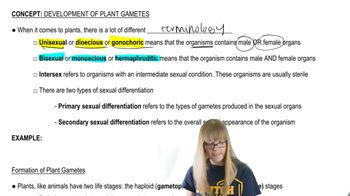
Primary sexual differentiation is based on the type of gametes produced, such as pollen or eggs. Secondary sexual differentiation refers to the visible sexual organs present in the plant.
What term describes plants that have both male and female reproductive organs?
Plants with both male and female organs are called bisexual, monoecious, or hermaphroditic. These terms are interchangeable and refer to the same condition.
What happens to most megaspores produced in the female organs of plants?
Most megaspores die after meiosis in the female organs. Usually, only one survives and divides by mitosis to form the female gametophyte.
How does fertilization occur in flowering plants?
Fertilization occurs when pollen lands on the stigma and fuses with the female gametophyte, called the embryo sac. This fusion produces a diploid zygote.
What is the main difference in the number of cells between male and female gametophytes in plants?
Male gametophytes (pollen) are produced in large numbers from microspores. Female gametophytes are much smaller, typically consisting of eight haploid nuclei.
What triggers the fusion of two haploid Chlamydomonas cells?
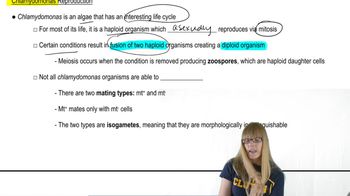
Unfavorable environmental conditions such as high salt, abnormal pH, or temperature trigger the fusion of two haploid Chlamydomonas cells. This fusion creates a diploid organism.
Why are Chlamydomonas gametes called isogametes?
Chlamydomonas gametes are called isogametes because they are morphologically indistinguishable under a microscope. Despite looking identical, they have internal differences that determine mating type.
What must be true of the mating types for Chlamydomonas cells to successfully fuse?
Chlamydomonas cells must be of opposite mating types, MT+ and MT-, to successfully fuse. Only these combinations can mate and form a diploid organism.
 Back
Back

 02:56
02:56