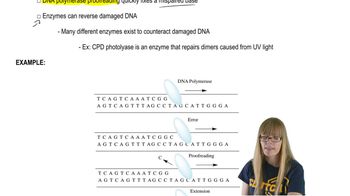
How does DNA polymerase help prevent mutations during DNA replication?
DNA polymerase helps prevent mutations by proofreading newly added nucleotides, excising incorrectly paired bases, and replacing them with the correct ones during DNA replication.
Which vitamin is involved in DNA repair processes?
Vitamin B3 (niacin) is involved in DNA repair processes, as it is a precursor for NAD+, which is required for the activity of some DNA repair enzymes.
What is the role of mismatch repair in maintaining DNA integrity?
Mismatch repair corrects errors such as insertions or deletions that occur during DNA replication by identifying the newly synthesized, unmethylated DNA strand and repairing the mismatched bases.
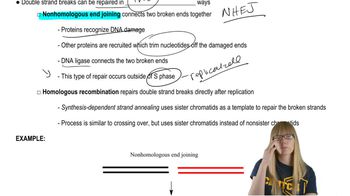
Describe the difference between non-homologous end joining and homologous recombination in repairing double-strand DNA breaks.
Non-homologous end joining simply joins broken DNA ends together, potentially losing genetic information, while homologous recombination uses a sister chromatid as a template to accurately repair the break, preserving genetic information.
What specific enzyme repairs UV-induced dimers in DNA?
CPD photolyase repairs dimers caused by UV light exposure. This enzyme directly reverses the damage by breaking the bonds between the dimerized bases.
In base excision repair, what is the role of DNA glycosylases?
DNA glycosylases recognize and remove damaged bases from the DNA backbone. This creates an abasic site that is further processed by other enzymes in the pathway.
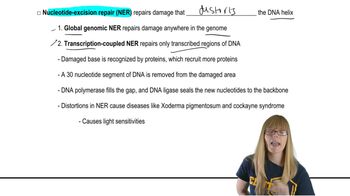
How does nucleotide excision repair differ in its global and transcription-coupled forms?
Global nucleotide excision repair targets lesions anywhere in the genome, while transcription-coupled repair specifically fixes damage in actively transcribed regions. Both pathways ultimately remove a segment of about 30 nucleotides and fill the gap.
What is a major consequence of defects in the nucleotide excision repair pathway?
Defects in nucleotide excision repair can lead to diseases like xeroderma pigmentosum. Individuals with these defects are highly sensitive to UV light and prone to skin cancers.
Why is translesion synthesis considered a last-resort DNA repair mechanism?
Translesion synthesis is used when other repair pathways cannot resolve DNA damage that stalls replication. It is error-prone and lacks proofreading, often introducing additional mutations.
During homologous recombination for double-strand break repair, what template is used to restore the lost DNA sequence?
The sister chromatid is used as a template during homologous recombination to accurately repair the break. This ensures that the original genetic information is restored.
 Back
Back

 01:45
01:45