What is the difference between the sugars in DNA and RNA at the 2' carbon position?
DNA has a hydrogen at the 2' carbon, while RNA has a hydroxyl group at the same position. This difference affects the properties of DNA and RNA.
Which components make up a nucleotide in DNA?
A nucleotide consists of a phosphate group, a deoxyribose sugar, and a nitrogenous base. These three components are essential for DNA structure.
What is the structural difference between purines and pyrimidines?
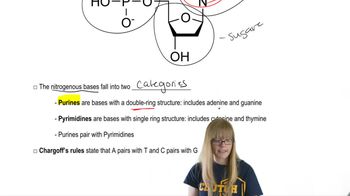
Purines have a double-ring structure, while pyrimidines have a single-ring structure. Adenine and guanine are purines, and cytosine and thymine are pyrimidines.
How do nucleosides differ from nucleotides?
Nucleosides contain only a base and a sugar, while nucleotides also include a phosphate group. This distinction is important in DNA chemistry.
What type of bond connects nucleotides within a single DNA strand?
Phosphodiester bonds connect nucleotides within a single DNA strand. These bonds form the backbone of the DNA molecule.
How many hydrogen bonds form between guanine and cytosine in DNA?
Three hydrogen bonds form between guanine and cytosine. This makes GC pairs stronger than AT pairs, which have only two hydrogen bonds.
What does it mean that DNA strands are antiparallel?
Antiparallel means one DNA strand runs 5' to 3' while the complementary strand runs 3' to 5'. This orientation is crucial for DNA structure and function.
What are the major and minor grooves in the DNA double helix?
The major groove is larger and contains more base pair interactions, while the minor groove is smaller. These grooves are structural features of the double helix.
Which base pairs are formed according to Chargaff's rules in DNA?
Adenine pairs with thymine, and cytosine pairs with guanine. These pairings maintain consistent base ratios in DNA across organisms.
 Back
Back
 06:25
06:25