Skip to main content
Genetics
My Course
Learn
Exam Prep
AI Tutor
Study Guides
Textbook Solutions
Flashcards
Explore
Try the app
My Course
Learn
Exam Prep
AI Tutor
Study Guides
Textbook Solutions
Flashcards
Explore
Try the app
Back
Epigenetics, Chromatin Modifications, and Regulation definitions
You can tap to flip the card.
Epigenetics
You can tap to flip the card.
👆
Epigenetics
Heritable changes in gene expression caused by mechanisms other than alterations in the DNA sequence, often involving chromatin structure.
Track progress
Control buttons has been changed to "navigation" mode.
1/15
Related flashcards
Related practice
Recommended videos
Epigenetics, Chromatin Modifications, and Regulation quiz #1
Epigenetics, Chromatin Modifications, and Regulation
15 Terms
Epigenetics, Chromatin Modifications, and Regulation
13. Gene Regulation in Eukaryotes
7 problems
Topic
Kylia
Post Translational Modifications
13. Gene Regulation in Eukaryotes
4 problems
Topic
Kylia
13. Gene Regulation in Eukaryotes
4 topics
11 problems
Chapter
Kylia
Guided course
02:51
Other Chromatin Modifications
1450
views
12
rank
3
comments
Guided course
07:55
Histone Protein Modifications
1876
views
15
rank
1
comments
Guided course
04:35
Chromatin
2015
views
16
rank
1
comments
Terms in this set (15)
Hide definitions
Epigenetics
Heritable changes in gene expression caused by mechanisms other than alterations in the DNA sequence, often involving chromatin structure.
Chromatin
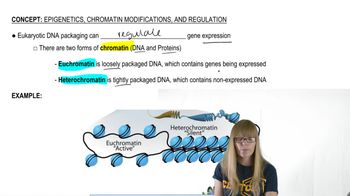
A complex of DNA and proteins that packages genetic material, influencing accessibility for gene expression.
Euchromatin
A loosely packaged chromatin state that allows proteins to access DNA, enabling active gene transcription.
Heterochromatin
A tightly packaged chromatin state that restricts protein access, resulting in gene silencing.
Chromatin Remodeling
The repositioning of nucleosomes along DNA to expose or hide regions, such as promoters, affecting transcription.
Nucleosome
A structural unit of chromatin, consisting of DNA wrapped around histone proteins, determining DNA packaging.
Histone Protein
A core protein component of nucleosomes, possessing tails that can be chemically modified to regulate chromatin structure.
Acetylation
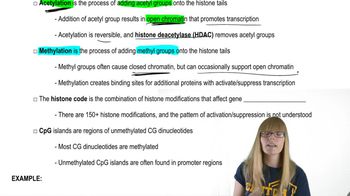
The addition of acetyl groups to histone tails, generally resulting in open chromatin and increased gene expression.
Methylation
The addition of methyl groups to histone tails, usually leading to closed chromatin and gene repression, but with context-dependent effects.
Histone Code
The complex pattern of over 150 possible histone modifications that collectively influence gene activation or suppression.
Histone Variant
A rare, non-standard histone protein found in specific chromosomal regions, potentially altering chromatin structure and gene regulation.
CpG Island
A DNA region rich in unmethylated CG dinucleotides, often located near promoters and associated with active gene expression.
SWI/SNF Complex
A multi-protein assembly responsible for repositioning nucleosomes during chromatin remodeling to regulate gene accessibility.
X Inactivation
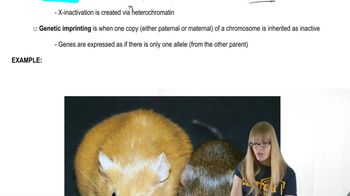
A process in female mammals where one X chromosome becomes transcriptionally silent, forming a Barr body to balance gene dosage.
Genetic Imprinting
A phenomenon where only one parental allele is expressed due to chromosomal inactivation, impacting phenotype despite identical DNA.
 BackBack
 02:51
02:51