Skip to main content
Genetics
My Course
Learn
Exam Prep
AI Tutor
Study Guides
Textbook Solutions
Flashcards
Explore
Try the app
My Course
Learn
Exam Prep
AI Tutor
Study Guides
Textbook Solutions
Flashcards
Explore
Try the app
Back
Eukaryotic Chromosome Structure definitions
You can tap to flip the card.
Chromatin
You can tap to flip the card.
👆
Chromatin
A complex of DNA and proteins that enables efficient packaging and organization within the nucleus.
Track progress
Control buttons has been changed to "navigation" mode.
1/15
Related flashcards
Related practice
Recommended videos
Eukaryotic Chromosome Structure quiz #1
Eukaryotic Chromosome Structure
39 Terms
Eukaryotic Chromosome Structure
7. DNA and Chromosome Structure
7 problems
Topic
Kylia
Bacterial and Viral Chromosome Structure
7. DNA and Chromosome Structure
5 problems
Topic
Kylia
7. DNA and Chromosome Structure
6 topics
14 problems
Chapter
Kylia
Guided course
07:10
Chromosome Structure
2563
views
30
rank
Guided course
03:07
Supercoiling
1868
views
14
rank
4
comments
Terms in this set (15)
Hide definitions
Chromatin
A complex of DNA and proteins that enables efficient packaging and organization within the nucleus.
Heterochromatin
A densely packed chromatin form, typically found in regions like centromeres, associated with gene silencing.
Euchromatin
A loosely packed chromatin form, allowing greater accessibility for gene expression.
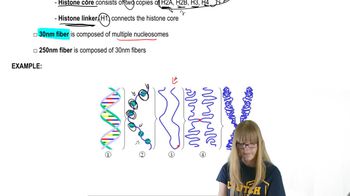
Nucleosome
A structural unit of chromatin, consisting of DNA wrapped around a histone protein core.
Histone
A family of proteins forming the core around which DNA coils, crucial for chromatin structure and compaction.
30 Nanometer Fiber
A higher-order chromatin structure formed by tightly packed nucleosomes, enhancing DNA condensation.
Centromere
A constricted chromosome region rich in heterochromatin, essential for proper segregation during cell division.
Kinetochore
A protein complex assembled on the centromere, serving as the attachment site for spindle fibers.
Telomere
A chromosome end structure with repetitive sequences and a G-rich overhang, protected by specific proteins.
Shelterin
A protein complex that binds telomeric repeats, safeguarding chromosome ends from degradation.
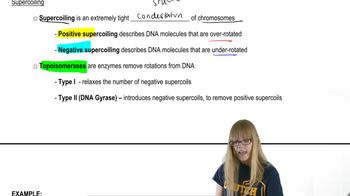
Supercoiling
A state of DNA where over- or under-twisting introduces tension, altering its normal helical structure.
Topoisomerase
An enzyme class that relieves or introduces DNA supercoils by creating transient breaks in the strands.
CENH3
A rare histone variant found exclusively at centromeres, crucial for their unique chromatin structure.
Histone Variant
A non-canonical histone protein, often conferring specialized chromatin properties at specific regions.
G-rich 3' Overhang
A single-stranded DNA extension at telomeres, rich in guanine, important for replication and protection.
 BackBack
 07:10
07:10