Skip to main content
Genetics
My Course
Learn
Exam Prep
AI Tutor
Study Guides
Textbook Solutions
Flashcards
Explore
Try the app
My Course
Learn
Exam Prep
AI Tutor
Study Guides
Textbook Solutions
Flashcards
Explore
Try the app
Back
Meiosis quiz #2
You can tap to flip the card.
Genetically-different __________ are the kind of cells made from meiosis.
You can tap to flip the card.
👆
Genetically-different __________ are the kind of cells made from meiosis.
Genetically-different gametes are made from meiosis.
Track progress
Control buttons has been changed to "navigation" mode.
1/40
Related flashcards
Related practice
Recommended videos
Meiosis quiz #1
Meiosis
40 Terms
Meiosis quiz #3
Meiosis
40 Terms
Meiosis quiz #4
Meiosis
40 Terms
Meiosis
9. Mitosis and Meiosis
7 problems
Topic
Kylia
Development of Animal Gametes
9. Mitosis and Meiosis
4 problems
Topic
Kylia
9. Mitosis and Meiosis
4 topics
10 problems
Chapter
Kylia
Guided course
05:30
Meiosis Overview
2896
views
38
rank
1
comments
Guided course
09:06
Meiosis Steps
2464
views
20
rank
3
comments
Terms in this set (40)
Hide definitions
Genetically-different __________ are the kind of cells made from meiosis.
Genetically-different gametes are made from meiosis.
During which phase do the chromosomes decondense and the two cells fully separate, making 4 haploid cells?
Chromosomes decondense and cells fully separate during telophase II and cytokinesis.
What occurs in meiosis but not in mitosis?
Crossing over and synapsis of homologous chromosomes occur in meiosis but not mitosis.
During which phase do chromosomal centromeres split and chromosomes migrate to opposite ends of the cell?
Centromeres split and chromosomes migrate during anaphase II.
Match the phase of meiosis to the event that occurs in the phase: telophase II.
During telophase II, chromosomes decondense and four haploid cells are formed.
During independent assortment, homologous chromosomes segregate in a random manner. In which phase does this occur?
Independent assortment occurs during metaphase I.
During which phase do synapsis of homologous chromosomes and crossing-over take place?
Synapsis and crossing-over take place during prophase I.
During which phase are sister chromatids separated?
Sister chromatids are separated during anaphase II.
During which process do sister chromatids separate from each other?
Sister chromatids separate from each other during meiosis II (anaphase II).
Crossing over occurs during which phase?
Crossing over occurs during prophase I.
The cell that enters meiosis is ______ with ______ set(s) of chromosomes.
The cell that enters meiosis is diploid with two sets of chromosomes.
Cleavage produces ______ cells.
Cleavage produces four haploid cells in meiosis.
During which stage does each pole contain only one member of the original pair of homologous chromosomes?
Each pole contains one member of the original pair after anaphase I.
Which process results in cells with unique combinations of genetic material?
Meiosis results in cells with unique combinations of genetic material.
How many times does a meiotic spindle form during a single cell's passage through meiosis?
The meiotic spindle forms twice, once in each division.
Homologous chromosomes move toward opposite poles of a dividing cell during which phase?
Homologous chromosomes move toward opposite poles during anaphase I.
Sister chromatids separate from each other during which phase?
Sister chromatids separate during anaphase II.
The homologous chromosomes split up and move toward the opposite ends of the cell during which phase?
Homologous chromosomes split up and move toward opposite ends during anaphase I.
Meiosis results in the production of what type of cells?
Meiosis results in the production of haploid gametes.
During which phase of meiosis do homologous chromosomes separate?
Homologous chromosomes separate during anaphase I.
Homologous pairs of chromosomes align independently at the equator during which phase of meiosis?
Homologous pairs align independently at the equator during metaphase I.
Meiosis occurs in which type of cells?
Meiosis occurs in germ cells.
At which stage of meiosis are sister chromatids separated?
Sister chromatids are separated during anaphase II.
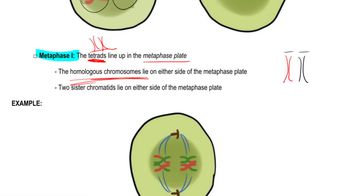
Match the phase of meiosis to the event that occurs in the phase: metaphase I.
During metaphase I, homologous chromosomes (tetrads) align at the metaphase plate.
What happens in meiosis but not mitosis?
Crossing over and synapsis of homologous chromosomes happen in meiosis but not mitosis.
During anaphase I, what happens to homologous chromosomes?
During anaphase I, homologous chromosomes are separated and move to opposite poles.
During meiosis, sister chromatids are held together by what structure?
Sister chromatids are held together by the centromere.
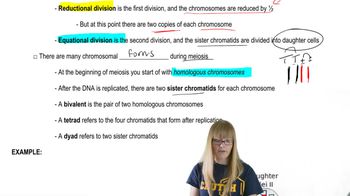
Are there sister chromatids in meiosis?
Yes, sister chromatids are present after DNA replication and during both divisions of meiosis.
Independent assortment of chromosomes occurs during which phase?
Independent assortment occurs during metaphase I.
What separates during anaphase II?
Sister chromatids separate during anaphase II.
Are homologous chromosomes present during metaphase I?
Yes, homologous chromosomes are present and paired as tetrads during metaphase I.
At the end of anaphase I of meiosis I, where are the homologues located?
Homologues have separated and are at opposite poles of the cell.
If the somatic cell of an organism has 22 chromosomes, how many chromosomes will its gametes have?
Its gametes will have 11 chromosomes.
Homologous chromosomes separate and move to opposite ends of the cell during which phase?
Homologous chromosomes separate and move to opposite ends during anaphase I.
In meiosis I during anaphase I, which structures are separated?
Homologous chromosomes are separated during anaphase I.
Sister chromatids are separated from each other during which phase?
Sister chromatids are separated during anaphase II.
A diploid cell divides to produce haploid cells by a process called what?
A diploid cell produces haploid cells by meiosis.
In meiosis I, homologous chromosomes separate, whereas in meiosis II, what happens?
In meiosis II, sister chromatids separate.
Crossing over occurs during the synapsis event of which stage of meiosis?
Crossing over occurs during prophase I.
What is the structure containing four chromatids that forms during meiosis called?
A tetrad is the structure containing four chromatids.
 BackBack
 05:30
05:30