Skip to main content
Genetics
My Course
Learn
Exam Prep
AI Tutor
Study Guides
Textbook Solutions
Flashcards
Explore
Try the app
My Course
Learn
Exam Prep
AI Tutor
Study Guides
Textbook Solutions
Flashcards
Explore
Try the app
Back
Mitosis quiz #1
You can tap to flip the card.
Are chromatids identical copies of each other?
You can tap to flip the card.
👆
Are chromatids identical copies of each other?
Yes, sister chromatids are identical copies of each other, formed during DNA replication in the S phase.
Track progress
Control buttons has been changed to "navigation" mode.
1/40
Related flashcards
Related practice
Recommended videos
Mitosis quiz #2
Mitosis
32 Terms
Mitosis definitions
Mitosis
15 Terms
Mitosis
9. Mitosis and Meiosis
7 problems
Topic
Kylia
Meiosis
9. Mitosis and Meiosis
7 problems
Topic
Kylia
9. Mitosis and Meiosis
4 topics
10 problems
Chapter
Kylia
Guided course
05:02
Mitosis Regulation
2322
views
39
rank
Guided course
09:46
Mitosis Steps
4130
views
61
rank
5
comments
Terms in this set (40)
Hide definitions
Are chromatids identical copies of each other?
Yes, sister chromatids are identical copies of each other, formed during DNA replication in the S phase.
What are the characteristics of cells made by mitosis?
Cells made by mitosis are genetically identical to the parent cell and to each other.
Consider a diploid cell with 2n = 6. In which phase of cell division is this cell in if it has 6 chromosomes and 12 chromatids?
The cell is in prophase or metaphase of mitosis, after DNA replication but before chromatid separation.
How do we refer to a replicated chromosome and its chromatids?
A replicated chromosome consists of two sister chromatids joined at the centromere.
Which process results in the formation of genetically identical cells?
Mitosis results in the formation of genetically identical cells.
How many chromatids are in each replicated chromosome?
Each replicated chromosome has two chromatids.
Which of these correctly distinguishes mitosis from meiosis?
Mitosis produces genetically identical cells, while meiosis produces genetically diverse cells.
How many kinetochores are present in a human cell during mitosis?
There are 46 chromosomes, each with two kinetochores, totaling 92 kinetochores during metaphase.
A great white shark has 82 chromosomes. How many chromosomes will each daughter cell have after mitosis?
Each daughter cell will have 82 chromosomes, identical to the parent cell.
Which chromosomal configuration would be observed in one daughter cell after telophase of mitosis?
Each daughter cell will have the same number and type of chromosomes as the original cell.
Meiosis is responsible for genetic variation while mitosis is responsible for genetic _____________.
Mitosis is responsible for genetic consistency or stability.
Centromeres divide and sister chromatids become full-fledged chromosomes during which phase?
This occurs during anaphase of mitosis.
Sister chromatids are held together by which protein?
Sister chromatids are held together by cohesion proteins.
Centromeres attach ______ to each other.
Centromeres attach sister chromatids to each other.
Which process involves duplication of chromosomes?
Duplication of chromosomes occurs during the S phase of interphase.
The two sister chromatids of a replicated chromosome attach at a point called the
Centromere.
Sister chromatid cohesion is maintained during which process?
Cohesion is maintained during prophase and metaphase, and lost during anaphase.
Duplication of the chromosomes to produce sister chromatids occurs during which phase?
Duplication occurs during the S phase of interphase.
During which phase do sister chromatids separate into individual chromosomes?
Sister chromatids separate during anaphase of mitosis.
If a human somatic cell is in metaphase, it has __________ chromatids.
It has 92 chromatids (46 chromosomes, each with 2 chromatids).
Sister chromatids differ from nonsister chromatids in that sister chromatids __________.
Sister chromatids are identical copies of the same chromosome, while nonsister chromatids are from different homologous chromosomes.
Are sister chromatids present in the G2 phase?
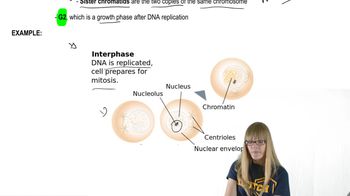
Yes, sister chromatids are present after DNA replication in the G2 phase.
Mitosis results in ______ new cells, each with ______ chromosomes.
Mitosis results in two new cells, each with the same number of chromosomes as the parent cell.
What is the correct chromosomal condition for one daughter nucleus at telophase of mitosis?
Each daughter nucleus has the same number and type of chromosomes as the original cell.
A cell that contains half the original number of chromosomes is called a ______ cell.
A cell with half the original number of chromosomes is called a haploid cell (but this occurs in meiosis, not mitosis).
During prophase, each pair of chromosomes is attached to each other by the _____.
By the centromere and cohesion proteins.
If there are 8 centromeres in metaphase, how many centromeres will be present in anaphase?
There will still be 8 centromeres; centromeres split but their number remains the same.
Sister chromatids are ______.
Sister chromatids are identical copies of a chromosome joined at the centromere.
Centromeres split and sister chromatids are separated from each other only during ___________.
Only during anaphase of mitosis.
Sister chromatids separate to opposite poles during which phase?
During anaphase of mitosis.
The sister chromatids of a replicated chromosome are attached at a specialized region termed the
Centromere.
If a cell has 2n=8, how many chromosomes does it have?
It has 8 chromosomes (assuming diploid).
How many chromatids result at the end of interphase?
After interphase (S phase), each chromosome has two chromatids; so a 2n=8 cell will have 16 chromatids.
Chromosomes are replicated during the ______ phase.
S phase of interphase.
The process that will produce two genetically identical daughter cells is ______.
Mitosis.
During which phase do sister chromatids separate into individual chromosomes?
During anaphase of mitosis.
Does mitosis maintain chromosome number?
Yes, mitosis maintains the chromosome number in daughter cells.
What is the difference between sister chromatids and homologous chromosomes?
Sister chromatids are identical copies of one chromosome; homologous chromosomes are similar but not identical chromosomes from each parent.
During the G1 stage of interphase, a diploid organism contains how many copies of each gene?
Two copies of each gene (one from each homologous chromosome).
How many chromatids are in each new cell after cytokinesis, and before the next round of division?
Each new cell has unreplicated chromosomes, so one chromatid per chromosome.
 BackBack
 05:02
05:02