Pearson+ LogoPearson+ Logo

Organelle DNA quiz #1 Flashcards

Back
Organelle DNA quiz #1
Control buttons has been changed to "navigation" mode.
1/22
  • Which best describes mitochondrial DNA (mtDNA)?

    Mitochondrial DNA is small, circular, and resembles prokaryotic DNA. It is found in mitochondria and is inherited maternally in humans.
  • Eukaryotic chromatin is composed of which of the following macromolecules?

    Eukaryotic chromatin is composed of DNA and proteins, primarily histones.
  • What happens to linear DNA that is not inserted into the bacterial chromosome?

    Linear DNA that is not inserted into the bacterial chromosome is typically degraded and lost, as bacteria usually maintain their DNA in circular form.
  • What is the typical structure of DNA found in most bacterial cells?

    Most bacterial cells contain small, circular DNA molecules known as nucleoids.
  • What term describes the DNA found in all of an organism's chromosomes?

    The term is nuclear DNA, which refers to the DNA present in all of an organism's chromosomes within the nucleus.
  • Prokaryotes can have small self-replicating circular pieces of DNA known as what?

    Prokaryotes can have plasmids, which are small, self-replicating circular DNA molecules.
  • Why do the genes located in mitochondria and chloroplasts not exhibit Mendelian patterns of inheritance?

    Genes in mitochondria and chloroplasts are inherited uniparentally, usually from the mother, rather than following Mendelian inheritance, which involves contributions from both parents.
  • What is the difference between homoplasmic and heteroplasmic cells regarding their DNA sources?

    Homoplasmic cells contain DNA from only one source, while heteroplasmic cells have DNA from both the nucleus and organelles like mitochondria or chloroplasts.
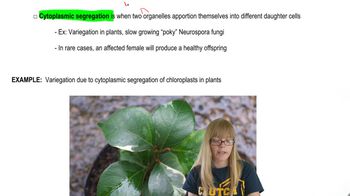
  • How does cytoplasmic segregation contribute to variegation in plants?

    Cytoplasmic segregation causes mutant and normal organelles to be distributed into different daughter cells, resulting in visually distinct regions such as green and white patches in plants.
  • Why is the genetic code in mitochondria and chloroplasts not considered completely universal?

    Some codons are interpreted differently in organelle DNA; for example, the codon AGA codes for serine in fruit fly mitochondria instead of arginine as in the universal code.
  • Which two organelles in eukaryotic cells contain their own DNA?

    Mitochondria and chloroplasts contain their own DNA.
  • What is organelle DNA and which organelles possess it?

    Organelle DNA refers to the genetic material found in mitochondria (mtDNA) and chloroplasts (cpDNA), both of which possess their own DNA.
  • What is included in the term 'extrachromosomal DNA' in eukaryotic cells?

    Extrachromosomal DNA includes DNA found outside the nucleus, specifically in mitochondria and chloroplasts.
  • Which organelles have their own genetic material separate from nuclear DNA?

    Mitochondria and chloroplasts have their own genetic material separate from nuclear DNA.
  • How is mitochondrial DNA (mtDNA) best described in terms of structure and origin?

    Mitochondrial DNA (mtDNA) is small, circular, and resembles prokaryotic DNA, supporting the endosymbiont theory that mitochondria originated from free-living bacteria.
  • What are the unique features of mitochondrial DNA compared to nuclear DNA?

    Mitochondrial DNA is small, circular, has heavy and light chains differing in nucleotide composition, and its genetic code is not entirely universal.
  • From which parent is mitochondrial DNA inherited in humans?

    Mitochondrial DNA is inherited exclusively from the mother in humans.
  • How do nuclear DNA and mitochondrial DNA differ in their inheritance patterns?

    Nuclear DNA is inherited from both parents, while mitochondrial DNA is inherited uniparentally, typically from the mother.
  • How is mitochondrial DNA typing used in forensic science?

    Mitochondrial DNA typing is used in forensic science to trace maternal lineage and identify individuals when nuclear DNA is unavailable or degraded.
  • How is mitochondrial DNA used in scientific research?

    Mitochondrial DNA is used in science to study maternal inheritance, evolutionary relationships, and to investigate diseases caused by mitochondrial mutations.
  • What is the significance of cytoplasmic segregation in organelle DNA inheritance?

    Cytoplasmic segregation can result in cells with different types of organelles, leading to phenomena like variegation in plants and affecting inheritance of organelle DNA.
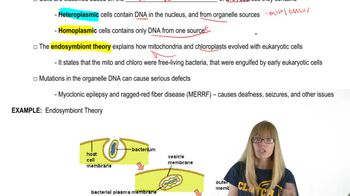
  • Why do mitochondria and chloroplasts have their own DNA according to the endosymbiont theory?

    According to the endosymbiont theory, mitochondria and chloroplasts have their own DNA because they originated as free-living prokaryotic cells that were engulfed by ancestral eukaryotic cells.