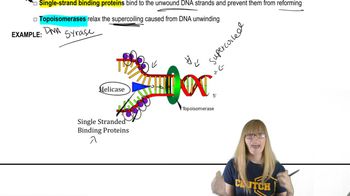
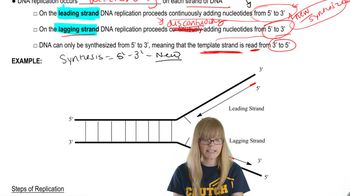
The product of DNA replication is two identical double-stranded DNA molecules, each consisting of one old (template) strand and one newly synthesized strand.
What does DNA replication produce?
DNA replication produces two identical copies of DNA, ensuring that each daughter cell receives a complete set of genetic information.
When is the DNA of the cell's chromosomes copied?
The DNA of the cell's chromosomes is copied during the S phase of the cell cycle, prior to cell division.
What are the stages of DNA replication?
The stages of DNA replication include unwinding the double helix, stabilizing single strands, synthesizing RNA primers, elongating new DNA strands, replacing RNA primers with DNA, and joining Okazaki fragments.
What does primase synthesize during DNA replication?
Primase synthesizes short RNA primers that provide a starting point for DNA polymerase to begin DNA synthesis.
Which cluster of terms accurately reflects the nature of DNA replication in prokaryotes?
Semi-conservative, bidirectional, and involves enzymes such as DNA helicase, primase, DNA polymerase III, DNA polymerase I, and DNA ligase.
At the completion of DNA replication, what is the result?
At the completion of DNA replication, each chromosome consists of two identical DNA molecules, each with one old and one new strand.
During DNA replication, a DNA strand that has the bases CTAGGT produces a strand with the bases:
GATCCA (complementary base pairing: C-G, T-A, A-T, G-C, G-C, T-A).
DNA coils tightly during division and assembles into visible structures called:
Chromosomes.
When the DNA strands begin to separate, they form this structure where replication begins:
Replication fork.
When nucleotides polymerize to form a nucleic acid, what type of bond is formed?
Phosphodiester bonds are formed between nucleotides during nucleic acid polymerization.
The first DNA base used as a template for RNA synthesis is called the _____ site.
Initiation site.
An old DNA strand is used as a _____ for the assembly of a new DNA strand.
Template.
The copying of the information in DNA is efficient because:
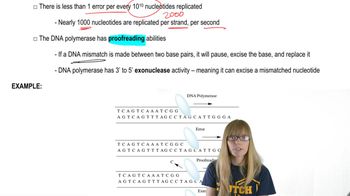
DNA polymerase has proofreading abilities and accessory proteins that ensure high fidelity and rapid synthesis.
Which protein stabilizes the DNA molecule during replication?
Single-strand binding proteins stabilize the unwound DNA during replication.
When does DNA replication occur in the cell cycle?
DNA replication occurs during the S phase of interphase.
What type of biological molecule is DNA helicase?
DNA helicase is a protein enzyme.
Which enzyme unzips DNA to prepare for replication?
DNA helicase unzips DNA by breaking hydrogen bonds between strands.
What is the enzyme that unzips the DNA to prepare for replication?
DNA helicase is the enzyme that unzips DNA for replication.
What is the role of helicase in DNA replication?
Helicase unwinds the double helix by breaking hydrogen bonds between DNA strands.
What is the role of DNA polymerase in DNA replication?
DNA polymerase synthesizes new DNA strands by adding nucleotides to the growing chain.
Which enzyme initiates the synthesis of DNA by creating a short RNA segment?
Primase initiates DNA synthesis by creating a short RNA primer.
What is the purpose of DNA replication?
The purpose of DNA replication is to produce two identical copies of DNA for cell division.
What are the fragments of copied DNA created on the lagging strand called?
The fragments are called Okazaki fragments.
Describe the role of helicase in DNA replication.
Helicase unwinds the DNA double helix by breaking hydrogen bonds, allowing replication to proceed.
What is the purpose of DNA replication?
DNA replication ensures that each daughter cell receives an identical copy of genetic material.
What is the function of topoisomerase in DNA replication?
Topoisomerase prevents supercoiling by cutting and rejoining DNA strands to relieve tension.
In which phase does DNA replication occur?
DNA replication occurs during the S phase of interphase.
What is the role of helicase in DNA replication?
Helicase unwinds the DNA double helix by breaking hydrogen bonds between the strands.
What are the sites where DNA replication and separation occur called?
These sites are called origins of replication.
What is the function of helicase in DNA replication?
Helicase unwinds the DNA double helix by breaking hydrogen bonds.
What is the process of copying DNA called?
The process is called DNA replication.
What is the function of the enzyme DNA polymerase?
DNA polymerase synthesizes new DNA strands and proofreads for errors.
What is the purpose of DNA replication?
DNA replication allows cells to divide and pass on genetic information to daughter cells.
What is the first step in eukaryotic DNA replication?
The first step is unwinding the double helix by DNA helicase.
What is the purpose of DNA replication?
To ensure each new cell has a complete set of genetic instructions.
What enzyme unzips the DNA?
DNA helicase unzips the DNA.
What does a DNA polymerase do?
DNA polymerase adds complementary nucleotides to synthesize new DNA strands.
Why is DNA replication necessary?
DNA replication is necessary for cell division and the transmission of genetic information.
 Back
Back
 02:35
02:35