What is the overall goal of gene expression in the context of proteins?
The overall goal of gene expression is to produce proteins, which are composed of amino acids linked in polypeptide chains and perform various functions in the cell.
Which chemical element is found in both DNA and proteins?
Nitrogen is found in both DNA and proteins.
In genetics, DNA acts as a recipe book for making what type of biological molecule?
DNA acts as a recipe book for making proteins.
What are the two main classes of protein shapes described in the video?
The two main classes are globular proteins, which are compact, and fibrous proteins, which are linear. These shapes are important for the proteins' biological functions.
What is the significance of the R group in an amino acid?
The R group determines the properties of each amino acid, such as being nonpolar, polar, or charged. These properties influence how the protein folds and functions.
What is the difference between parallel and antiparallel beta sheets in protein secondary structure?
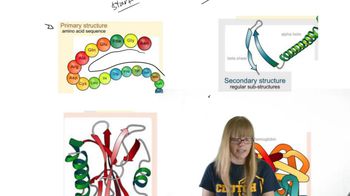
Parallel beta sheets have strands running in the same direction, while antiparallel beta sheets have strands running in opposite directions. This orientation affects the local structure of the protein.
What is the role of chaperone proteins in protein folding?
Chaperone proteins assist other proteins in folding correctly. They help prevent misfolding and ensure proper protein function.
What structural level of a protein involves the 3D arrangement of multiple polypeptide chains?
The quaternary structure involves the 3D arrangement of multiple polypeptide chains. This level contributes to the protein's overall function and stability.
What are protein domains and why are they important?
Protein domains are specific structural regions within a protein that perform particular functions. For example, enzyme active sites can be domains with specialized roles.
Which ends are present in every protein polypeptide chain and what do they represent?
Every protein has an amino (N-terminus) and a carboxyl (C-terminus) end. These represent the start and end of the polypeptide chain, respectively.
 Back
Back
 05:05
05:05