Skip to main content
Genetics
My Course
Learn
Exam Prep
AI Tutor
Study Guides
Textbook Solutions
Flashcards
Explore
Try the app
My Course
Learn
Exam Prep
AI Tutor
Study Guides
Textbook Solutions
Flashcards
Explore
Try the app
Back
Telomeres and Telomerase definitions
You can tap to flip the card.
Telomere
You can tap to flip the card.
👆
Telomere
Protective DNA sequence at chromosome ends, composed of many non-coding repeats, preventing loss of genetic information during replication.
Track progress
Control buttons has been changed to "navigation" mode.
1/13
Related flashcards
Related practice
Recommended videos
Telomeres and Telomerase quiz #1
Telomeres and Telomerase
12 Terms
Telomeres and Telomerase
8. DNA Replication
4 problems
Topic
Kylia
Recombination
8. DNA Replication
4 problems
Topic
Nicole
8. DNA Replication
4 topics
9 problems
Chapter
Kylia
Guided course
08:38
Telomeres and Telomerase
2414
views
22
rank
6
comments
Terms in this set (13)
Hide definitions
Telomere
Protective DNA sequence at chromosome ends, composed of many non-coding repeats, preventing loss of genetic information during replication.
Telomerase
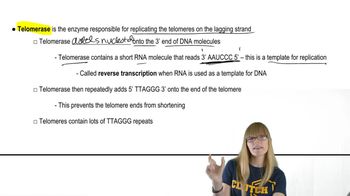
Enzyme containing an RNA template, responsible for adding repetitive DNA sequences to chromosome ends, maintaining their length.
Chromosome
Linear DNA structure in cells, carrying genetic information, with specialized ends requiring unique replication mechanisms.
Lagging Strand
DNA strand synthesized discontinuously during replication, forming Okazaki fragments and facing challenges at chromosome ends.
Okazaki Fragment
Short DNA segment produced on the lagging strand, initiated by RNA primers, essential for complete DNA replication.
RNA Primer
Short RNA sequence providing a starting point for DNA polymerase to synthesize new DNA strands during replication.
Reverse Transcription
Process where RNA serves as a template for synthesizing DNA, as seen in telomerase activity at chromosome ends.
DNA Polymerase
Enzyme that extends DNA strands by adding nucleotides, requiring a primer to initiate synthesis.
Germ Cell
Reproductive cell type, such as egg or sperm, containing high telomerase levels to ensure intact chromosomes for offspring.
Somatic Cell
Non-reproductive body cell, typically with little or no telomerase, leading to gradual telomere shortening and aging.
Senescence
Cellular state where division ceases due to critically short telomeres, resulting in old, non-replicating cells.
Repetitive Sequence
Non-coding DNA motif, such as TTA GGG, added repeatedly to chromosome ends to prevent genetic loss.
Aging
Biological process influenced by telomere shortening in somatic cells, contributing to cell death and tissue renewal limits.
 BackBack

 08:38
08:38