A codon is defined as a sequence of three nucleotides in DNA or mRNA that codes for a specific amino acid.
How does DNA code for proteins?
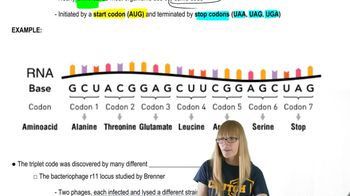
DNA codes for proteins by using sequences of three nucleotides (codons) that are transcribed into mRNA and then translated into amino acids, forming a polypeptide chain.
How many genetic codes are used by life on Earth?
Life on Earth uses a nearly universal genetic code, with only minor variations in a few organisms and organelles.
Which part of DNA provides the code for proteins?
The sequence of nucleotides in the coding regions of DNA provides the code for proteins.
What does it mean that the genetic code is non-overlapping?
It means that each nucleotide is part of only one codon and codons are read in discrete groups of three. This ensures that each triplet codes for only one amino acid without sharing nucleotides with adjacent codons.
How did Brenner's experiments with bacteriophages demonstrate the importance of reading frames?
Brenner showed that single nucleotide mutations could disrupt the reading frame, altering the resulting protein. He also found that adding or removing a nucleotide could restore the original reading frame, partially reverting the phenotype.
What is the significance of RNA homopolymers in deciphering the genetic code?
RNA homopolymers, which are synthetic RNAs made of repeating single nucleotides, were used to determine which codons correspond to specific amino acids. By translating these homopolymers, scientists could directly link codon sequences to amino acids.
Why is the genetic code described as degenerate?
The code is called degenerate because there are more codons (64) than amino acids (20), so multiple codons can specify the same amino acid. This redundancy helps protect against some mutations.
What role do start and stop codons play in translation?
The start codon (AUG) signals where translation begins, while stop codons (UAA, UAG, UGA) signal where translation ends. These codons ensure proteins are synthesized with the correct sequence and length.
How did the discovery of the triplet code impact our understanding of protein synthesis?
It allowed scientists to predict which nucleotide sequences would produce specific proteins. This understanding was crucial for advances in genetics and molecular biology.
 Back
Back
 11:43
11:43