Examples of traits include human height (continuous trait), flower color (categorical trait), number of spots on a Dalmatian (categorical counting trait), and human weight (continuous trait).
Which trait among eye color, blood type, a tiger's stripes, and a scar is an acquired trait?
A scar is an acquired trait; the others (eye color, blood type, tiger's stripes) are inherited traits.
Which trait is Lisa most likely to inherit from her mother?
Lisa is most likely to inherit genetically determined traits such as eye color, hair color, or blood type from her mother.
The traits of an organism are controlled by its _______.
The traits of an organism are controlled by its genes and, in some cases, environmental factors.
What distinguishes a threshold trait from other categorical traits?
Threshold traits require a combination of genetic and environmental factors to be expressed, and only individuals who reach a certain threshold will show the trait.
How do additive and non-additive alleles differ in polygenic inheritance?
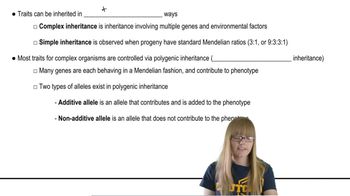
Additive alleles contribute to the phenotype when present, while non-additive alleles do not affect the phenotype.
Why does the F2 generation in a polygenic cross often show more phenotypic variation than the parental generation?
The F2 generation displays a range of phenotypes due to different combinations of additive alleles from multiple genes, unlike the uniform parental phenotypes.
What formula is used to determine the number of genes involved in a polygenic trait based on parental phenotype ratios?
The formula is 1/4^n = ratio of parental phenotypes, where n is the number of genes involved.
How can you calculate the number of phenotypic categories in the F2 generation for a trait controlled by multiple genes?
Use the formula 2n + 1, where n is the number of polygenes controlling the trait.
In the corn color example, what determines whether a kernel is purple, dark red, red, light red, or white?
The number of additive alleles present in the genotype determines the kernel color, with more additive alleles resulting in darker colors.
What is the difference between single gene (simple) traits and polygenic (complex) traits in genetics?
Single gene traits are controlled by one gene and typically show Mendelian inheritance patterns, resulting in discrete phenotypes. Polygenic traits are influenced by multiple genes, each contributing additively or non-additively to the phenotype, and often result in a continuous range of phenotypes.
What is polygenic inheritance?
Polygenic inheritance is a type of complex inheritance where multiple genes contribute to a single trait, with each gene's alleles adding to or not affecting the phenotype. This often produces a continuous range of phenotypes rather than discrete categories.
What is an example of polygenic inheritance?
Human height is an example of polygenic inheritance, as it is influenced by multiple genes, each contributing to the overall phenotype.
What factors affect the phenotype of an organism?
Phenotype is affected by both genetic factors (such as the number and type of genes involved) and environmental factors, which can interact to produce the observed traits.
Give an example of polygenic inheritance and explain how it is identified.
An example of polygenic inheritance is the color of corn kernels resulting from crossing white and purple corn. In the F2 generation, a variety of phenotypes appear based on the number of additive alleles present, rather than a simple Mendelian ratio, indicating polygenic inheritance.
 Back
Back

 13:40
13:40