Skip to main content
Genetics
My Course
Learn
Exam Prep
AI Tutor
Study Guides
Textbook Solutions
Flashcards
Explore
Try the app
My Course
Learn
Exam Prep
AI Tutor
Study Guides
Textbook Solutions
Flashcards
Explore
Try the app
Back
Transduction definitions
You can tap to flip the card.
Transduction
You can tap to flip the card.
👆
Transduction
A process where a bacteriophage transfers foreign DNA into a bacterium, enabling genetic exchange between bacterial cells.
Track progress
Control buttons has been changed to "navigation" mode.
1/15
Related flashcards
Related practice
Recommended videos
Transduction quiz #1
Transduction
11 Terms
Transduction
5. Genetics of Bacteria and Viruses
3 problems
Topic
Kylia
Bacteriophage Genetics
5. Genetics of Bacteria and Viruses
7 problems
Topic
Kylia
5. Genetics of Bacteria and Viruses
5 topics
13 problems
Chapter
Kylia
Guided course
05:53
Transduction
1402
views
5
rank
Terms in this set (15)
Hide definitions
Transduction
A process where a bacteriophage transfers foreign DNA into a bacterium, enabling genetic exchange between bacterial cells.
Bacteriophage
A virus capable of infecting bacteria and facilitating the transfer of genetic material between bacterial cells.
Generalized Transduction
A mechanism where any segment of bacterial DNA can be transferred by a phage after bacterial lysis.
Specialized Transduction
A process where only specific bacterial genes near a phage insertion site are transferred to another cell.
Cotransduction
The simultaneous transfer of two or more genes by a single bacteriophage, useful for mapping gene proximity.
Cotransduction Frequency
A measure indicating how often two genes are transferred together, reflecting their physical closeness on the chromosome.
Gene Mapping
A technique using cotransduction frequencies to determine the relative positions of genes on a bacterial chromosome.
Gene Linkage
The tendency of genes located close together on a chromosome to be inherited together during transduction.
Lysed Bacterium
A bacterial cell that has been broken open, releasing its DNA into the environment for potential uptake by phages.
Transducer
A phage element that inserts into a specific bacterial chromosome site, enabling the transfer of adjacent genes.
Mutant Strain
A bacterial variant with genetic alterations, often used in experiments to study DNA transfer mechanisms.
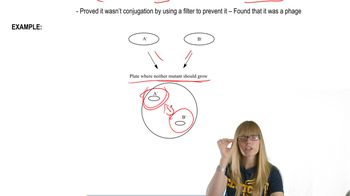
Filter
A barrier used in experiments to block cell-to-cell contact, allowing only small particles like viruses to pass through.
Chromosome
A DNA molecule within bacteria that carries genetic information, segments of which can be transferred by phages.
Recombination Frequency
A value previously used to estimate gene distances, now complemented by cotransduction frequency in mapping studies.
E. coli
A model bacterial species frequently used in genetic experiments to study DNA transfer processes like transduction.
 BackBack
 05:53
05:53