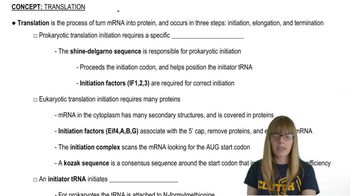
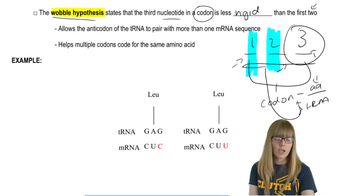
When does translation stop during protein synthesis?
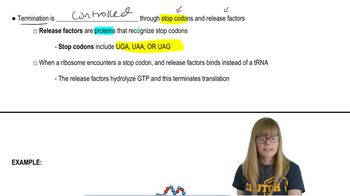
Translation stops when the ribosome encounters a stop codon on the mRNA, which is recognized by release factors that trigger the release of the completed polypeptide chain.
Which process is not a step in translation: initiation, elongation, replication, or termination?
Replication is NOT a step in translation; the steps are initiation, elongation, and termination.
What occurs during translation in the process of gene expression?
During translation, the mRNA sequence is decoded by ribosomes and tRNAs to synthesize a polypeptide chain (protein).
What is the role of the ribosome (rRNA) during translation?
The ribosome (rRNA) facilitates the decoding of mRNA, positions tRNAs, and catalyzes the formation of peptide bonds between amino acids during translation.
Which nucleic acid is translated to make a protein?
Messenger RNA (mRNA) is translated to make a protein.
How many tRNAs are required to translate the DNA template sequence GTTCTGTGGGCTACT into amino acids?
Five tRNAs are required, as the sequence codes for five codons (each codon requires a tRNA).
What is the process called in which an mRNA sequence is decoded to produce a polypeptide chain?
This process is called translation.
What pairs with an mRNA codon during translation?
A tRNA molecule with a complementary anticodon pairs with an mRNA codon during translation.
During translation termination, which codon does the ribosome interact with?
Translation termination occurs when a ribosome interacts with a stop codon.
Translation is the synthesis of what molecule?
Translation is the synthesis of a polypeptide (protein) from an mRNA template.
Which types of RNA are involved in protein synthesis during translation?
The types of RNA involved in protein synthesis during translation are messenger RNA (mRNA), transfer RNA (tRNA), and ribosomal RNA (rRNA).
What is the process called in which a protein is assembled from RNA?
The process of assembling a protein from RNA is called translation.
What is the final product of gene expression?
The final product of gene expression is a protein.
Does the enzyme RNA polymerase participate in translation?
No, RNA polymerase does not participate in translation; it is involved in transcription, the process of synthesizing RNA from DNA.
What is the product of gene expression?
The product of gene expression is a protein.
What types of RNA are involved in the process of translation?
Messenger RNA (mRNA), transfer RNA (tRNA), and ribosomal RNA (rRNA) are involved in translation.
If DNA makes RNA, what does RNA make?
RNA makes protein through the process of translation.
Which RNA types are involved in translation?
The RNA types involved in translation are mRNA, tRNA, and rRNA.
Which types of RNA are involved in translation?
Messenger RNA (mRNA), transfer RNA (tRNA), and ribosomal RNA (rRNA) are involved in translation.
Where does translation of DNA-derived mRNA take place in eukaryotic cells?
Translation of DNA-derived mRNA takes place in the cytoplasm of eukaryotic cells.
 Back
Back
 01:55
01:55