Skip to main content
Genetics
My Course
Learn
Exam Prep
AI Tutor
Study Guides
Textbook Solutions
Flashcards
Explore
Try the app
My Course
Learn
Exam Prep
AI Tutor
Study Guides
Textbook Solutions
Flashcards
Explore
Try the app
Back
Types of Mutations quiz #2
You can tap to flip the card.
Which type of mutation always produces a stop codon?
You can tap to flip the card.
👆
Which type of mutation always produces a stop codon?
A nonsense mutation always produces a stop codon.
Track progress
Control buttons has been changed to "navigation" mode.
1/29
Related flashcards
Related practice
Recommended videos
Types of Mutations quiz #1
Types of Mutations
40 Terms
Types of Mutations definitions
Types of Mutations
30 Terms
Types of Mutations
17. Mutation, Repair, and Recombination
7 problems
Topic
Kylia
Spontaneous Mutations
17. Mutation, Repair, and Recombination
4 problems
Topic
Kylia
17. Mutation, Repair, and Recombination
4 topics
10 problems
Chapter
Nicole
Guided course
03:49
Base Distortions
2054
views
23
rank
2
comments
Guided course
09:49
Point Mutations
2780
views
47
rank
Guided course
10:48
Mutations and Phenotypes
1977
views
27
rank
Terms in this set (29)
Hide definitions
Which type of mutation always produces a stop codon?
A nonsense mutation always produces a stop codon.
How is a mutation best described?
A mutation is any change in the nucleotide sequence of DNA.
Which mutation could be passed on to future generations?
Germ cell mutations can be passed on to future generations.
Which type of mutation is responsible for causing Tay-Sachs disease?
A frameshift mutation is responsible for causing Tay-Sachs disease.
What would result in a frameshift mutation?
An insertion or deletion of nucleotides not in multiples of three results in a frameshift mutation.
What is an example of a neutral mutation?
A silent mutation is an example of a neutral mutation.
What is the difference between a nonsense and missense mutation?
A nonsense mutation introduces a stop codon, ending translation, while a missense mutation changes one amino acid to another.
What is a substitution mutation?
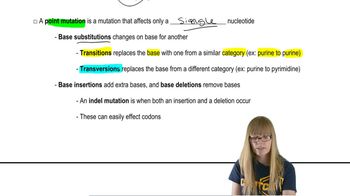
A substitution mutation is a point mutation where one base is replaced by another.
What is the difference between missense and nonsense mutation?
Missense mutations change the amino acid sequence, while nonsense mutations introduce a stop codon.
What is a silent mutation?
A silent mutation changes a nucleotide but does not alter the amino acid sequence of the protein.
What is missense mutation in biology?
A missense mutation changes a codon so that it codes for a different amino acid.
What is a frameshift mutation?
A frameshift mutation alters the reading frame of the genetic code by inserting or deleting nucleotides not in multiples of three.
What could be a good effect of a mutation?
A mutation could be beneficial if it increases an organism's fitness or provides a new advantageous trait.
How does a frameshift mutation affect the protein?
A frameshift mutation changes the reading frame, resulting in a completely different and often nonfunctional protein.
How can a mutation be helpful?
A mutation can be helpful if it leads to a beneficial trait, such as resistance to disease or adaptation to the environment.
How might a mutation be beneficial to an organism?
A mutation may be beneficial if it provides an advantage, such as improved survival or reproduction.
Which is a frameshift mutation?
An insertion or deletion of nucleotides not in multiples of three is a frameshift mutation.
Which mutation will cause translation to stop?
A nonsense mutation will cause translation to stop by introducing a stop codon.
Which is an example of a beneficial mutation?
A mutation that confers resistance to a disease or environmental stress is an example of a beneficial mutation.
The SNP resulted from what type of mutation?
A SNP (single nucleotide polymorphism) results from a point mutation, specifically a base substitution.
What is the difference between a point mutation and a frameshift mutation?
A point mutation changes a single nucleotide, while a frameshift mutation alters the reading frame by inserting or deleting nucleotides.
What is a neutral mutation?
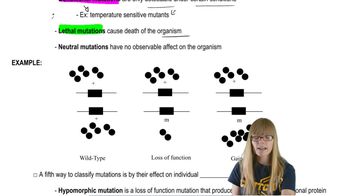
A neutral mutation has no observable effect on the organism's phenotype.
What is a missense mutation?
A missense mutation changes a codon so that it codes for a different amino acid.
What is a nonsense mutation?
A nonsense mutation changes a codon to a stop codon, terminating translation prematurely.
What is a germ cell mutation?
A germ cell mutation occurs in reproductive cells and can be passed to offspring.
What is a somatic cell mutation?
A somatic cell mutation occurs in non-reproductive cells and affects only the individual.
What is a suppressor mutation?
A suppressor mutation reduces or blocks the effect of another mutation, and can be intragenic or intergenic.
What is a loss of function mutation?
A loss of function mutation reduces or eliminates the activity of a protein.
What is a gain of function mutation?
A gain of function mutation increases the activity or efficiency of a protein, or gives it a new function.
 BackBack


 03:49
03:49