Skip to main content
Genetics
My Course
Learn
Exam Prep
AI Tutor
Study Guides
Textbook Solutions
Flashcards
Explore
Try the app
My Course
Learn
Exam Prep
AI Tutor
Study Guides
Textbook Solutions
Flashcards
Explore
Try the app
Back
DNA Replication and Cell Cycle in Genetics
You can tap to flip the card.
What is the cell cycle?
You can tap to flip the card.
👆
What is the cell cycle?
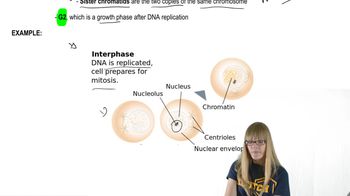
The cell cycle is the series of phases that a eukaryotic cell goes through to grow and divide, including G1, S, G2, and M phases.
Track progress
Control buttons has been changed to "navigation" mode.
1/20
Recommended videos
05:02
Mitosis Regulation
2358
views
39
rank
09:46
Mitosis Steps
4204
views
61
rank
5
comments
Terms in this set (20)
Hide definitions
What is the cell cycle?
The cell cycle is the series of phases that a eukaryotic cell goes through to grow and divide, including G1, S, G2, and M phases.
When does DNA replication occur in the cell cycle?
DNA replication occurs during the S phase of the cell cycle.
What is semiconservative DNA replication?
Semiconservative replication means each new DNA molecule contains one original strand and one newly synthesized strand.
Who experimentally demonstrated semiconservative DNA replication?
Meselson and Stahl (1958) used E. coli grown in heavy and light DNA media to show semiconservative replication.
What does bidirectional replication mean?
Bidirectional replication means DNA synthesis occurs in two directions from each origin, with two replication forks moving away from the origin.
How many origins of replication do eukaryotic chromosomes have?
Eukaryotic chromosomes have multiple origins of replication to speed up genome duplication.
In which direction does DNA polymerase elongate the new DNA strand?
DNA polymerase synthesizes new DNA in the 5' to 3' direction by adding nucleotides to the 3' end.
What is the role of DNA polymerase III in replication?
DNA polymerase III adds nucleotides to the growing DNA strand starting from the RNA primer.
Why is an RNA primer needed in DNA replication?
DNA polymerases cannot start synthesis de novo; they require a primer with a free 3'-OH group to begin DNA synthesis.
What are Okazaki fragments?
Okazaki fragments are short DNA segments synthesized discontinuously on the lagging strand during replication.
Which enzyme removes RNA primers during DNA replication?
DNA polymerase I removes RNA primers by its 5' to 3' exonuclease activity and replaces them with DNA.
What enzyme joins Okazaki fragments together?
DNA ligase seals the gaps between Okazaki fragments by forming phosphodiester bonds.
What is the function of helicase in DNA replication?
Helicase unwinds the double-stranded DNA by breaking hydrogen bonds between bases to separate the strands.
What is the role of DNA gyrase (topoisomerase) during replication?
DNA gyrase relieves supercoiling ahead of the replication fork by cutting and rejoining DNA strands.
What is the difference between continuous and discontinuous DNA synthesis?
The leading strand is synthesized continuously, while the lagging strand is synthesized discontinuously in Okazaki fragments.
What is the significance of the 3' to 5' exonuclease activity of DNA polymerases?
This activity allows DNA polymerases to proofread and correct errors by removing mismatched nucleotides.
What happens during mitosis?
Mitosis is the process where a diploid eukaryotic cell divides to produce two genetically identical diploid daughter cells.
When are chromosomes duplicated in preparation for mitosis?
Chromosomes are duplicated during the S phase before mitosis begins.
What is binary fission in bacteria?
Binary fission is asexual reproduction where bacteria duplicate their circular chromosome and divide into two identical haploid cells.
What is the role of primase in DNA replication?
Primase synthesizes short RNA primers needed to start DNA synthesis on both leading and lagging strands.
 BackBack
 05:02