 Back
BackAdvanced Study Notes: CRISPR/Cas Adaptive Immunity and Gene Regulation in Eukaryotes
Study Guide - Smart Notes
 Tailored notes based on your materials, expanded with key definitions, examples, and context.
Adaptive Immunity in Prokaryotes: CRISPR/Cas System
Overview of CRISPR/Cas Adaptive Immunity
The CRISPR/Cas system is a form of adaptive immunity found in most prokaryotes, providing defense against invading genetic elements such as bacteriophages. Unlike innate immunity, which is non-specific, CRISPR/Cas immunity is acquired and sequence-specific, allowing bacteria and archaea to 'remember' and target previously encountered phages.
CRISPR: Clustered Regularly Interspaced Palindromic Repeats—short, repetitive DNA sequences interspaced with unique 'spacer' sequences derived from invading DNA.
Cas proteins: CRISPR-associated nucleases that mediate the acquisition, processing, and interference steps of the immune response.
First discovered in Escherichia coli in 2005.
Mechanism involves destruction of invading phage DNA upon re-infection.
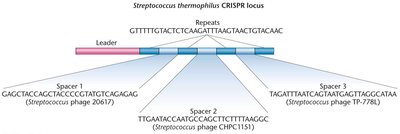
CRISPR/Cas Mechanism: Three Main Steps
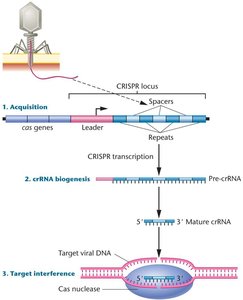
Spacer Acquisition: When a bacteriophage infects a prokaryotic cell, segments of the phage DNA are cleaved and integrated as new spacers into the CRISPR locus. Cas nucleases are essential for this process.
crRNA Biogenesis: The CRISPR locus is transcribed into a long precursor RNA, which is then processed into small CRISPR RNAs (crRNAs), each containing a single spacer flanked by repeat sequences.
Target Interference: Mature crRNAs, in complex with Cas nucleases, guide the complex to complementary sequences in invading DNA. The Cas nuclease cleaves the target DNA, neutralizing the infection.
Gene Regulation in Eukaryotes
Epigenetics and Chromatin Structure
Gene expression in eukaryotes is tightly regulated at multiple levels, beginning with chromatin structure. Epigenetics refers to heritable changes in gene expression that do not involve changes to the DNA sequence itself. Chromatin must be remodeled to allow access for transcriptional machinery.
Chromatin Remodeling: ATP-dependent complexes (e.g., SWI/SNF) reposition nucleosomes to expose regulatory DNA.
Histone Modifications: Acetylation (by HATs), methylation, and phosphorylation of histone tails alter chromatin accessibility.
DNA Methylation: Addition of methyl groups to cytosines (often in CpG islands) generally represses transcription.
Transcriptional Regulation: Cis- and Trans-Acting Elements
Transcription initiation in eukaryotes requires the coordinated action of DNA elements and protein factors:
Cis-acting elements: DNA sequences near or within genes (e.g., promoters, enhancers, silencers) that regulate transcription.
Trans-acting factors: Proteins (e.g., transcription factors, activators, repressors) that bind cis-elements to modulate gene expression.
Promoters and Core Promoter Elements
TATA Box: Located ~-30 bp upstream of the transcription start site; recognized by TFIID.
CAAT Box: Located ~-80 bp; enhances transcription efficiency.
Core Promoter: Minimal sequence required for accurate transcription initiation, including the Inr (initiator), BRE, MTE, and DPE elements.
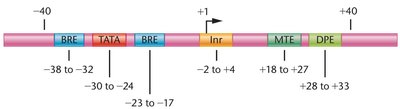
Enhancers and Silencers
Enhancers: Increase transcription rates; can function at great distances and in either orientation.
Silencers: Decrease transcription rates; often confer tissue- or temporal-specific repression.
Transcription Factors
General transcription factors: Required for RNAP II binding and initiation (e.g., TFIID, TFIIA, TFIIB).
Activators and repressors: Bind enhancers and silencers, respectively, to modulate transcription in response to signals.
Post-Transcriptional Regulation
Gene expression is further regulated after transcription through mRNA processing, stability, and translation:
Alternative Splicing: Generates multiple mRNA isoforms from a single gene, increasing proteomic diversity.
mRNA Stability: The half-life of mRNA molecules affects protein output; regulated by sequences in the 3'-UTR and by RNA-binding proteins.
Noncoding RNAs: Small RNAs (siRNA, miRNA) regulate gene expression by promoting mRNA degradation or inhibiting translation.
Post-Translational Regulation
Protein function can be modified after translation by:
Phosphorylation: Addition of phosphate groups by kinases; reversible by phosphatases.
Methylation and Glycosylation: Addition of methyl or carbohydrate groups, affecting protein activity and localization.
Ubiquitin-Mediated Degradation: Proteins tagged with ubiquitin are targeted for degradation by the proteasome.
Recombinant DNA Technology
Overview and Importance
Recombinant DNA technology involves combining DNA from different sources to study gene function, produce proteins, or engineer organisms. It is foundational for genetic engineering, biotechnology, and modern medicine.
Applications: Medicine production, gene therapy, genetically modified organisms, forensic analysis.
Key Tools and Methods
Restriction Enzymes: Molecular scissors that recognize and cut specific DNA sequences, generating fragments with 'sticky' or 'blunt' ends.
Vectors: DNA molecules (e.g., plasmids, BACs, YACs) used to carry and replicate foreign DNA in host cells. Essential features include an origin of replication, selectable marker, and multiple cloning site (MCS).
Blue/White Selection: Technique to identify recombinant bacteria using disruption of the lacZ gene and X-gal indicator.
Transformation: Introduction of recombinant DNA into host cells (e.g., bacteria).
DNA Libraries and PCR
Genomic Library: Collection of DNA clones representing the entire genome.
cDNA Library: Collection of DNA clones synthesized from mRNA, representing expressed genes.
PCR (Polymerase Chain Reaction): In vitro method to amplify specific DNA sequences rapidly and sensitively.
DNA Analysis Techniques
Gel Electrophoresis: Separates DNA fragments by size for analysis.
Southern Blotting: Detects specific DNA sequences using labeled probes.
FISH (Fluorescent in situ Hybridization): Visualizes specific DNA or RNA sequences in chromosomes or tissues.
Sanger Sequencing: Chain-termination method for determining DNA sequence.
Genome Editing: CRISPR/Cas9
The CRISPR/Cas9 system has been adapted for precise genome editing in eukaryotic cells. Cas9, guided by a single-guide RNA (sgRNA), introduces double-strand breaks at specific genomic locations. Repair by nonhomologous end-joining (NHEJ) or homology-directed repair (HDR) enables targeted gene disruption or correction.
Genomics, Bioinformatics, and Proteomics
Genomics
Genomics is the study of entire genomes, including their sequence, structure, function, and evolution. It utilizes bioinformatics tools to analyze and interpret large-scale DNA and protein data.
Genome Sequencing: Clone-by-clone and shotgun methods are used to determine the complete DNA sequence of organisms.
GenBank: The largest public DNA sequence database, maintained by NCBI.
BLAST: Software for comparing nucleotide or protein sequences to identify similarities and evolutionary relationships.
Functional and Comparative Genomics
Functional Genomics: Assigns functions to genes and regulatory elements, often using transcriptome and proteome analysis.
Comparative Genomics: Compares genomes across species to study evolution, gene function, and disease mechanisms.
Proteomics
Proteomics is the large-scale study of proteins, their structures, functions, and interactions. It complements genomics by revealing the functional output of the genome.
Techniques include 2D gel electrophoresis and mass spectrometry.
The Genetics of Cancer
Genetic Basis of Cancer
Cancer is a genetic disease of somatic cells, characterized by uncontrolled cell growth and the ability to invade other tissues (metastasis). It arises from the accumulation of mutations in genes regulating cell division, apoptosis, and DNA repair.
Proto-oncogenes: Normal genes that promote cell cycle progression; mutations convert them to oncogenes with gain-of-function effects.
Tumor Suppressor Genes: Encode proteins that inhibit cell division or promote apoptosis; loss-of-function mutations contribute to cancer.
p53 and Rb: Key tumor suppressors frequently mutated in cancers.
Clonal Evolution and Hallmarks of Cancer
Cancer cells are clonal, originating from a single mutated cell, but tumors can contain genetically distinct subclones.
Hallmarks include genomic instability, evasion of apoptosis, sustained angiogenesis, and tissue invasion/metastasis.
Hereditary Cancer and Carcinogens
Some cancers are linked to inherited mutations in tumor suppressor genes (e.g., BRCA1, APC).
Carcinogens (chemicals, radiation, viruses) induce mutations that can initiate or promote cancer development.
Population and Evolutionary Genetics
Population Genetics and the Hardy-Weinberg Law
Population genetics studies the distribution and change of allele frequencies under evolutionary forces. The Hardy-Weinberg law provides a mathematical model for allele and genotype frequencies in an ideal population.
For two alleles (A and a): $p + q = 1$
Genotype frequencies: $p^2 + 2pq + q^2 = 1$
Forces Affecting Allele Frequencies
Natural Selection: Differential survival and reproduction of genotypes.
Mutation: Source of new alleles.
Migration (Gene Flow): Movement of alleles between populations.
Genetic Drift: Random changes in allele frequencies, especially in small populations.
Nonrandom Mating: Alters genotype frequencies but not allele frequencies.
Speciation and Phylogenetics
Reproductive isolation leads to genetic divergence and speciation.
Phylogenetic trees illustrate evolutionary relationships; the molecular clock estimates divergence times based on mutation rates.
Special Topics: Gene Therapy, DNA Profiling, and GMOs
Gene Therapy
Gene therapy aims to treat or cure diseases by modifying cellular DNA. Strategies include replacing mutated genes, inactivating disease-causing genes, or introducing new genes. Delivery can be ex vivo or in vivo.
DNA Profiling
DNA profiling (fingerprinting) uses short tandem repeats (STRs) to identify individuals for forensic, familial, or identification purposes. PCR amplifies STR loci, and gel electrophoresis determines allele sizes.
Genetically Modified Organisms (GMOs)
GMOs are organisms whose genomes have been altered for agricultural or research purposes. Common traits include herbicide and insect resistance. While GMOs are considered safe for consumption, environmental concerns remain.
