 Back
BackBacterial DNA Replication: Mechanisms, Enzymes, and Experimental Evidence
Study Guide - Smart Notes
 Tailored notes based on your materials, expanded with key definitions, examples, and context.
Ch. 10 – Bacterial DNA Replication
The Mechanism of DNA Replication
DNA replication is the process by which a cell duplicates its DNA, ensuring that each daughter cell receives an identical copy. In bacteria, this process is highly regulated and involves a series of coordinated enzymatic activities.
Models of DNA Replication
In the late 1950s, three models were proposed to explain how DNA replicates:
Conservative Model: Both parental DNA strands remain together after replication, and the daughter molecule consists of two newly synthesized strands.
Semiconservative Model: Each daughter DNA molecule contains one parental and one newly synthesized strand. This is the correct model.
Dispersive Model: Parental and daughter DNA segments are interspersed in both strands after replication.
The semiconservative model was experimentally confirmed and is now accepted as the mechanism for DNA replication in all organisms.
Experimental Evidence: The Meselson-Stahl Experiment
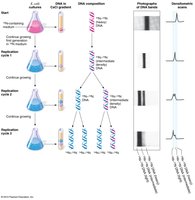
Matthew Meselson and Franklin Stahl (1958) provided experimental evidence for the semiconservative model using isotopic labeling of DNA in E. coli:
Cells were grown in a medium containing heavy nitrogen (15N), then transferred to a medium with light nitrogen (14N).
After each replication cycle, DNA was extracted, lysed, and separated by density gradient centrifugation.
Results showed 'half-heavy' DNA after one generation and both 'light' and 'half-heavy' DNA after two generations, consistent only with the semiconservative model.
Initiation of Bacterial DNA Replication
Replication in bacteria begins at a single origin of replication (oriC) and proceeds bidirectionally, forming two replication forks.
oriC: The unique origin site on the bacterial chromosome.
Key DNA sequences at oriC:
DnaA boxes: Binding sites for DnaA protein, which initiates replication.
AT-rich regions: Sites where DNA strands separate due to weaker hydrogen bonding.
GATC methylation sites: Regulate timing of replication initiation via methylation status.
Initiation involves DnaA proteins binding to DnaA boxes, DNA bending, strand separation at AT-rich regions, and loading of DnaB (helicase) to further unwind DNA.
Regulation by GATC Methylation
GATC methylation sites are methylated by DNA adenine methyltransferase (Dam). Only fully methylated DNA can efficiently initiate replication, preventing premature re-initiation and aiding in mutation repair.
Unwinding and Stabilization of DNA
DNA helicase: Unwinds the DNA helix by breaking hydrogen bonds between strands.
Topoisomerase II (DNA gyrase): Relieves positive supercoiling ahead of the replication fork.
Single-strand binding proteins: Stabilize separated DNA strands and prevent re-annealing.
Synthesis of RNA Primers and DNA
Primase: Synthesizes short RNA primers (10–12 nucleotides) required for DNA polymerase to begin synthesis.
Leading strand: Requires a single primer; synthesized continuously.
Lagging strand: Requires multiple primers; synthesized discontinuously as Okazaki fragments.
Key Proteins in Bacterial DNA Replication
Protein | Function |
|---|---|
DNA helicase | Unwinds DNA strands |
Topoisomerase II (gyrase) | Relieves supercoiling |
Single-strand binding proteins | Stabilize single-stranded DNA |
Primase | Synthesizes RNA primers |
DNA polymerase III | Main enzyme for DNA synthesis |
DNA polymerase I | Removes RNA primers, fills gaps with DNA |
DNA ligase | Seals nicks between Okazaki fragments |
DNA Polymerases in E. coli
DNA pol III: Main enzyme for DNA replication; a holoenzyme with 10 subunits. The α subunit catalyzes phosphodiester bond formation.
DNA pol I: Removes RNA primers and replaces them with DNA.
DNA pol II, IV, V: Involved in DNA repair and replication of damaged DNA.
Structure of DNA Polymerase
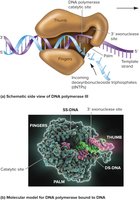
DNA polymerase has a structure resembling a right hand, with the template DNA passing through the 'palm' and the 'thumb' and 'fingers' wrapping around the DNA. This structure facilitates accurate and efficient DNA synthesis.
Features and Directionality of DNA Polymerase
Cannot initiate synthesis de novo; requires an RNA primer.
Synthesizes DNA only in the 5’ to 3’ direction.
Leading strand is synthesized continuously; lagging strand is synthesized discontinuously as Okazaki fragments.
Synthesis of Leading and Lagging Strands
Leading strand: Synthesized continuously toward the replication fork.
Lagging strand: Synthesized away from the fork in short Okazaki fragments, each initiated by a new RNA primer.
Processing Okazaki Fragments
DNA pol I removes RNA primers and fills gaps with DNA.
DNA ligase forms covalent bonds to join Okazaki fragments, creating a continuous DNA strand.
Replication Complexes: Primosome and Replisome
Primosome: Complex of helicase and primase, coordinating unwinding and primer synthesis.
Replisome: Primosome associated with two DNA pol III holoenzymes, enabling simultaneous replication of both strands.
Lagging Strand Looping
The lagging strand template loops out so that DNA polymerase can synthesize Okazaki fragments in the 5’ to 3’ direction. After each fragment, the polymerase is reloaded at the next primer, and the process repeats.
Termination of Replication
Replication ends at ter sequences (T1 and T2) on the opposite side of the chromosome from oriC.
The tus protein binds to ter sequences, halting replication forks.
DNA ligase joins the final DNA fragments.
Resulting catenated (interlinked) DNA molecules are separated by topoisomerase.
Chemistry of DNA Synthesis
DNA polymerase catalyzes the formation of a phosphodiester bond between the 3’-OH of the growing DNA strand and the innermost phosphate of the incoming deoxyribonucleoside triphosphate. The reaction releases pyrophosphate (PPi):
Processivity of DNA Polymerase III
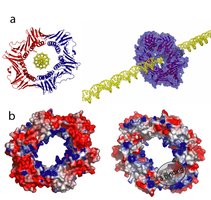
DNA pol III is highly processive due to its β subunit, which forms a sliding clamp around DNA, allowing the enzyme to synthesize long stretches of DNA without dissociating.
Fidelity Mechanisms in DNA Replication
High fidelity: DNA pol III makes only one error per 108 bases.
Proofreading: DNA polymerases possess 3’ to 5’ exonuclease activity, allowing them to remove mismatched nucleotides and resume synthesis.
Base pair stability: Correct base pairs are more stable and fit better in the polymerase active site, reducing errors.
Summary: Steps in Bacterial DNA Replication
Initiation: Recognition of oriC, DNA unwinding, and primer synthesis.
Elongation: Leading and lagging strand synthesis, Okazaki fragment processing.
Termination: Replication fork arrest at ter sequences, ligation, and decatenation of daughter chromosomes.
