 Back
BackBacterial Genetics: Mechanisms of Gene Transfer and Recombination
Study Guide - Smart Notes
 Tailored notes based on your materials, expanded with key definitions, examples, and context.
Bacterial Genetics
Introduction to Bacterial Gene Transfer
Bacteria possess several mechanisms for exchanging genetic material, which contribute to genetic diversity and adaptation. The primary methods include transduction and conjugation. These processes are essential for understanding bacterial evolution, antibiotic resistance, and gene mapping.
Transduction
Definition and Discovery
Transduction is a process of horizontal gene transfer in which bacterial DNA is transferred from a donor to a recipient bacterium via a bacteriophage (virus that infects bacteria). This process was discovered by Joshua Lederberg and Norton Zinder in 1952 during studies with Salmonella typhimurium.
Bacteriophage: Virus that infects bacteria and can mediate gene transfer.
Transduced DNA: Bacterial DNA carried by a bacteriophage.
Zinder and Lederberg's Experiment (1952)
This experiment used two auxotrophic strains of Salmonella typhimurium and a U-tube apparatus with a fine filter that allowed only viruses and medium to pass, not bacterial cells. Despite the physical separation, some bacteria acquired the ability to grow on minimal medium, indicating gene transfer via a filterable agent (bacteriophage).

Types of Bacteriophages
Virulent phages: Cause lytic infections, destroying the host cell (e.g., T4 phage in E. coli).
Temperate phages: Can integrate their DNA into the host genome (lysogeny) and later enter the lytic cycle (e.g., Lambda phage).
Types of Transduction
Generalized Transduction: Any bacterial gene can be transferred; occurs during the lytic cycle (e.g., P1 phage in E. coli).
Specialized Transduction: Only specific genes near the prophage insertion site are transferred; occurs during the lysogenic cycle (e.g., Lambda phage in E. coli).
Significance of Transduction
Facilitates horizontal gene transfer and increases genetic variation.
Contributes to bacterial evolution and adaptation.
Can transfer antibiotic resistance and virulence genes.
Provides evidence for gene exchange in prokaryotes.
Conjugation
Definition and Mechanism
Conjugation is a process of genetic recombination in bacteria involving direct cell-to-cell contact. Genetic material is transferred unidirectionally from a donor (F+) to a recipient (F-) cell through a physical bridge called a pilus or conjugation bridge.
Transferred DNA may recombine with the recipient's chromosome, introducing new traits.
Recipient cells that incorporate donor DNA are called transconjugants.
Conjugation spreads traits such as antibiotic resistance.
Lederberg and Tatum Experiment
This classic experiment used two auxotrophic strains of E. coli:
Strain A: Required methionine and biotin.
Strain B: Required threonine and leucine.
Neither strain could grow on minimal medium alone, but when mixed, some colonies grew, indicating genetic recombination and the formation of prototrophs.
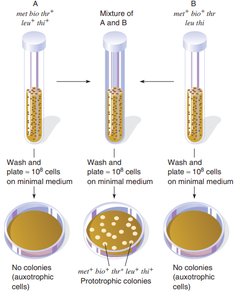
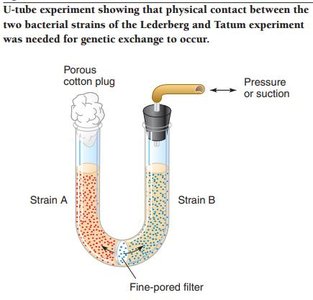
Bernard Davis U-Tube Experiment (1950)
This experiment tested whether direct contact was required for recombination. Two auxotrophic E. coli strains were separated by a fine filter in a U-tube. No prototrophic colonies formed, demonstrating that physical contact is essential for conjugation.
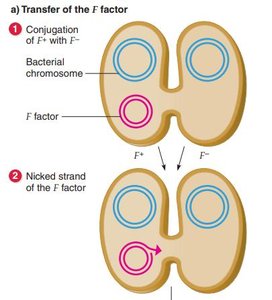
Molecular Events During Conjugation in E. coli
Contact Formation: F+ cell produces sex pili to attach to F- cell.
Conjugation Bridge Formation: Bridge forms for DNA transfer.
DNA Nicking: Relaxosome cuts one strand of F factor DNA at oriT.
Transfer Initiation: Coupling factor guides DNA to exporter proteins.
DNA Transfer: Single DNA strand passes to recipient; replication restores missing strand in donor.
Circularization and Replication: Relaxase joins DNA ends in recipient; complementary strand synthesized.
Completion: Recipient becomes F+; donor remains F+.
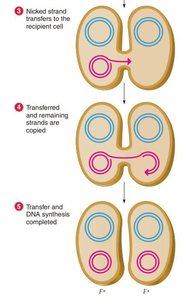
Hfr Strains and F′ Factors
Hfr (High Frequency Recombination) Strains
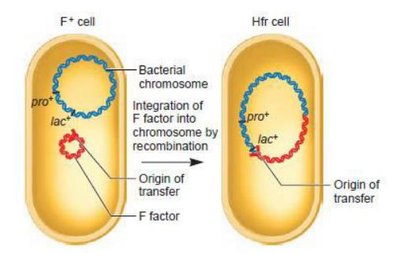
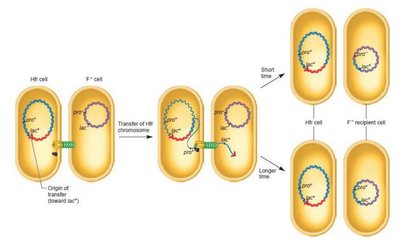
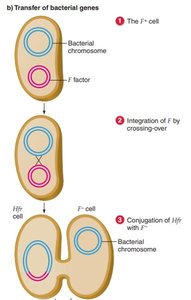
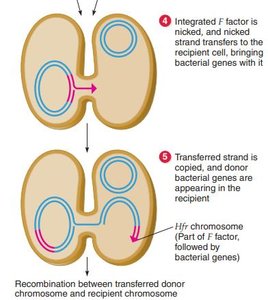
Hfr strains are formed when the F factor integrates into the bacterial chromosome via homologous recombination. These strains transfer chromosomal genes to recipients at high frequency, starting at the origin of transfer (oriT).
Formation of F′ (F Prime) Factors
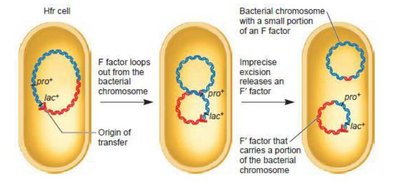
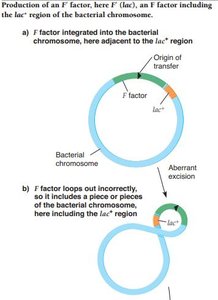
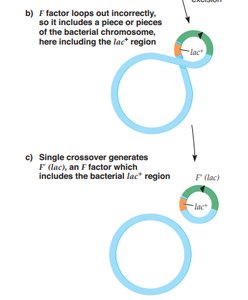
Sometimes, the integrated F factor is excised from the chromosome. If excision is imprecise, the F factor carries some bacterial genes, forming an F′ factor. F′ factors can transfer both F factor and bacterial genes to recipients.
Hfr Strains Transfer Chromosomal Genes
During conjugation, Hfr strains transfer chromosomal genes to F- cells. Transfer begins at oriT, and the order of gene transfer depends on the position and orientation of oriT. Complete transfer of the chromosome is rare due to interruption of mating.
Genes closer to oriT are transferred first.
Different Hfr strains have oriT at different locations, resulting in varied gene transfer order.
Significance of Hfr Conjugation
Enables chromosomal gene mapping in bacteria.
Timing of gene entry helps determine gene order and relative positions.
Generates recombinants with new allele combinations.
