 Back
BackBacteriophages and Bacterial Defense Mechanisms: Genetics and Molecular Biology
Study Guide - Smart Notes
 Tailored notes based on your materials, expanded with key definitions, examples, and context.
Bacteriophages: Structure, Life Cycles, and Genetics
Introduction to Bacteriophages
Bacteriophages, or phages, are viruses that infect bacteria. They play a crucial role in microbial genetics, horizontal gene transfer, and the evolution of bacterial populations. Their study has provided foundational insights into molecular genetics and gene regulation.
Definition: Bacteriophages are viruses that specifically infect bacterial cells.
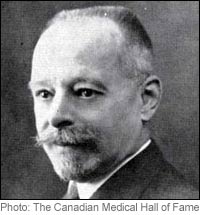
Discovery: Felix d’Herelle is credited with the discovery of bacteriophages.
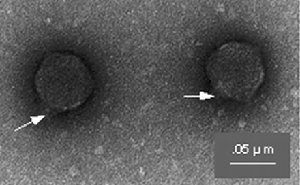
Structure: Most phages have a head-tail structure, with a protein capsid enclosing their genetic material (DNA or RNA).
Genetic Material: Phages can have double-stranded or single-stranded DNA or RNA genomes.
Bacteriophage Structure
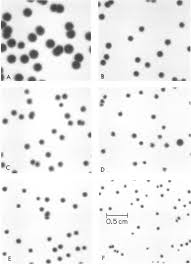
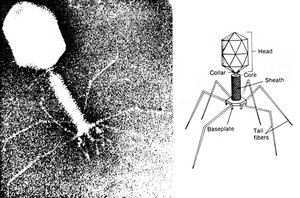
Bacteriophages exhibit diverse morphologies, but the most studied are the tailed phages (Caudovirales), which have a head (capsid), tail, and tail fibers for host recognition and attachment.
Capsid: Protein shell that encases the viral genome.
Tail: Used for attachment to the bacterial surface and injection of genetic material.
Tail Fibers: Recognize and bind to specific receptors on the bacterial cell surface.
Bacteriophage Life Cycles
Bacteriophages can follow two main life cycles: the lytic cycle and the lysogenic cycle. The choice of cycle has significant implications for bacterial genetics and population dynamics.
Lytic Cycle: The phage takes over the host machinery to replicate its genome and produce new phage particles, culminating in host cell lysis and release of progeny phages.
Lysogenic Cycle: The phage genome integrates into the host chromosome as a prophage and replicates along with the host cell, remaining dormant until induced to enter the lytic cycle.
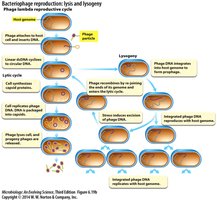
Steps of the Lytic Cycle
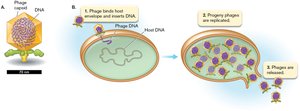
Attachment (Adsorption): Phage binds to specific receptors on the bacterial surface.
Penetration (Genome Entry): Phage injects its genetic material into the host cell.
Replication: Host machinery is hijacked to synthesize phage components (enzymes, nucleic acids, capsids).
Assembly (Maturation): New phage particles are assembled.
Release: Host cell lyses, releasing progeny phages.
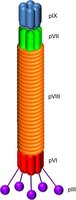
Filamentous Phages and Slow Release
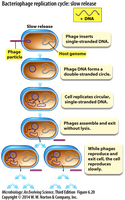
Some phages, such as filamentous phages, extrude progeny through the cell envelope without lysing the host, allowing the host to survive and continue growing, albeit more slowly.
Batch Culture and Phage Growth Curves
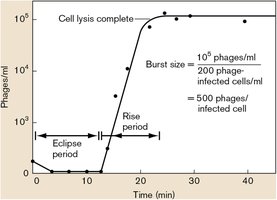
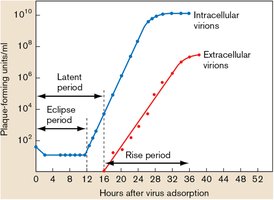
Batch culture experiments are used to study phage replication dynamics, including the eclipse period, rise period, and burst size.
Eclipse Period: Time after infection during which no infectious phage particles are detected.
Rise Period: Period during which phage particles are released from lysed cells.
Burst Size: Average number of phages produced per infected cell.
Bacterial Defense Mechanisms Against Phages
Prevention of Phage Attachment
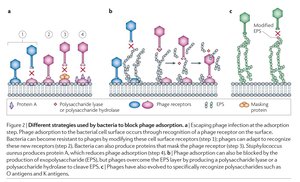
Bacteria have evolved multiple strategies to prevent phage adsorption and infection, including modification or masking of surface receptors.
Receptor Modification: Alteration of phage-binding sites on the bacterial surface.
Production of Extracellular Polysaccharides (EPS): Masking receptors with capsules or biofilm matrix.
Blocking Phage DNA Entry
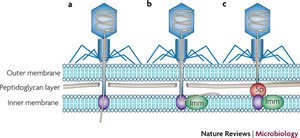
Bacteria can prevent the entry of phage nucleic acids through various mechanisms, such as superinfection exclusion systems.
Destruction of Invading Phage Nucleic Acid
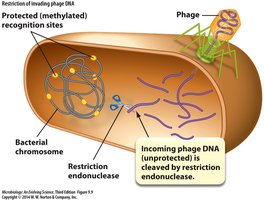
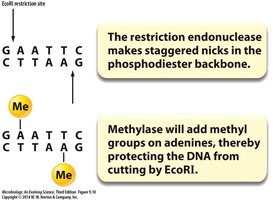
Once phage DNA enters the cell, bacteria can destroy it using restriction-modification systems.
Restriction Endonucleases: Enzymes that recognize and cleave foreign DNA at specific sequences.
Methylation: Host DNA is protected from cleavage by methylation of recognition sites.
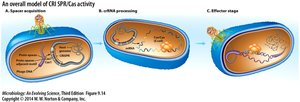
CRISPR-Cas Adaptive Immune System
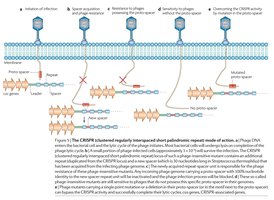
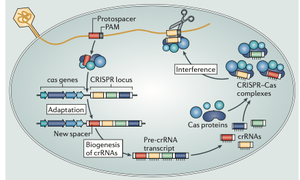
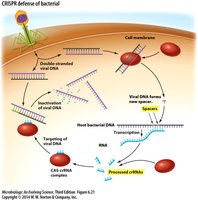
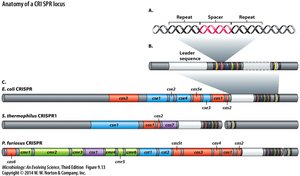
CRISPR (Clustered Regularly Interspaced Short Palindromic Repeats) is an adaptive immune system in bacteria and archaea that provides sequence-specific defense against phages.
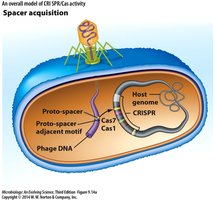
Spacer Acquisition: Short sequences from invading phage DNA are integrated into the CRISPR locus as new spacers.
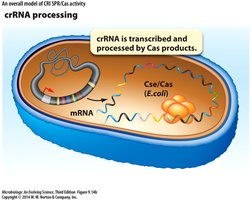
crRNA Processing: The CRISPR array is transcribed and processed into small CRISPR RNAs (crRNAs).
Effector Stage: crRNAs guide Cas proteins to recognize and cleave complementary phage DNA during subsequent infections.
Phages in the Environment and Human Health
The Gut Bacteriophage Community
Bacteriophages are abundant in the human gut, where they influence bacterial populations, horizontal gene transfer, and potentially human health.
Population Dynamics: Phages can modulate the abundance and diversity of gut bacteria.
Gene Transfer: Phages facilitate horizontal gene transfer, impacting bacterial evolution and antibiotic resistance.
Key Terms and Concepts
Bacteriophage: Virus that infects bacteria.
Lytic Cycle: Phage replication cycle resulting in host cell lysis.
Lysogenic Cycle: Phage genome integrates into host genome and replicates passively.
Restriction-Modification System: Bacterial defense involving restriction enzymes and DNA methylation.
CRISPR-Cas System: Adaptive immune system in bacteria and archaea for sequence-specific defense against phages.
Summary Table: Bacterial Defense Mechanisms Against Phages
Defense Mechanism | Description | Example |
|---|---|---|
Receptor Modification | Alters or masks phage-binding sites on the bacterial surface | Capsule formation, LPS modification |
Superinfection Exclusion | Prevents entry of phage DNA into the cell | Superinfection exclusion proteins |
Restriction-Modification | Cleaves foreign DNA, protects host DNA by methylation | EcoRI restriction enzyme |
CRISPR-Cas System | Acquires and uses phage DNA sequences to target and destroy invaders | Spacer acquisition, crRNA processing, interference |
Further Topics
Lambda phage and control of lysogeny
Virus morphology and classification
Additional info: The study of bacteriophages is foundational for understanding gene regulation, horizontal gene transfer, and the development of molecular biology tools such as restriction enzymes and CRISPR-Cas systems.
