 Back
BackBasic Principles of Heredity: Mendelian Genetics and Human Inheritance
Study Guide - Smart Notes
 Tailored notes based on your materials, expanded with key definitions, examples, and context.
Basic Principles of Heredity
Introduction to Mendelian Genetics
The study of heredity began with Gregor Mendel, whose experiments with pea plants established the foundational principles of inheritance. These principles explain how traits are passed from parents to offspring and form the basis for modern genetics.
Genetic Basis of Traits
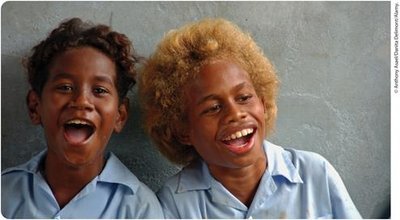
Blond Hair in the Solomon Islands
Blond hair in the Solomon Islands is a recessive trait found in 5-10% of the population. Unlike European blond hair, it is caused by a different genetic variant, illustrating that similar phenotypes can have distinct genetic origins. Understanding the genetic basis of such traits is important for studying human diversity and evolution.
Key Genetic Terms
Genetics uses specific terminology to describe the units and patterns of inheritance:
Gene: An inherited factor (region of DNA) that helps determine a characteristic.
Allele: One of two or more alternative forms of a gene.
Locus: A specific place on a chromosome occupied by an allele.
Genotype: The set of alleles possessed by an individual organism.
Phenotype (trait): The appearance or manifestation of a characteristic.
Homozygote: An individual with two of the same alleles at a locus.
Heterozygote: An individual with two different alleles at a locus.
Mendel’s Experiments and Principles
Mendel’s Experimental Model
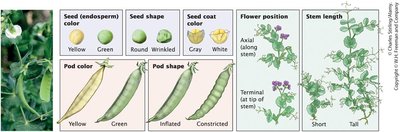
Mendel used Pisum sativum (pea plants) as his model organism, focusing on easily distinguishable characteristics such as seed color, seed shape, and flower position.
Genes, Alleles, and Chromosomes
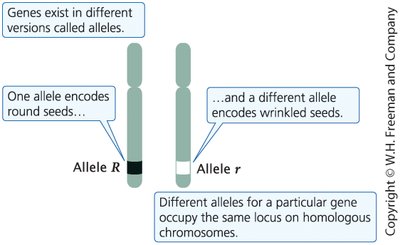
Genes exist in different versions called alleles, which occupy the same locus on homologous chromosomes. For example, the gene for seed shape has two alleles: one for round seeds (R) and one for wrinkled seeds (r).
Monohybrid Crosses and the Principle of Segregation
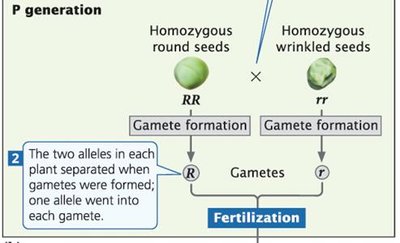
A monohybrid cross involves parents that differ in a single characteristic. Mendel’s first law, the principle of segregation, states that each individual has two alleles for a trait, which segregate during gamete formation so that each gamete receives one allele.
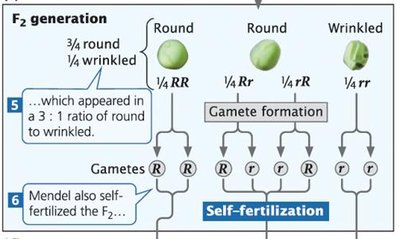
When homozygous round (RR) and homozygous wrinkled (rr) peas are crossed, all F1 progeny are round (Rr).
Self-fertilization of F1 plants produces F2 progeny in a 3:1 ratio of round to wrinkled seeds.
Dominance and Recessiveness
In a heterozygote, the dominant allele determines the phenotype, while the recessive allele is masked. For example, round seed shape (R) is dominant over wrinkled (r).
Phenotypic and Genotypic Ratios
Monohybrid crosses yield predictable ratios:
Phenotypic ratio (Aa × Aa): 3:1 (dominant:recessive)
Genotypic ratio (Aa × Aa): 1:2:1 (AA:Aa:aa)
Testcrosses
A testcross is used to determine the genotype of an individual with a dominant phenotype by crossing it with a homozygous recessive individual. The resulting progeny ratios reveal the unknown genotype.
Probability in Genetics
Probability Rules
Genetic outcomes can be predicted using probability:
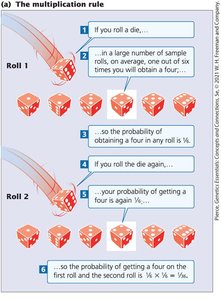
Multiplication Rule: The probability of two independent events both occurring is the product of their individual probabilities.
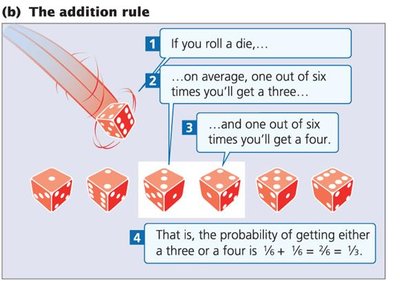
Addition Rule: The probability of either of two mutually exclusive events occurring is the sum of their individual probabilities.
Dihybrid Crosses and Independent Assortment
Principle of Independent Assortment
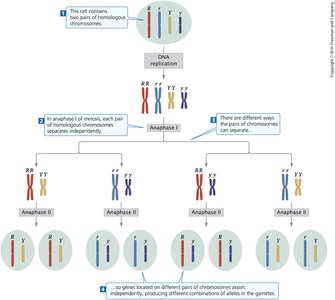
Mendel’s second law states that alleles at different loci separate independently during gamete formation, provided the genes are on different chromosomes. Dihybrid crosses (e.g., RrYy × RrYy) produce a 9:3:3:1 phenotypic ratio in the F2 generation.
Branch Diagrams and Testcrosses
Branch diagrams help visualize the expected proportions of genotypes and phenotypes in dihybrid crosses. Testcrosses with double heterozygotes and double recessives yield a 1:1:1:1 ratio.
Statistical Analysis of Genetic Data
Chi-Square Goodness-of-Fit Test
The chi-square test is used to determine whether observed genetic ratios deviate significantly from expected ratios due to chance. The formula is:
where O = observed value, E = expected value. The result is compared to a critical value table to assess significance.
Pedigree Analysis in Human Genetics
Pedigrees and Inheritance Patterns
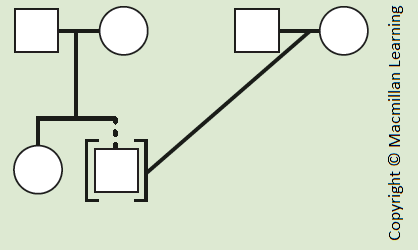
Pedigrees are diagrams that show the inheritance of traits in families. They help identify modes of inheritance such as autosomal dominant, autosomal recessive, X-linked, and Y-linked traits.
Autosomal Recessive Inheritance
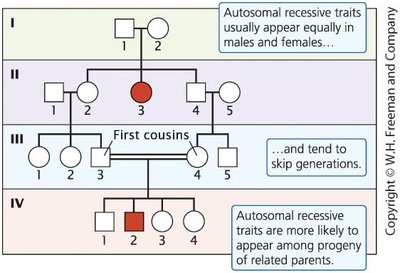
Autosomal recessive traits often skip generations and appear equally in males and females. They are more likely to appear in offspring of related parents (inbreeding).
Autosomal Dominant Inheritance
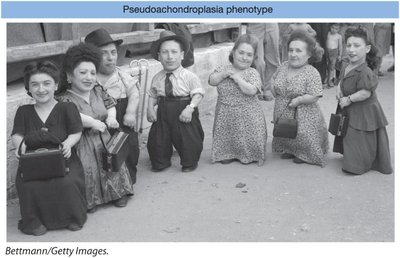
Autosomal dominant traits appear in every generation and are transmitted equally by males and females to their offspring.
Summary Table: Key Genetic Terms
Term | Definition |
|---|---|
Gene | An inherited factor (region of DNA) that helps determine a characteristic |
Allele | One of two or more alternative forms of a gene |
Locus | A specific place on a chromosome occupied by an allele |
Genotype | A set of alleles possessed by an individual organism |
Homozygote | Individual with two of the same alleles at a locus |
Heterozygote | Individual with two different alleles at a locus |
Phenotype | The appearance or manifestation of a characteristic |
Conclusion
The principles of segregation and independent assortment remain fundamental to understanding inheritance, even in the era of genomics. Mastery of these concepts, along with the ability to analyze pedigrees and apply probability, is essential for students of genetics.
