 Back
BackCell Division and Chromosome Heredity: Meiosis and Mendelian Principles
Study Guide - Smart Notes
 Tailored notes based on your materials, expanded with key definitions, examples, and context.
Cell Division and Chromosome Heredity
Introduction to Cell Division
Cell division is a fundamental process in genetics, responsible for the transmission of genetic material from one generation to the next. In eukaryotes, two main types of cell division exist: mitosis and meiosis. Mitosis produces genetically identical cells for growth and maintenance, while meiosis generates gametes with half the chromosome number, enabling sexual reproduction and genetic diversity.
Types of Reproduction
Asexual reproduction: Organisms reproduce without mating, producing genetically identical offspring (clones).
Sexual reproduction: Involves the production of gametes (sperm and egg), which unite during fertilization to form genetically unique progeny.
Multicellular eukaryotes primarily reproduce sexually, requiring the formation of haploid gametes from both males and females. The fusion of these gametes restores diploidy in the offspring.
Meiosis: The Basis of Sexual Reproduction
Overview of Meiosis
Meiosis is a specialized form of cell division that reduces the chromosome number by half, producing four genetically distinct haploid gametes from a single diploid cell. This process is essential for maintaining chromosome number across generations and for generating genetic variation.
Meiosis consists of two sequential divisions: Meiosis I and Meiosis II.
There is no DNA replication between Meiosis I and II.
Gametes produced are not genetically identical due to crossing over and independent assortment.
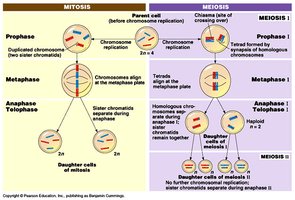
Comparison of Mitosis and Meiosis
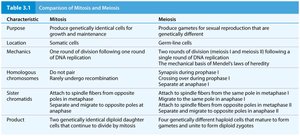
Mitosis and meiosis share some similarities, such as the occurrence of interphase, but differ significantly in their outcomes and mechanisms.
Characteristic | Mitosis | Meiosis |
|---|---|---|
Purpose | Produces genetically identical cells for growth and maintenance | Produces gametes for sexual reproduction that are genetically distinct |
Location | Somatic cells | Germ-line cells |
Mechanism | One round of division following one round of DNA replication | Two rounds of division (meiosis I and II) following a single round of DNA replication |
Homologous chromosomes | Do not pair | Synapsis during prophase I; crossing over occurs |
Sister chromatids | Attach to spindle fibers from opposite poles in metaphase | Attach to spindle fibers from the same pole in metaphase I; separate and migrate to opposite poles in anaphase II |
Product | Two genetically identical diploid daughter cells | Four genetically distinct haploid cells |
Phases of Meiosis
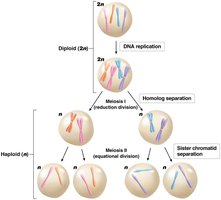
Meiosis is divided into two main stages, each with distinct phases:
Meiosis I: Homologous chromosomes separate, reducing chromosome number from diploid (2n) to haploid (n).
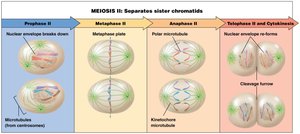
Meiosis II: Sister chromatids separate, producing four haploid gametes.
Meiosis I: Reduction Division
Three hallmark events characterize Meiosis I:
Homologous chromosome pairing
Crossing over between homologous chromosomes
Segregation of homologous chromosomes
Stages of Meiosis I
Prophase I: Subdivided into leptotene, zygotene, pachytene, diplotene, and diakinesis. Homologous chromosomes pair and recombine.
Metaphase I: Homologous chromosomes align at the metaphase plate.
Anaphase I: Homologs separate to opposite poles; sister chromatids remain attached.
Telophase I and Cytokinesis: Nuclear membranes reform and the cell divides, producing two haploid cells.
Prophase I Substages
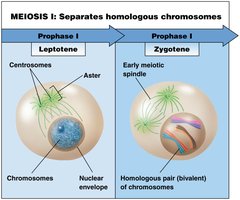
Leptotene: Chromosome condensation begins; meiotic spindle forms.
Zygotene: Nuclear envelope disintegrates; homologous chromosomes undergo synapsis.
Synaptonemal Complex: A protein structure forms between homologs, facilitating tight binding and recombination.
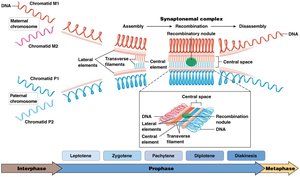
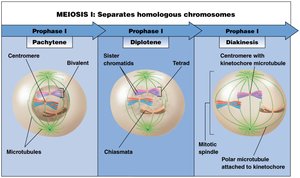
Pachytene: Chromosomes condense further; homologs (tetrads) undergo crossing over at recombination nodules.
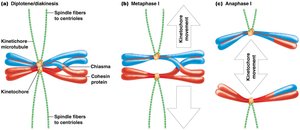
Diplotene: Synaptonemal complex dissolves; chiasmata (sites of crossing over) become visible; cohesin proteins hold sister chromatids together.
Diakinesis: Chromosomes move toward the metaphase plate, attached to kinetochore microtubules.
Metaphase I, Anaphase I, and Telophase I
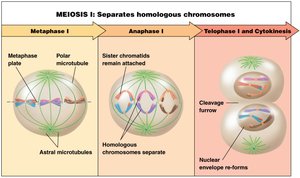
Metaphase I: Homologous chromosomes align on opposite sides of the metaphase plate; chiasmata are resolved.
Anaphase I: Homologs are pulled to opposite poles; sister chromatids remain attached by cohesin.
Telophase I and Cytokinesis: Nuclear membranes reform; cytoplasm divides, resulting in two haploid cells.
Meiosis II: Equational Division
Meiosis II resembles mitosis but occurs in haploid cells. Sister chromatids are separated, resulting in four genetically distinct haploid gametes.
Mendelian Principles and Chromosome Behavior
Law of Segregation
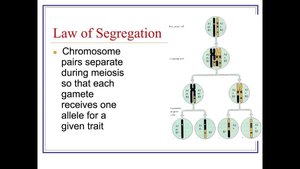
The law of segregation states that the two alleles for each trait separate during gamete formation, with each gamete receiving one allele. This is explained by the separation of homologous chromosomes during anaphase I of meiosis.
Each allele has an equal probability of inclusion in a gamete.
Random union of gametes at fertilization restores diploidy and determines progeny ratios.
Mechanistic Basis of Mendelian Ratios
The physical separation of homologs and sister chromatids during meiosis provides the mechanistic basis for Mendel's laws. For example, in a heterozygote (Aa), homologs bearing A and a separate during anaphase I, resulting in gametes with either allele and a 1:1 ratio.
Law of Independent Assortment
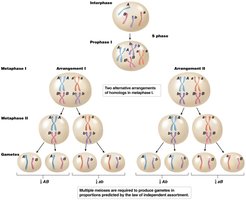
The law of independent assortment is illustrated by the behavior of two pairs of homologs during meiosis. For a dihybrid (AaBb), two equally likely arrangements of homologs can occur, producing four types of gametes (AB, ab, Ab, aB) with equal probability.
Summary Table: Key Differences Between Mitosis and Meiosis
Feature | Mitosis | Meiosis |
|---|---|---|
Number of divisions | 1 | 2 |
Number of daughter cells | 2 | 4 |
Genetic identity | Identical | Unique |
Chromosome number | Diploid (2n) | Haploid (n) |
Role | Growth, repair | Sexual reproduction |
Additional info: The process of meiosis is essential for generating genetic diversity through recombination and independent assortment, which are foundational to evolution and heredity.
