 Back
Cell Division and Chromosome Heredity: Structured Study Notes 3
Study Guide - Smart Notes
 Tailored notes based on your materials, expanded with key definitions, examples, and context.
Cell Division and Chromosome Heredity
Cell Division Overview
Cell division is fundamental to growth, development, and heredity. Eukaryotic cells divide by mitosis or meiosis, each serving distinct biological purposes.
Mitosis: Produces two genetically identical daughter cells, maintaining chromosome number. Occurs in somatic (body) cells, which are typically diploid (2n).
Meiosis: Produces four genetically distinct haploid (n) gametes, reducing chromosome number by half. Occurs in germ cells for sexual reproduction.
Key Concept: Mitosis maintains genetic stability; meiosis introduces genetic variation.
The Cell Cycle
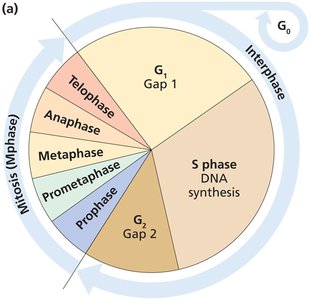
The eukaryotic cell cycle alternates between interphase and M phase, ensuring proper DNA replication and cell division.
G1 phase: Cell growth, active gene expression, and normal activity.
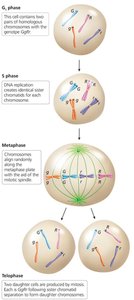
S phase: DNA replication, producing sister chromatids.
G2 phase: Preparation for cell division.
M phase: Mitosis or meiosis, followed by cytokinesis.
G0 phase: Cells may exit the cycle and enter a quiescent state.
Mitosis Stages
Mitosis partitions replicated chromosomes into two identical daughter cells through a series of well-defined stages.
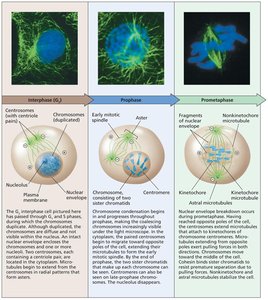
Prophase: Chromosomes condense; spindle formation begins.
Prometaphase: Nuclear envelope breaks down; microtubules attach to kinetochores.
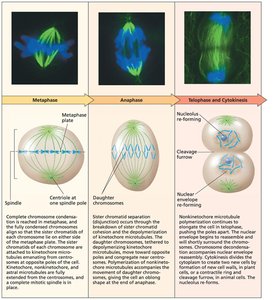
Metaphase: Chromosomes align at the metaphase plate.
Anaphase: Sister chromatids separate and move to opposite poles.
Telophase/Cytokinesis: Nuclei reform; cytoplasm divides.
Cytokinesis in Animal and Plant Cells
Cytokinesis is the physical process of cell division, differing between animal and plant cells.
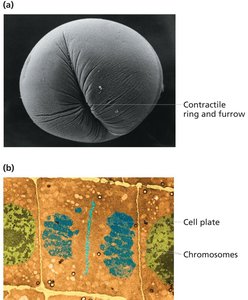
Animal cells: Contractile ring forms a cleavage furrow.
Plant cells: Cell plate forms, separating daughter cells.
Spindle Mechanics
Microtubules are essential for chromosome movement during mitosis.
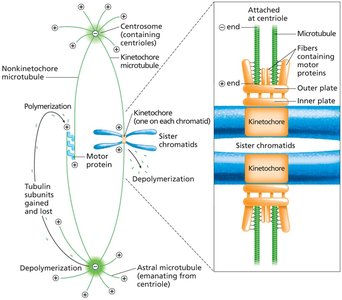
Centrosomes: Organize spindle microtubules at cell poles.
Kinetochore microtubules: Attach to kinetochores at centromeres.
Polar microtubules: Elongate and stabilize the cell.
Astral microtubules: Extend toward the cell membrane.
Mechanism: Microtubules attach, pull, depolymerize, and elongate to move chromosomes.
Chromatid Separation
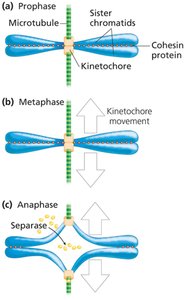
Sister chromatids are held together by cohesin proteins until anaphase, when separase cleaves cohesin, allowing chromatids to separate.
Cohesin: Protein complex holding sister chromatids together, especially at centromeres.
Separase: Enzyme that cleaves cohesin at anaphase.
Chromosome disjunction: Separation of sister chromatids.
Cell Cycle Checkpoints and Cancer
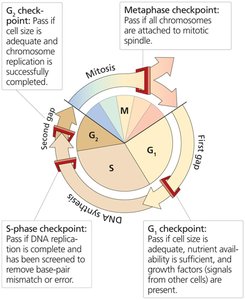
Checkpoints ensure cell division occurs only when conditions are optimal, preventing errors and uncontrolled proliferation.
G1 checkpoint: Monitors cell size, nutrients, and growth signals.
S checkpoint: Ensures DNA replication and screens for errors.
G2 checkpoint: Confirms complete chromosome replication.
Metaphase checkpoint: Verifies all chromosomes are attached to the spindle.
Cancer: Loss of checkpoint control can lead to abnormal cell proliferation.
Meiosis and Mendel
Meiosis Overview
Meiosis is essential for sexual reproduction, producing haploid gametes and increasing genetic diversity.
Meiosis I: Separates homologous chromosomes (reduction division).
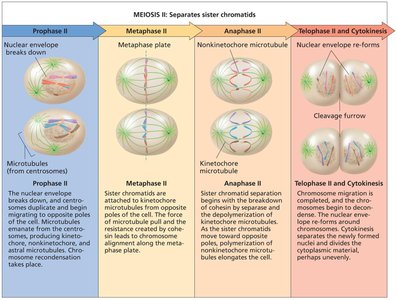
Meiosis II: Separates sister chromatids (resembles mitosis).
Result: Four genetically distinct haploid gametes.
Prophase I: Homolog Pairing and Crossing Over
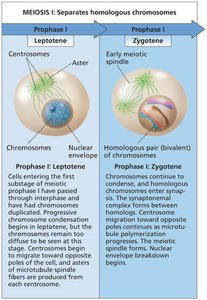
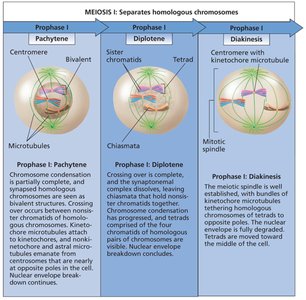
Prophase I is complex, involving pairing of homologous chromosomes and exchange of genetic material.
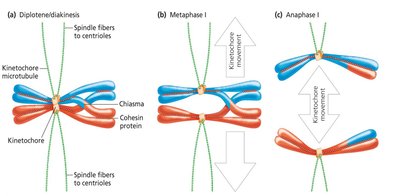
Synapsis: Homologous chromosomes pair tightly.
Synaptonemal complex: Protein structure holding nonsister chromatids together.
Crossing over: Exchange of DNA between homologs, forming chiasmata.
Tetrads: Paired homologs with four chromatids.
Meiosis I and II: Chromosome Segregation
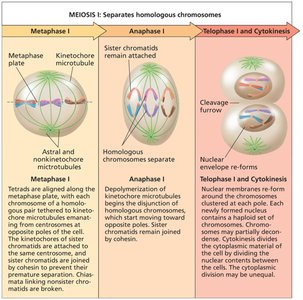
Meiosis I reduces chromosome number, while Meiosis II separates sister chromatids.
Metaphase I: Homologs align at the metaphase plate.
Anaphase I: Homologs separate; sister chromatids remain together.
Telophase I/Cytokinesis: Two haploid cells form.
Meiosis II: Similar to mitosis, separates sister chromatids.
Meiosis and Mendel's Laws
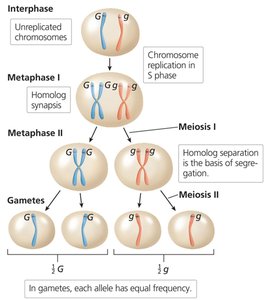
Chromosome behavior during meiosis explains Mendel's laws of segregation and independent assortment.
Law of Segregation: Homologous chromosomes separate, so alleles segregate into different gametes.
Law of Independent Assortment: Different chromosome pairs orient randomly, producing varied gamete combinations.
Crossing over: Further increases genetic variation.
Chromosome Theory and Sex Chromosomes
Chromosome Theory of Heredity
Genes are carried on chromosomes, and their behavior during cell division explains inheritance patterns.
Sutton and Boveri: Proposed chromosome behavior mirrors gene transmission.
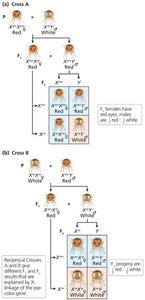
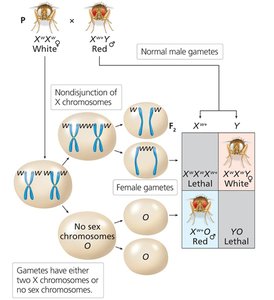
Morgan's Drosophila experiments: Demonstrated sex-linked inheritance and gene location on chromosomes.
Wild type: Most common phenotype in a population.
X-Linked Genes and Sex Chromosome Inheritance
Sex chromosomes (X and Y) influence inheritance patterns, especially for traits linked to the X chromosome.
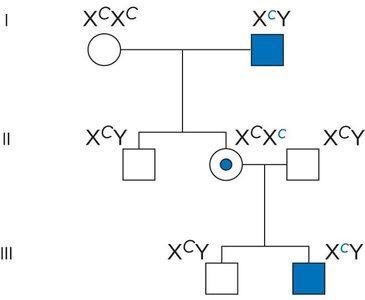
X-linked inheritance: Genes on the X chromosome; males are hemizygous (one X).
Reciprocal crosses: Can yield different results for X-linked traits.
Nondisjunction: Failure of chromosome separation during meiosis, leading to exceptional phenotypes.
Sex-Linked Transmission Patterns
X-linked and Y-linked traits exhibit distinct inheritance patterns.
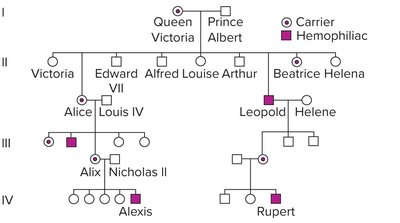
X-linked recessive: More frequent in males; carrier females can transmit to sons.
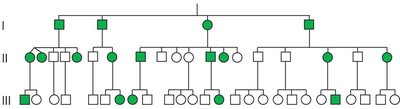
X-linked dominant: Affected males pass trait to all daughters, not sons; heterozygous females pass to half of offspring.
Y-linked: Transmitted strictly from father to son; few genes on Y chromosome.
Dosage Compensation
Dosage compensation equalizes gene expression from sex chromosomes between males and females.
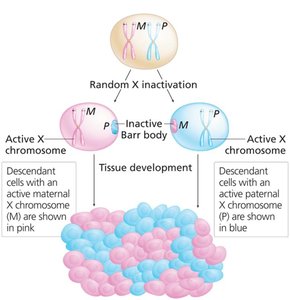
X inactivation: In placental mammals, one X chromosome is randomly inactivated in female somatic cells, forming a Barr body.
Mosaicism: Females are mosaics, expressing either maternal or paternal X in different cells.
XIST RNA: Coats the chromosome to be inactivated.
Sex Determination Systems
Sex can be determined chromosomally or genetically, with different mechanisms across species.
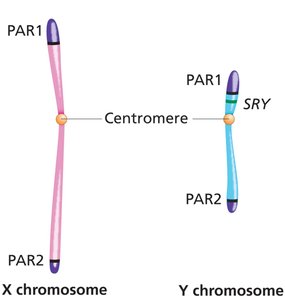
Chromosomal sex: Determined at fertilization (e.g., XX/XY in humans).
Phenotypic sex: Results from sex-specific gene expression.
SRY gene: Initiates male development in mammals.
Other systems: X:A ratio in Drosophila, ZW/ZZ in birds, temperature-dependent sex determination in reptiles.
Table: Sex Determination Systems in Various Organisms
Organism | System | Sex Chromosomes |
|---|---|---|
Humans, Drosophila | Chromosomal | XX (female), XY (male) |
Moths, C. elegans | Chromosomal | XX (hermaphrodite), X0 (male) |
Birds, Butterflies | Chromosomal | ZW (female), ZZ (male) |
Bees, Wasps | Genetic | Diploid (female), Haploid (male) |
Lizards, Alligators | Environmental | Temperature-dependent |
Tortoises, Turtles | Environmental | Temperature-dependent |
Anemone Fish | Genetic/Age | Older adults (female), Young adults (male) |
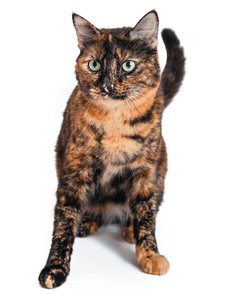
Example: In calico cats, random X inactivation leads to mosaic fur coloration, with orange and black patches corresponding to different active X chromosomes.
Additional info: Table entries inferred from context and standard genetics knowledge.
