 Back
BackCell Division II: Meiosis – Structure, Stages, and Comparison with Mitosis
Study Guide - Smart Notes
 Tailored notes based on your materials, expanded with key definitions, examples, and context.
Cell Division II: Meiosis
Introduction to Meiosis
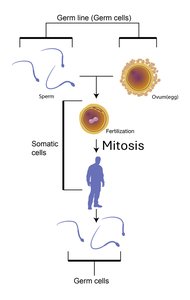
Meiosis is a specialized form of cell division that occurs in reproductive cells (gametes), resulting in four genetically distinct haploid cells from a single diploid precursor. This process is essential for sexual reproduction, reducing the chromosome number by half and generating genetic diversity through recombination and independent assortment.
Gametes: Reproductive cells (sperm and egg in animals, pollen and ovules in plants).
Somatic cells: All other body cells, which divide by mitosis.
Purpose of Meiosis: To produce haploid gametes (n) from diploid (2n) cells, ensuring chromosome number is maintained across generations.
Genetic Variation: Achieved through crossing over and independent assortment.
Overview of Meiosis: Two Successive Divisions
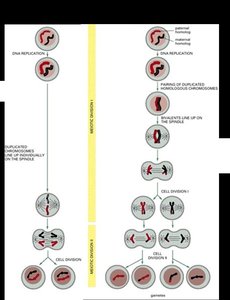
Meiosis consists of two sequential divisions: Meiosis I (reductional division) and Meiosis II (equational division). The process results in four non-identical haploid cells.
Meiosis I: Homologous chromosomes separate, reducing chromosome number by half (2n → n).
Meiosis II: Sister chromatids separate, similar to mitosis, but the chromosome number remains the same (n → n).
Stages of Meiosis
Meiosis I
Meiosis I is characterized by the pairing and separation of homologous chromosomes. It includes several key substages, especially during Prophase I.
Prophase I: Substages and Key Events
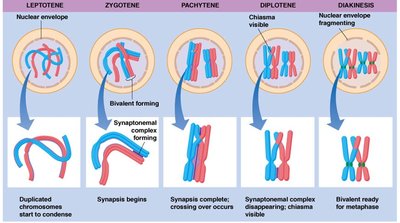
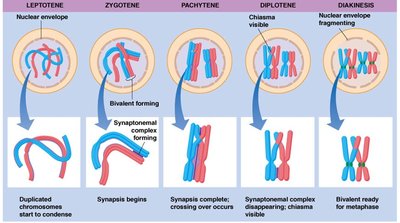
Prophase I is subdivided into five stages, each with distinct chromosomal behaviors:
Leptotene: Chromosomes begin to condense and become visible as thin threads.
Zygotene: Homologous chromosomes pair up (synapsis) and the synaptonemal complex forms.
Pachytene: Synapsis is complete; crossing over (genetic recombination) occurs between non-sister chromatids.
Diplotene: Synaptonemal complex dissolves; homologs remain attached at chiasmata (sites of crossing over).
Diakinesis: Chromosomes further condense, chiasmata become visible, and the nuclear envelope breaks down.
Key Structures and Processes in Prophase I
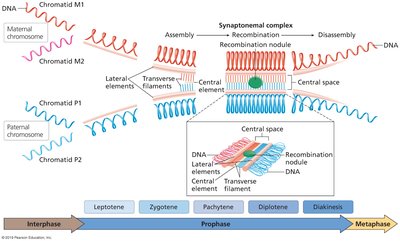
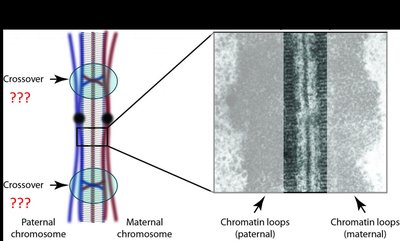
Synaptonemal Complex: A protein structure that forms between homologous chromosomes during zygotene and pachytene, facilitating synapsis and recombination.
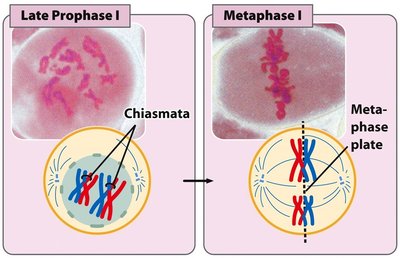
Chiasmata: Physical sites where crossing over has occurred, holding homologs together until anaphase I.
Crossing Over: Exchange of genetic material between non-sister chromatids, increasing genetic diversity.
Metaphase I
Homologous chromosome pairs (bivalents/tetrads) align at the metaphase plate. The orientation of each pair is random, contributing to genetic variation through independent assortment.
Bivalent/Tetrad: A structure consisting of two homologous chromosomes, each with two sister chromatids, aligned together.
Independent Assortment: The random orientation of homologous pairs leads to different combinations of maternal and paternal chromosomes in gametes.
Anaphase I and Telophase I
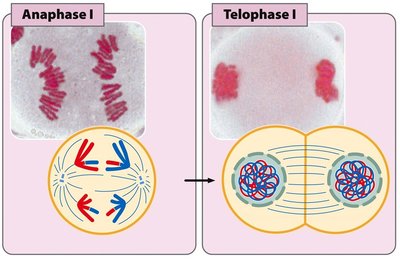
During anaphase I, homologous chromosomes are pulled to opposite poles, while sister chromatids remain attached. Telophase I and cytokinesis follow, resulting in two haploid cells.
Reductional Division: Chromosome number is halved (2n → n).
Genetic Diversity: Each daughter cell receives a unique combination of chromosomes.
Meiosis II
Meiosis II resembles mitosis, where sister chromatids of each chromosome are separated into different cells. This division does not change the chromosome number.
Equational Division: Chromosome number remains the same (n → n).
Result: Four genetically distinct haploid gametes are produced from the original diploid cell.
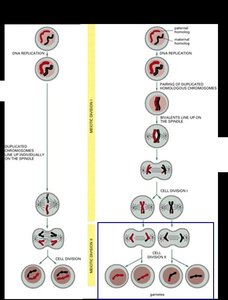
Summary Table: Comparison of Mitosis and Meiosis
The following table summarizes the key differences between mitosis and meiosis:
Characteristic | Mitosis | Meiosis |
|---|---|---|
Purpose | Growth, maintenance, repair (identical cells) | Production of gametes (genetically variable cells) |
Location | Somatic cells | Germ-line cells |
Number of Divisions | One | Two (Meiosis I & II) |
Chromosome Number in Products | Diploid (2n) | Haploid (n) |
Genetic Variation | No (except mutations) | Yes (crossing over, independent assortment) |
Synapsis & Crossing Over | No | Yes, during Prophase I |
Product | 2 identical cells | 4 genetically distinct cells |
Key Concepts and Calculations
Chromosome and Chromatid Counting
Understanding the number of chromosomes, chromatids, and DNA molecules at each stage is crucial for genetics. For a diploid organism with 2n chromosomes:
At the start (after DNA replication): Chromosome number = 2n, Chromatid number = 4n
After Meiosis I: Chromosome number = n, Chromatid number = 2n
After Meiosis II: Chromosome number = n, Chromatid number = n
Example Calculation: For an organism with 2n = 6:
After Meiosis I: Each cell has 3 chromosomes (n = 3), each with 2 chromatids.
After Meiosis II: Each gamete has 3 chromosomes (n = 3), each with 1 chromatid.
Stages of Meiosis: Summary Table
Stage | Key Event | Chromosome Number | Chromatid Number | Ploidy |
|---|---|---|---|---|
Prophase I | Homologs pair, crossing over | 2n | 4n | Diploid |
Metaphase I | Bivalents align at plate | 2n | 4n | Diploid |
Anaphase I | Homologs separate | 2n → n | 4n → 2n | Haploid |
Telophase I | Two haploid cells form | n | 2n | Haploid |
Meiosis II | Sister chromatids separate | n | n | Haploid |
Practice Questions
Given a diploid number (2n), determine the number of chromosomes and chromatids at each stage of meiosis and mitosis.
Identify the stage of cell division from a diagram based on chromosome arrangement and number.
Summary
Meiosis is essential for sexual reproduction, producing four genetically variable haploid gametes from one diploid cell.
Key events include homolog pairing, crossing over, and two sequential divisions (reductional and equational).
Understanding chromosome and chromatid numbers at each stage is fundamental for genetics problem-solving.
Meiosis and mitosis differ in purpose, process, and genetic outcomes.
