 Back
BackChapter 10: DNA Structure and Analysis – Study Notes
Study Guide - Smart Notes
 Tailored notes based on your materials, expanded with key definitions, examples, and context.
DNA Structure and Analysis
Introduction
This chapter explores the discovery, characteristics, and chemical structure of DNA as the genetic material. It covers the historical experiments that established DNA's role, the chemical nature of nucleic acids, and the evidence supporting DNA (and, in some viruses, RNA) as the hereditary molecule.
10.1 The Genetic Material Must Exhibit Four Characteristics
Criteria for Genetic Material
For a molecule to serve as genetic material, it must fulfill four essential criteria:
Replication: The molecule must be able to make copies of itself to pass genetic information to the next generation.
Storage of Information: It must store all the information necessary for the structure, function, and development of an organism.
Expression of Information: The information must be accessible for cellular processes, leading to phenotype expression.
Variation by Mutation: The molecule must be capable of undergoing changes (mutations) to allow genetic diversity.
The Central Dogma of Molecular Genetics
The central dogma describes the flow of genetic information within a biological system:
DNA is transcribed into RNA.
RNA is translated into protein.
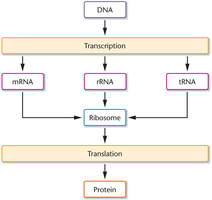
Example: The gene for hemoglobin is transcribed into mRNA, which is then translated into the hemoglobin protein.
10.2 Until 1944, Observations Favored Protein as the Genetic Material
Protein vs. DNA as Genetic Material
In the early 20th century, proteins were considered the most likely candidates for genetic material due to their chemical diversity and abundance. DNA was thought to be too simple, based on the tetranucleotide hypothesis, which suggested DNA was composed of repeating units of four nucleotides in equal amounts, lacking the complexity needed for genetic information.
Tetranucleotide Hypothesis: Proposed that DNA was made of identical repeats of four nucleotides, implying insufficient chemical diversity for genetic storage.
Proteins: With 20 different amino acids, proteins were believed to have the necessary variability to encode genetic information.
10.3 Evidence Favoring DNA as the Genetic Material Was First Obtained during the Study of Bacteria and Bacteriophages
Griffith’s Transformation Experiment
Frederick Griffith (1927) demonstrated that non-virulent strains of Diplococcus pneumoniae could be transformed into virulent forms, suggesting the presence of a "transforming principle." This experiment laid the groundwork for identifying DNA as the genetic material.
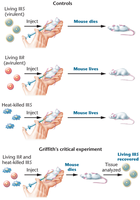
Example: Mixing heat-killed virulent bacteria with live non-virulent bacteria resulted in the death of mice and recovery of live virulent bacteria, indicating transformation.
Avery, MacLeod, and McCarty Experiment
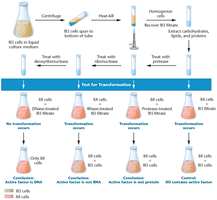
In 1944, Avery, MacLeod, and McCarty identified DNA as the "transforming principle" by showing that only DNA, not protein or RNA, could transform non-virulent bacteria into virulent forms. Treatment with DNase destroyed transforming activity, confirming DNA's role.
Hershey and Chase Experiment
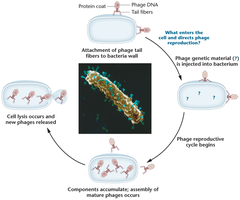
Hershey and Chase (1952) used bacteriophage T2 and radioisotopes to demonstrate that DNA, not protein, is the genetic material in viruses. They labeled DNA with phosphorus-32 and protein with sulfur-35, showing that only DNA entered bacterial cells and directed viral reproduction.
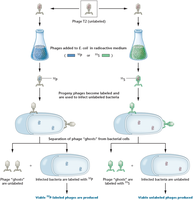
Transfection
Transfection involves infecting bacterial protoplasts (cells with the wall removed) with only viral nucleic acid. This conclusively proved that DNA alone contains all the information necessary for viral replication.
10.4 Indirect and Direct Evidence Supports the Concept That DNA Is the Genetic Material in Eukaryotes
Indirect Evidence
DNA Distribution: The amount of DNA in gametes and diploid cells correlates with chromosome number, while protein content does not.
Mutagenesis: DNA absorbs UV light at 260 nm, the same wavelength that induces mutations. Proteins absorb at 280 nm, where no significant mutagenic effects are observed.
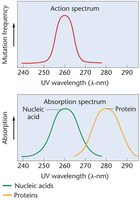
Direct Evidence: Recombinant DNA Technology
Recombinant DNA studies provided direct evidence by inserting eukaryotic genes into bacteria, which then produced the corresponding eukaryotic proteins (e.g., insulin, interferon). This demonstrated that DNA is both present and functional across species.
10.5 RNA Serves as the Genetic Material in Some Viruses
RNA as Genetic Material
Some viruses, such as Tobacco Mosaic Virus (TMV), use RNA instead of DNA as their genetic material. The replication of viral RNA depends on the enzyme RNA replicase.
Retroviruses: These viruses replicate by reverse transcription, where RNA serves as a template for DNA synthesis using the enzyme reverse transcriptase (an RNA-dependent DNA polymerase).
Example: Human Immunodeficiency Virus (HIV) is a retrovirus that uses reverse transcriptase to integrate its genetic material into the host genome.
10.6 Knowledge of Nucleic Acid Chemistry Is Essential to the Understanding of DNA Structure
Nucleotides: The Building Blocks of DNA and RNA
Nucleotides are the monomers of nucleic acids. Each nucleotide consists of:
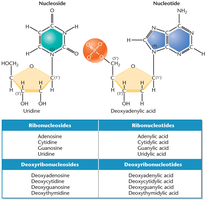
Nitrogenous base: Purines (adenine, guanine) and pyrimidines (cytosine, thymine, uracil)
Pentose sugar: Ribose (in RNA) or deoxyribose (in DNA)
Phosphate group
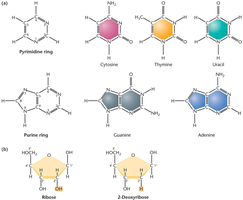
Nitrogenous Bases in DNA and RNA
DNA: Adenine (A), Cytosine (C), Guanine (G), Thymine (T)
RNA: Adenine (A), Cytosine (C), Guanine (G), Uracil (U)
Thymine is unique to DNA; uracil is unique to RNA.
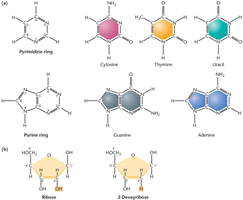
Nucleosides and Nucleotides
Nucleoside: Nitrogenous base + pentose sugar
Nucleotide: Nucleoside + phosphate group
Mono-, Di-, and Triphosphates
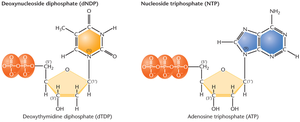
Nucleoside monophosphate (NMP): One phosphate group
Nucleoside diphosphate (NDP): Two phosphate groups
Nucleoside triphosphate (NTP): Three phosphate groups (e.g., ATP, GTP)
Triphosphates serve as precursors for nucleic acid synthesis and are involved in energy transfer.
Phosphodiester Bonds
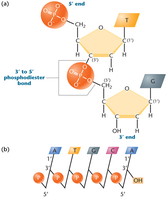
Nucleotides are linked together by phosphodiester bonds, which connect the 5' phosphate group of one nucleotide to the 3' hydroxyl group of the next. This linkage forms the sugar-phosphate backbone of nucleic acids.
Directionality: DNA and RNA strands have a 5' to 3' direction, essential for replication and transcription.
Summary Table: Key Differences Between DNA and RNA
Feature | DNA | RNA |
|---|---|---|
Sugar | Deoxyribose | Ribose |
Bases | A, T, C, G | A, U, C, G |
Strandedness | Double-stranded (usually) | Single-stranded (usually) |
Function | Genetic information storage | Information transfer, catalysis, regulation |
Review Questions
The Central Dogma specifies that the information in DNA is copied into an RNA molecule during transcription, and the information in that RNA molecule is used to make a protein during translation.
The classic Hershey and Chase (1952) experiment made use of phosphorus and sulfur labeled components.
When a protoplast is infected by only the nucleic acid component of a virus, the infection is referred to as transfection.
Reverse transcriptase is an enzyme found in association with retroviral activity. It has the property of synthesis of DNA from an RNA template.
The covalent linkage between the monomers in a dinucleotide is a(n) phosphodiester bond.
The basic structure of a nucleotide includes base, sugar, and phosphate.
Additional info:
Further topics such as the detailed structure of DNA, alternative DNA forms, and analytical techniques are covered in subsequent sections of the chapter.
