 Back
BackChapter 13: The Genetic Code and Transcription – Mini-Textbook Study Notes
Study Guide - Smart Notes
 Tailored notes based on your materials, expanded with key definitions, examples, and context.
Chapter 13: The Genetic Code and Transcription
Introduction to Transcription
Transcription is the process by which genetic information encoded in DNA is transferred to an RNA molecule. This is a critical step in gene expression, serving as the bridge between DNA and protein synthesis. The process is highly regulated and differs between prokaryotes and eukaryotes.
The Central Dogma and Gene Expression
The central dogma of molecular genetics describes the directional flow of genetic information: DNA → RNA → Protein. Gene expression refers to the process by which information from a gene is used to synthesize RNA and protein products.
Transcription Overview
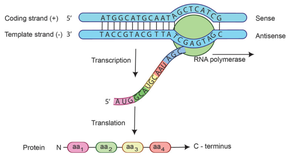
Transcription involves synthesizing RNA from a DNA template. The resulting RNA molecule is complementary to the DNA template strand and serves as an intermediate in protein synthesis.
Open Reading Frame (ORF): A DNA sequence that produces an RNA with defined start and stop points for transcription, specifying a polypeptide during translation.
Overlapping Genes: In bacteria and viruses, a single mRNA can have multiple initiation points, resulting in different ORFs and more than one protein product.
Differences Between DNA and RNA
Strandedness: DNA is double-stranded; RNA is single-stranded.
Sugar: DNA contains deoxyribose; RNA contains ribose.
Bases: DNA uses thymine (T); RNA uses uracil (U), which pairs with adenine (A).
RNA Polymerase and the Transcription Process
RNA polymerase is the enzyme responsible for synthesizing RNA from a DNA template. In prokaryotes, the enzyme consists of multiple subunits, including a sigma (σ) subunit for promoter recognition.
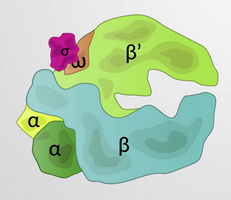
Stages of Transcription in Bacteria
Promoter Binding
Initiation
Chain Elongation
Termination
Step 1: Promoter Binding
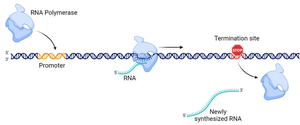
Transcription begins when RNA polymerase binds to a specific DNA sequence called the promoter, located upstream of the gene. The sigma subunit is essential for recognizing the promoter, which in E. coli typically contains the -10 (TATAAT) and -35 (TTGACA) sequences.
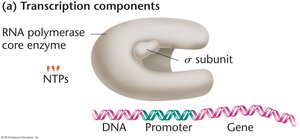
Step 2: Initiation of Transcription
After binding, the DNA double helix is unwound to expose the template strand. The interaction between promoters and RNA polymerase regulates the efficiency of transcription initiation. Both cis-acting elements (DNA sequences) and trans-acting factors (proteins) can influence this process.
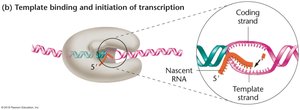
Step 3: Elongation of the RNA Transcript
Once initiation is complete, the sigma subunit dissociates, and the core enzyme continues RNA synthesis. RNA polymerase adds ribonucleotides in the 5' to 3' direction, complementary to the DNA template strand. The enzyme can also proofread and replace mismatched bases.
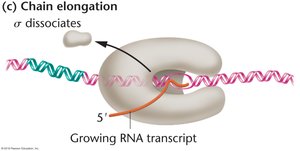
Coding and Template Strands
During transcription, only one DNA strand (the template or antisense strand) is used to synthesize RNA. The other strand is the coding (sense) strand, which has the same sequence as the RNA (except T is replaced by U in RNA).
Step 4: Termination of Transcription
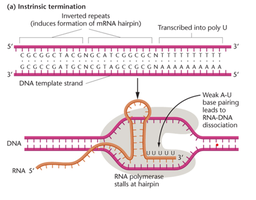
Termination occurs when RNA polymerase encounters a specific sequence that signals the end of transcription. In bacteria, intrinsic termination involves the formation of a hairpin structure in the RNA, causing the polymerase to stall and the transcript to dissociate.
Transcription in Eukaryotes
Transcription in eukaryotes is more complex and occurs in the nucleus. Chromatin must be remodeled to make DNA accessible, and multiple RNA polymerases are involved, each transcribing different types of genes. Transcription factors, enhancers, and silencers regulate gene expression.
RNA Polymerases in Eukaryotes
Eukaryotes have three main RNA polymerases:
Form | Product | Location |
|---|---|---|
I | rRNA | Nucleolus |
II | mRNA, snRNA | Nucleoplasm |
III | 5S rRNA, tRNA | Nucleoplasm |
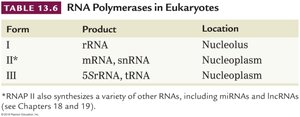
RNA Pol II is responsible for transcribing protein-coding genes and is highly regulated by promoter elements and transcription factors, such as the TATA box and TFIID.
Post-Transcriptional Processing of mRNA
Eukaryotic mRNAs undergo several modifications before becoming mature mRNAs:
5' Capping: Addition of a 7-methylguanosine cap to the 5' end, which protects the mRNA and aids in export and translation initiation.
3' Polyadenylation: Addition of a poly-A tail to the 3' end, which prevents degradation and assists in export.
Splicing: Removal of non-coding introns and joining of exons.
Introns and Exons in Eukaryotic Genes
Introns are non-coding sequences that are transcribed but not translated. Exons are coding sequences retained in the mature mRNA. Prokaryotes generally lack introns.
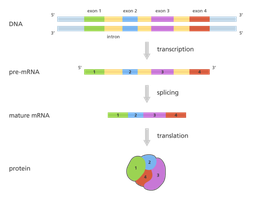
Splicing and the Spliceosome
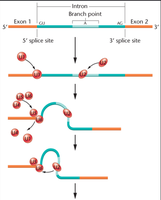
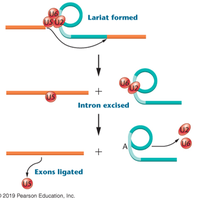
Splicing is carried out by the spliceosome, a large complex of small nuclear RNAs (snRNAs) and proteins (snRNPs). The spliceosome recognizes specific sequences at the intron-exon boundaries and catalyzes the removal of introns.
U1 binds to the 5' splice site.
U2 binds to the branch point.
U4/U5/U6 complex is recruited, and U1/U4 are released.
U5/U6 and U2 catalyze the splicing reaction, forming a lariat structure and joining exons.
Visualization of Transcription
Electron microscopy has allowed scientists to visualize transcription in action, showing multiple RNA polymerases transcribing a single gene simultaneously. In prokaryotes, transcription and translation can occur concurrently because there is no nuclear membrane separating the processes.
Key Terms and Concepts
Central Dogma: DNA → RNA → Protein
Transcription: Synthesis of RNA from a DNA template
RNA Polymerase: Enzyme that synthesizes RNA
Promoter: DNA sequence where RNA polymerase binds to initiate transcription
Introns/Exons: Non-coding/coding regions in eukaryotic genes
Spliceosome: Complex that removes introns from pre-mRNA
Example: Determining mRNA and Coding Strands
Given a template DNA strand: 3'-CTTTTTTGCCAT-5'
mRNA sequence: 5'-GAAAAAACGGUA-3'
Coding strand: 5'-GAAAAAACGGTA-3'
Summary Table: Comparison of Prokaryotic and Eukaryotic Transcription
Feature | Prokaryotes | Eukaryotes |
|---|---|---|
Location | Cytoplasm | Nucleus |
RNA Polymerases | One | Three (I, II, III) |
mRNA Processing | None | 5' cap, poly-A tail, splicing |
Introns | Rare | Common |
Initiation | Sigma factor | Transcription factors |
