 Back
Chapter 13: The Genetic Code and Transcription – Study Notes
Study Guide - Smart Notes
 Tailored notes based on your materials, expanded with key definitions, examples, and context.
Chapter 13: The Genetic Code and Transcription
Section 13.1: The Genetic Code Uses Ribonucleotide Bases as “Letters”
The genetic code is the set of rules by which information encoded in DNA is translated into proteins via messenger RNA (mRNA). It is written in linear form using ribonucleotide bases, and each "word" consists of three ribonucleotide letters, known as a triplet code or codon.
Codon: A sequence of three ribonucleotides in mRNA that specifies a single amino acid.
Unambiguous: Each triplet codon specifies only one amino acid.
Degenerate: Most amino acids are specified by more than one codon.
Start and Stop Codons: Specific triplets initiate and terminate translation.
Commaless: Codons are read sequentially without breaks.
Nonoverlapping: Each nucleotide is part of only one codon.
Colinearity: The order of codons in mRNA determines the order of amino acids in the protein.
Nearly Universal: The same coding dictionary is used by most organisms.
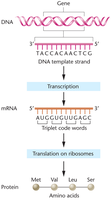
Section 13.2: Early Studies Established the Basic Operational Patterns of the Code
Messenger RNA (mRNA) serves as the intermediate in transferring genetic information from DNA to proteins. The triplet code provides 64 codons to specify 20 amino acids. Frameshift mutations helped reveal the triplet nature of the code.
Reading Frame: The contiguous sequence of nucleotides read in triplets.
Frameshift Mutation: Insertions or deletions shift the reading frame, altering downstream codons.
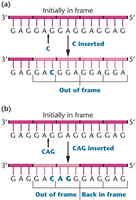
Section 13.3: Deciphering the Genetic Code
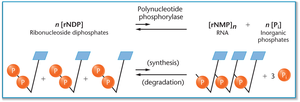
Studies by Nirenberg, Matthaei, and others used synthetic polypeptides and polynucleotide phosphorylase to produce synthetic mRNAs for in vitro translation. Homopolymers and heteropolymers of RNA were used to determine which amino acids were encoded by specific codons.
Polynucleotide Phosphorylase: Enzyme that catalyzes the production of synthetic mRNAs.
RNA Homopolymers: RNA molecules composed of only one type of ribonucleotide.
RNA Heteropolymers: RNA molecules composed of two or more different ribonucleotides.
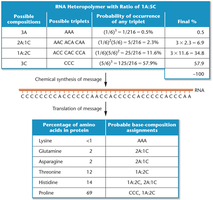
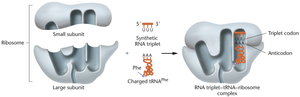
The triplet binding assay, developed by Nirenberg and Leder, determined specific codon assignments by observing ribosome binding to single codons and complementary amino acid-charged tRNAs.
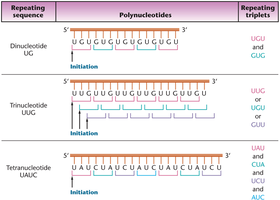
Repeating copolymers were used to determine more codon assignments by enzymatically joining short repeating sequences.
Section 13.4: Patterns and Properties of the Genetic Code
The genetic code exhibits degeneracy, with many amino acids specified by multiple codons. Only tryptophan and methionine are encoded by a single codon. Chemically similar amino acids often share one or two middle bases in their codons.
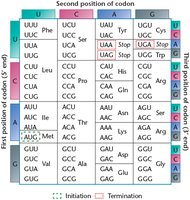
Wobble Hypothesis: The first two bases of a codon are more critical for specifying an amino acid than the third, which is less spatially constrained and allows for non-standard base pairing.
Initiation Codon: AUG (methionine) is the start codon for translation; in bacteria, it codes for N-formylmethionine.
Termination Codons: UAG, UAA, and UGA signal the end of translation and are not recognized by tRNA.
Nonsense Mutations: Mutations that produce a stop codon internally, resulting in truncated polypeptides.
Section 13.5: Confirmation of the Genetic Code in Phage MS2
Phage MS2, a bacteriophage infecting E. coli, has a small RNA genome. Sequencing its gene products confirmed the universality and accuracy of the genetic code.
Phage MS2: Contains four genes on 3500 ribonucleotides, specifying coat protein, RNA-directed replicase, lysis protein, and maturation protein.
Section 13.6: Universality and Exceptions of the Genetic Code
The genetic code is nearly universal, but exceptions exist, particularly in mitochondrial DNA (mtDNA). For example, UGA, normally a stop codon, encodes tryptophan in yeast and humans, and AUA, normally isoleucine, encodes methionine in human mitochondria.
Section 13.7: Overlapping Genes and Open Reading Frames
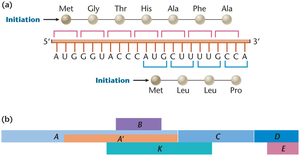
Overlapping genes occur when a single mRNA has multiple initiation points, creating different reading frames and specifying more than one polypeptide. Open reading frames (ORFs) are DNA sequences that produce functional RNA with start and stop codons.
Section 13.8: Transcription Synthesizes RNA on a DNA Template
Transcription is the process by which RNA is synthesized from a DNA template. Genetic information stored in DNA is transferred to RNA, which serves as an intermediate between DNA and proteins. Each triplet codon in mRNA is complementary to the anticodon of tRNA.
Section 13.9: RNA Polymerase Directs RNA Synthesis
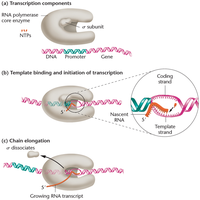
RNA polymerase is the enzyme responsible for synthesizing RNA using a DNA template. It does not require a primer for initiation and uses ribose-containing nucleotides.
Promoters: Specific DNA sequences upstream from the coding sequence where RNA polymerase binds to initiate transcription.
Sigma Factor: Subunit responsible for promoter recognition.
Transcription Start Site: The point at which transcription begins, indicated as position +1.
Consensus Sequences: DNA sequences homologous in different genes, such as TTGACA and TATAAT (Pribnow box) in E. coli.
Chain Elongation: Ribonucleotides are added to the growing RNA chain; the sigma subunit dissociates, and elongation proceeds under the direction of the core enzyme.
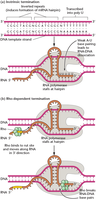
Termination: Transcription ends when a termination sequence is encountered. In bacteria, this may involve hairpin formation or rho-dependent termination.
Section 13.10: Transcription in Eukaryotes
Transcription in eukaryotes occurs within the nucleus and involves chromatin remodeling, multiple RNA polymerases, and complex regulation by transcription factors, enhancers, and silencers. Primary mRNAs (pre-mRNAs) must be processed to become mature mRNAs.
RNA Polymerases: Eukaryotes possess three forms, each transcribing different types of genes.
TATA Box: Core-promoter element influencing transcription efficiency.
Enhancers and Silencers: Regulatory sequences that modulate transcription from a distance.
Transcription Factors: Facilitate RNA polymerase binding and initiation.
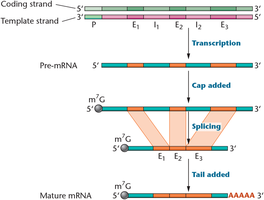
Posttranscriptional Modifications: Addition of 7-mG cap, poly-A tail, and excision of introns.
Section 13.11: Introns and Exons in Eukaryotic Genes
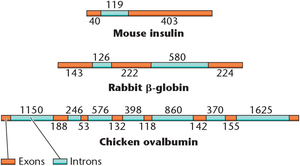
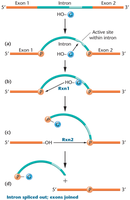
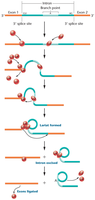
Introns are intervening sequences in the initial RNA transcript that are not expressed in the protein. Exons are the sequences retained and expressed. Introns are removed by splicing, and exons are joined together in mature mRNA. Prokaryotes do not have introns.
Splicing: Posttranscriptional modification where introns are removed and exons joined.
Self-Splicing RNAs: Some introns can excise themselves without protein assistance.
Spliceosome: Complex responsible for splicing pre-mRNA introns, involving formation of a lariat structure.
Section 13.12: RNA Editing
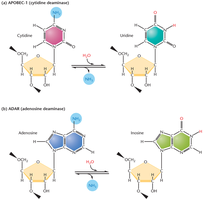
RNA editing modifies the final transcript by altering the identities of individual nucleotide bases (substitution editing) or by adding/removing nucleotides (insertion/deletion editing). This process is prevalent in mitochondria and chloroplast RNA in plants.
Section 13.13: Visualization of Transcription
Transcription has been visualized by electron microscopy, showing RNA strands emanating from DNA templates and numerous transcription events occurring simultaneously. The longer the RNA strand, the greater the number of ribosomes attached, forming polyribosomes.
